
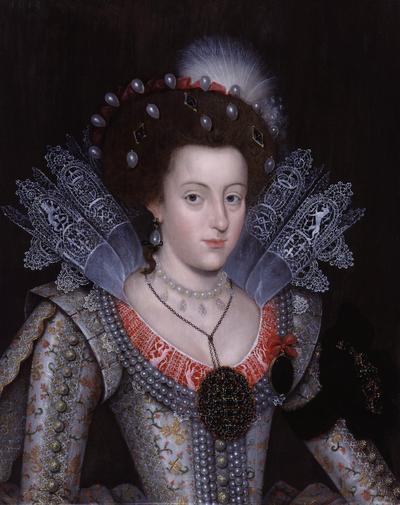
Elizabeth Stuart, Queen Of Bohemia
| Name | Elizabeth Stuart, Queen Of Bohemia |
| Title | Electress consort of the Palatine and Queen of Bohemia (1596-1662) |
| Gender | Female |
| Birthday | 1596-08-19 |
| nationality | Kingdom of England |
| Source | https://www.wikidata.org/wiki/Q158252 |
| pptrace | View Family Tree |
| LastUpdate | 2025-11-12T01:15:09.131Z |
Family Tree
Tap  to expand more relatives
Introduction
Elizabeth Stuart was born on 19 August 1596 at Dunfermline Palace in Fife, Scotland. She was the only surviving daughter of James VI of Scotland and I of England and Ireland and his wife, Anne of Denmark. Her birth occurred at 2 a.m., shortly after her father traveled from Callendar, where he was attending a wedding. She was named in honor of her father's cousin and predecessor on the English throne, Elizabeth I. She was christened on 28 November 1596 in the Chapel Royal at Holyroodhouse and was proclaimed as "Lady Elizabeth" by heralds.
During her childhood, Elizabeth was raised mainly at Linlithgow Palace under the care of Lord Livingstone and Eleanor Hay. Her younger sister Margaret was also placed in their care, though Elizabeth’s affections were primarily with her brother Henry.
In 1603, following the death of Queen Elizabeth I, her father succeeded as King of England and Ireland, thereby uniting the crowns. Elizabeth traveled south with her mother and brother to England, where she gained a governess, the Countess of Kildare. She was present at several court events, including dancing at Worksop Manor and a masque commissioned by her mother at Winchester.
Unbeknownst to her at the time, her family was targeted in the Gunpowder Plot of 1605, which aimed to assassinate King James I, kidnap Elizabeth, and replace her with a Catholic monarch. The plan considered Elizabeth as a potential figurehead due to her ceremonial readiness and status as a child.
Elizabeth received a comprehensive education that included natural history, geography, theology, languages, music, and dancing. She was fluent in several languages by age 12, notably French, which she later used in her correspondence. Her education deliberately excluded Latin, based on her father's belief that it would make women more cunning. She also developed skills in riding and letter writing.
Her marriage prospects were numerous, with suitors including Gustavus Adolphus of Sweden, Prince Maurice of Nassau, and Philip III of Spain, among others. Ultimately, she married Frederick V, Count Palatine of the Rhine, in a royal wedding at Whitehall on 14 February 1613. The marriage was celebrated with elaborate festivities and was considered a significant alliance for Protestant interests in Europe.
Following their union, Elizabeth and Frederick moved to Heidelberg, where her residence was transformed into a symbol of cultural and political importance. They had three children in Heidelberg: Frederick Henry (born in 1614), Charles (born in 1617), and Elisabeth (born in 1618). Relations with Frederick's mother, Louise Juliana, were strained due to her opposition to Elizabeth’s precedence as a bride.
In 1619, Elizabeth’s husband was elected to the throne of Bohemia, after the death of Emperor Matthias. Frederick was crowned King of Bohemia on 4 November 1619, with Elizabeth crowned as Queen shortly thereafter. Their reign in Bohemia was short-lived; it lasted just over a year until the defeat at the Battle of White Mountain on 8 November 1620. Following this, Elizabeth left Prague and gave birth to her fifth child, Maurice, at the Castle of Custrin.
The family fled into exile, first to The Hague, as the Palatinate had fallen to Habsburg control. Elizabeth in exile bore eight more children and remained active in supporting her husband’s political and military efforts. Frederick died in 1632, and Elizabeth continued her life in The Hague, where she supported the arts and engaged in diplomatic correspondence.
After the Stuart Restoration, Elizabeth returned to England in 1661, residing initially at Drury House and later at Leicester House in Westminster. She fell ill with pneumonia and died on 13 February 1662. She was buried in Westminster Abbey, near her brother Henry, Prince of Wales.
Elizabeth Stuart was the mother of 13 children, including Charles I Louis, Elector Palatine, and Sophia, Electress of Hanover, ancestor of the British royal family. Her legacy includes her influence on European dynastic politics and her depiction as “The Winter Queen,” a symbol of her brief reign and exile.
