John Wayles
| Name | John Wayles |
| Title | American lawyer and planter (1715-1773) |
| Gender | Male |
| Birthday | 1715-01-31 |
| nationality | England |
| Source | https://www.wikidata.org/wiki/Q16859631 |
| pptrace | View Family Tree |
| LastUpdate | 2025-11-16T10:02:08.711Z |
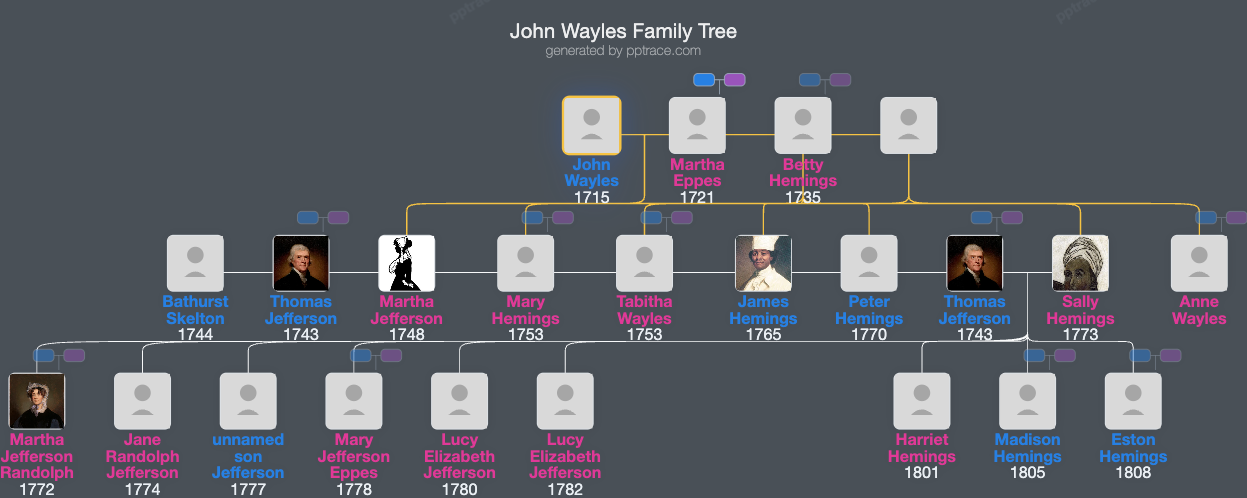
Family Tree
Tap  to expand more relatives
Introduction
John Wayles was born on January 31, 1715, in Lancaster, Virginia. He was a colonial American planter, lawyer, and slave trader active in colonial Virginia until his death. Wayles became a prominent figure within the Virginia planter elite and accumulated substantial property and wealth over his lifetime.
He moved to the Virginia Colony likely during the 1730s as a young man, where he later obtained his license to practice law in Virginia in 1741. That same year, he began his legal career, traveling on horseback to plantations in the Tidewater region to draft legal documents and serve as a prosecuting attorney in Henrico County. In addition to his legal work, Wayles became involved in the tobacco trade, serving as an agent for Farrell and Jones of Bristol and organizing tobacco sales between Virginia planters and European buyers. He also engaged in debt collection activities, which contributed to his financial success.
Wayles owned a plantation called "The Forest" located in Charles City County. He eventually expanded his business ventures to include slavery and slave trading, earning considerable wealth through these activities. His involvement in the tobacco economy and slavery contributed to his status among Virginia's planters.
Regarding his personal life, Wayles married three times and had a total of eleven children, five of whom reached adulthood. His first marriage was on May 3, 1746, to Martha Eppes (born April 10, 1721), the daughter of Colonel Francis Epps. They had four children: a set of twins born and died in December 1746; Martha, born October 31, 1748, who survived to adulthood but died six days after her mother in November 1748. Martha was Wayles' only surviving child from his first marriage.
His second marriage was to Tabitha Cocke of Malvern Hill. They had several children, including Elizabeth (born February 24, 1752), who married Francis Eppes (a relative of Martha Eppes), and other children such as Sarah, Elizabeth, Tabitha, and Anne. Elizabeth and Francis Eppes had two sons, Richard and John Wayles Eppes; the latter married Thomas Jefferson's daughter, Mary Jefferson. Tabitha Cocke died sometime between August 1756 and January 1760.
Wayles' third marriage was on January 26, 1760, to Elizabeth Lomax Skelton, widow of Reuben Skelton. This marriage produced no children, and Elizabeth Skelton Wayles died on February 10, 1761.
Through his relationship with Betty Hemings, an enslaved woman inherited as part of his marriage settlement, Wayles fathered six children: Robert (1762–1819), James (1765–1801), Thenia (1767–1796), Critta (1769–1850), Peter (begun 1770), and Sally Hemings (1773–1835). Betty Hemings was the daughter of an English sea captain named Hemings and an enslaved woman. The children of Betty Hemings and Wayles were born into slavery under the legal principle of partus sequitur ventrum, which mandated that a child's status followed that of the mother.
Wayles did not acknowledge these children publicly nor did he free them in his will, though he allowed some freedoms, such as access to education and the ability to earn money. Sally Hemings and others remained enslaved during his lifetime. After his death, Betty Hemings and her children were moved to Monticello, Jefferson's estate, to prevent their separation.
John Wayles died on May 28, 1773, at the age of 58. His estate was valued at approximately £30,000 but was encumbered with debts totaling around £11,000 to Farrell and Jones. His heirs, including Thomas Jefferson, inherited plantations and enslaved persons, including members of the Hemings family. Jefferson and the other executors worked for years to settle Wayles' estate and clear its debts.