Betty Hemings
| Name | Betty Hemings |
| Title | mother of Sally Hemings |
| Gender | Female |
| Birthday | 1735-00-00 |
| nationality | United States of America |
| Source | https://www.wikidata.org/wiki/Q4898836 |
| pptrace | View Family Tree |
| LastUpdate | 2025-11-16T10:02:06.238Z |
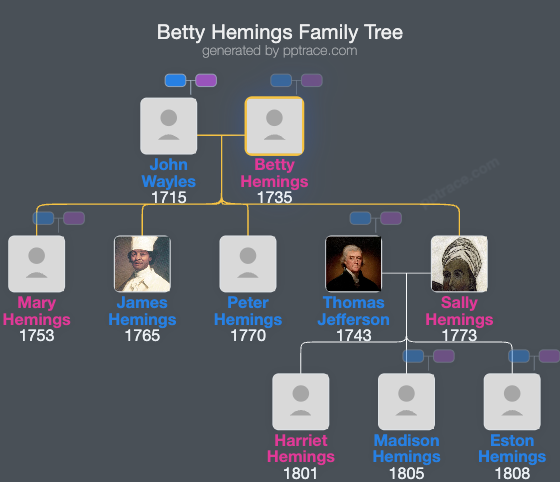
Family Tree
Tap  to expand more relatives
Introduction
Elizabeth Hemings (circa 1735 – 1807) was an enslaved woman of mixed ethnicity in colonial Virginia. She was born into slavery, with oral histories suggesting her father was a "White captain of an English trading vessel" and her mother was "a full-blooded African." Some family traditions indicate her father's surname was Hemings, and her mother may have been named Parthenia, though specific details are unconfirmed. Her place of birth is uncertain; Hemings stated it was Williamsburg, Virginia.
By 1746, Elizabeth Hemings was recorded as property of Francis Eppes IV of Bermuda Hundred plantation. Family tradition states that Captain Hemings attempted to buy Elizabeth when he discovered her birth, but he was thwarted by John Wayles, who later became her owner. After Wayles married Martha Eppes in 1746, he acquired Elizabeth as part of her father’s wedding settlement. According to the terms of this settlement, Elizabeth was to always belong to Martha Wayles and her heirs.
Elizabeth Hemings was trained as a domestic servant at one of Wayles' plantations. In the 1750s, she gave birth to her first four children with a male enslaved individual; these children included Mary Hemings (born 1753), Martin Hemings (born 1755), Betty Brown (born 1759), and Nance Hemings (born 1761). Some of these children gained varying degrees of privilege and some were recognized for specialized skills; Mary became a seamstress, Betty Brown was a servant at Monticello, and Nance was gifted to Martha Jefferson's sister and later repurchased by Jefferson.
In 1761, after the death of John Wayles’ third wife, Elizabeth Hemings began a relationship with Wayles that produced six children. These children included Robert Hemings (born 1762), James Hemings (born 1765), and Sally Hemings (born circa 1773). These offspring were of mixed racial heritage, with three-quarters white ancestry, and, following the conditions of their mother, were considered slaves from birth. Many of her children and grandchildren remained enslaved at Monticello and other Virginia plantations, although some gained manumission before the Civil War.
Her children by Wayles included Robert Hemings, who purchased his freedom in 1794; James Hemings, freed by Thomas Jefferson in 1796; Thenia Hemings, sold to James Monroe in 1794; Critta Hemings Bowles, who married Zachariah Bowles and was later freed; Peter Hemings, who served as a chef and was freed in 1834; and Sally Hemings, who had a long-term relationship with Thomas Jefferson and bore seven children, five of whom survived.
Following John Wayles’ death in 1773, his estate, including the Hemings family, was inherited by his daughter Martha Wayles and her husband Thomas Jefferson. The Jefferson household trained some of the Hemings children as artisans and household staff, providing them with skills and positions that did not involve fieldwork.
Elizabeth Hemings continued to reside at Monticello until her death in 1807. During the last decade of her life, she had her own cabin on the estate, where she raised produce and sold it to the Jefferson household. Her legacy includes numerous descendants, some of whom gained freedom and notable social standing, such as Eston Hemings Jefferson, who served as a colonel in the U.S. Army during the Civil War, and Frederick Madison Roberts, the first African-American elected to a state legislature in California.
Throughout her life, Elizabeth Hemings remained a central figure in the interconnected history of slavery, family, and race relations in Virginia, and her descendants represent a diverse range of achievements across generations.