Sally Hemings
| Name | Sally Hemings |
| Title | slave of Thomas Jefferson (c.1773–1835) |
| Gender | Female |
| Birthday | 1773-01-01 |
| nationality | United States of America |
| Source | https://www.wikidata.org/wiki/Q257464 |
| pptrace | View Family Tree |
| LastUpdate | 2025-11-17T06:37:27.078Z |
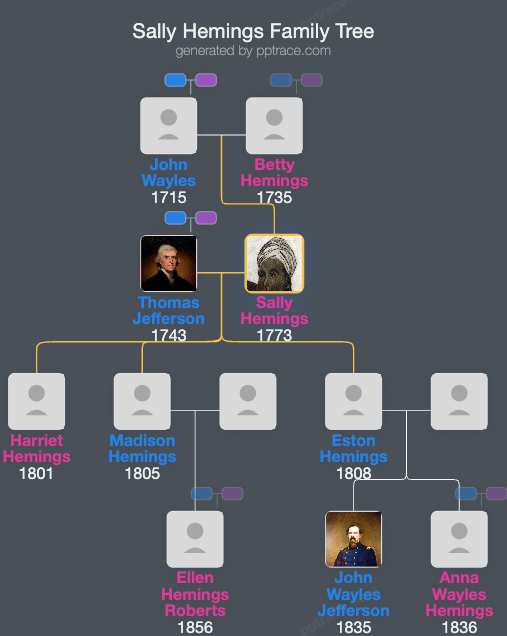
Family Tree
Tap  to expand more relatives
Introduction
Sally Hemings (circa 1773 – 1835) was an enslaved woman associated with Thomas Jefferson, the third President of the United States. She was inherited by Jefferson from his father-in-law, John Wayles, and was a member of a family with mixed racial heritage.
Her mother was Elizabeth "Betty" Hemings, and her father was John Wayles, who owned Betty Hemings from her birth. Betty Hemings' parents were an enslaved African woman and an English captain named John Hemings. Consequently, Sally Hemings was of approximately three-quarters European ancestry and one-quarter African ancestry, classifying her as a quadroon according to 19th-century American racial terminology. Her maternal grandfather was John Hemings, and her maternal grandmother's name has not been recorded.
Betty Hemings and John Wayles had several children, including Sally's half-siblings. John Wayles was a widower when he took Betty Hemings as a concubine, and their children were considered enslaved under Virginia law. This was due to the principle of partus, which dictated that the status of the child followed that of the mother regardless of paternity.
In 1782, Martha Jefferson, Thomas Jefferson's wife, died. In 1784, when Hemings was approximately 11 years old, Jefferson's daughter Martha (Patsy) was sent to Europe, and Hemings was chosen to accompany her to London and later to Paris. Hemings was approximately 14 years old at this time. In Paris, slavery was not legal, rendering Hemings legally free during her residence there.
During her stay in France, it is believed that Thomas Jefferson and Sally Hemings entered into an intimate relationship. Modern research, including DNA analyses, indicates that Jefferson likely fathered her children. Hemings' son, Madison Hemings, and other descendants have provided oral histories supporting this. Evidence suggests that Hemings agreed with Jefferson that she would return to Virginia and resume slavery, with her children being freed when they reached adulthood.
Sally Hemings' children—four of whom survived into adulthood—were freed by Jefferson or through his will as they came of age. Her youngest son, Eston Hemings, is thought to be the result of Jefferson's paternity, a conclusion supported by genealogical DNA testing conducted in 1998–1999, which matched Jefferson's male line with descendants of Eston Hemings. Interpretations of the relationship's nature vary, with some debate over whether coercion was involved, considering Hemings' age, the legal and social context, and Jefferson's ownership status.
Hemings died in Charlottesville, Virginia, in 1835, at her sons' home. The question of Jefferson's paternity has been a subject of historical debate, notably during the Jefferson–Hemings controversy. Historical analysis in the late 20th century, including the genealogical DNA tests, led the Thomas Jefferson Foundation to conclude that Jefferson was the father of her children and to treat this as a settled issue. Conversely, the Thomas Jefferson Heritage Society's panel commissioned in 2001 was unable to definitively prove or disprove Jefferson's paternity.
Sally Hemings' early life was shaped by her familial and social circumstances. She was born around 1773 to Betty Hemings and John Wayles. Her maternal lineage included an enslaved African woman and a white English sea captain, which contributed to her mixed heritage. After the death of John Wayles in 1773, Hemings and her family were inherited by Jefferson and his wife Martha upon Wayles' estate division.
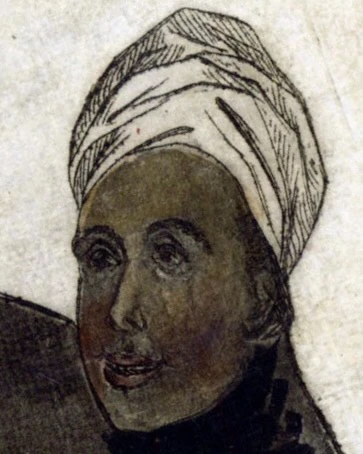
Her physical appearance was noted by contemporaries as "mighty near white" and "handsome," with long straight hair. As an adolescent, her appearance was perceived as light-skinned and attractive.
In addition to her relationship with Jefferson, Hemings' life included her involvement in the households of Monticello and her experiences as an enslaved woman during the late 18th and early 19th centuries.