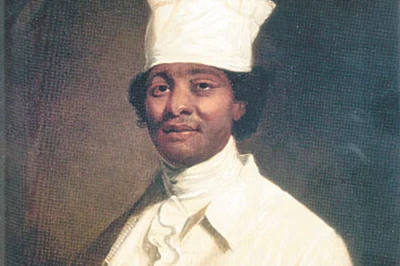
James Hemings
| Name | James Hemings |
| Title | American chef and enslaved person |
| Gender | Male |
| Birthday | 1765-01-01 |
| nationality | United States of America |
| Source | https://www.wikidata.org/wiki/Q6135835 |
| pptrace | View Family Tree |
| LastUpdate | 2025-11-27T10:43:48.797Z |
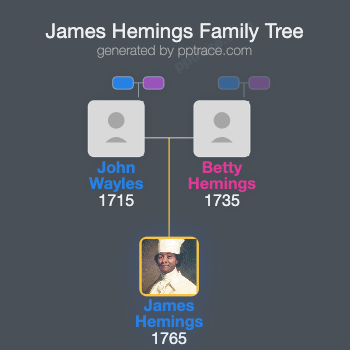
Family Tree
Tap  to expand more relatives
Introduction
James Hemings (circa 1765–1801) was an American enslaved individual known for his training as a chef in France. He was born in Virginia around 1765 into Betty Hemings’s family, which was of mixed European and African ancestry. Betty Hemings was the daughter of an enslaved African mother and an English sea captain; her father was John Wayles, a prominent lawyer and planter. Betty Hemings was the concubine of Wayles, and their relationship lasted approximately 12 years, resulting in six children, including James and Sally Hemings. Martha Jefferson, Thomas Jefferson's wife, was the half-sister of Betty Hemings’s children, making James Hemings a half-brother to Martha Jefferson and an older brother to Sally Hemings.
In 1773, Thomas Jefferson, then a widower, inherited Betty Hemings and her children, including James. At age 19, in 1784, Jefferson took Hemings to Paris to serve as his personal chef while Jefferson was serving as the U.S. Minister to France. During his time in France, Hemings received formal culinary training from pastry chefs and specialists, including a chef serving a prince, and also learned to speak French independently. He earned wages of four dollars per month, a modest sum compared to the wages paid to Jefferson’s previous white chef. Hemings eventually became the chef de cuisine in Jefferson’s kitchen on the Champs-Élysées, preparing meals for aristocrats, scientists, and writers.
While in France, Hemings learned recipes such as macaroni and cheese, which evolved from an Italian pasta dish. He is credited as one of the first Americans to prepare and introduce this dish, often called "macaroni pie" in early references. Hemings also introduced Snow Eggs, a French dessert composed of meringue and custard. He studied the language extensively, paying for a personal tutor, and became proficient in French and English, reportedly becoming literate. His culinary skills and influence are recognized as significant contributions to American cuisine.
In 1789, with the abolition of slavery in France, Hemings and his family were concerned about the possibility of gaining freedom. Jefferson was also wary of Hemings learning about emancipation, as Hemings might have sought legal avenues for freedom. During their time in France, Hemings’s relatives, including Sally Hemings and her children, considered staying in France for freedom, according to the 1873 memoir of Madison Hemings, James's nephew. Despite these concerns, Hemings returned to the United States with Jefferson in 1789, most likely due to kinship ties with the Hemings family at Monticello.
Back in Virginia, Hemings worked briefly in New York City, where he managed the kitchen at a leased house on Maiden Lane, a period during which Jefferson and Hemings’s role as Jefferson’s personal chef was maintained. Hemings participated in notable dinners, including a 1790 event where Jefferson, Alexander Hamilton, and others negotiated federal arrangements and political compromises. In 1791, Hemings accompanied Jefferson and James Madison on travels through the Northeast, including New York, Vermont, and western Massachusetts. In Philadelphia, Hemings continued to be paid wages since Pennsylvania abolished slavery.
In 1793, Jefferson negotiated a plan for Hemings's freedom: after training a replacement chef at Monticello, Hemings would be granted emancipation. Hemings trained his younger brother Peter in culinary skills and gained freedom in 1796. Upon his emancipation, Hemings left Monticello with recipes, writings, and a handwritten inventory of kitchen supplies. He later worked as a cook in Philadelphia and Baltimore.
Hemings never married or had children. In 1801, Jefferson offered him a position at the White House, which he declined. Later that year, while employed as a cook at a Baltimore tavern, Hemings died by suicide at the age of 36. His death was reported to William Evans in Baltimore, who inquired about the circumstances.