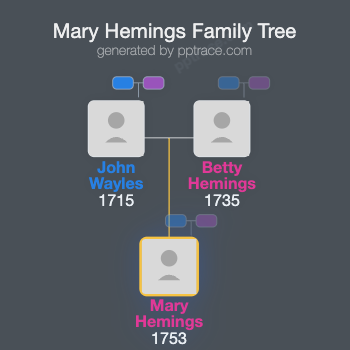
Mary Hemings
| Name | Mary Hemings |
| Title | American slave |
| Gender | Female |
| Birthday | 1753-01-01 |
| nationality | United States of America |
| Source | https://www.wikidata.org/wiki/Q6779764 |
| pptrace | View Family Tree |
| LastUpdate | 2025-11-28T20:11:13.037Z |
Family Tree
Tap  to expand more relatives
Introduction
Mary Hemings Bell (circa 1753 – after 1834) was born into slavery, most likely in Charles City County, Virginia. She was the eldest child of Elizabeth Hemings, a mixed-race slave owned by John Wayles. Elizabeth Hemings was the daughter of an enslaved African woman and an English sea captain, whose surname was Hemings. Mary's date of birth is estimated around 1753.
In 1773, upon the death of John Wayles, Elizabeth Hemings, her children, including Mary, and other members of the Hemings family were inherited by Thomas Jefferson, the husband of Martha Wayles Skelton Wayles—the daughter of John Wayles. The family was relocated to Monticello, Jefferson’s plantation in Virginia. During Jefferson's tenure in France as a diplomat, Hemings was hired out to Thomas Bell, a wealthy white merchant in Charlottesville. Hemings became his common-law wife, and they had two children together: Robert Washington Bell and Sarah Jefferson Bell.
Thomas Bell purchased Mary Hemings and her children from Jefferson in 1792. Following the purchase, Bell informally freed them, acknowledging their status as free individuals. Hemings adopted Bell's surname, becoming Mary Hemings Bell. She was the first of Elizabeth Hemings's children to gain her freedom.
Mary Hemings Bell and Thomas Bell lived together for the remainder of their lives. Bell died in 1800, leaving Mary and their children a significant estate, including property in Charlottesville on Main Street. Despite her freedom, Hemings remained in communication with her enslaved family at Monticello and continued to support them with gifts.
Mary Hemings Bell was the mother of six children. Her initial children included Daniel Farley (1772–1837), whom Jefferson gave to his sister Molly Hemings; Martha Jefferson Hemings, given as a wedding gift to Jefferson's daughter Martha Jefferson Randolph; Joseph Fossett (1780–1858), believed to be the son of William Fossett, a white craftsman at Monticello; and Betsy Hemings (1783–1857). Some accounts suggest Betsy was fathered by Thomas Jefferson, which has been a subject of historical investigation; documentation indicates Jefferson took Mary Hemings to Williamsburg and Richmond to care for Jefferson’s family during 1779–1781, and he gifted Betsy Hemings to his daughter at age 14.
Local oral traditions and historical research suggest that Betsy Hemings had children with Jefferson, including a daughter, Frances, and a son, Joseph, although records of other children have been lost or destroyed. Betsy remained with the Eppes family, and her burial site is marked at the family cemetery; her service and relationship with Jefferson have been studied by historians.
Joseph Fossett was freed by Jefferson in 1826 as recognition of his service as an ironworker. With assistance from his mother and other free family members, Fossett was able to purchase the freedom of his wife and several children, and they relocated to Ohio around 1840.
During the American Revolutionary War, Jefferson’s household, including Hemings, moved to Williamsburg and later Richmond, Virginia. In 1781, Hemings was captured by British forces during their raid on Richmond led by Benedict Arnold. She was held prisoner as a prisoner of war and was released after the siege of Yorktown, returning to slavery under Jefferson. In 2007, the Daughters of the American Revolution recognized her as a Patriot of the Revolution due to her imprisonment status, making her the first enslaved person to be honored as such. Her female descendants became eligible to join the DAR because of this recognition.
Mary Hemings Bell's date of death is recorded as after 1834. She lived in Charlottesville, Virginia, in her later years, and her grave site remains unidentified. Her descendants include William Monroe Trotter, a prominent Boston newspaper publisher and activist, who graduated magna cum laude from Harvard University in 1895 and was the first person of color to earn a Phi Beta Kappa key at Harvard.
References:
- Stanton, Lucia. "Slavery At Monticello," Jefferson Memorial Foundation, 1993.
- Stanton, Lucia. "Monticello to Main Street," Albemarle County History, 1997.
- Stanton, Lucia. "Free Some Day," Monticello Monograph Series, 2000.
- Gordon-Reed, Annette. "The Hemingses of Monticello," W.W. Norton & Company, 2008.
- Fox, Stephan R. "The Guardian of Boston," Atheneum, 1970.
- Anthony, Lena. "Family Ties," Daughters of the American Revolution, 2009.