
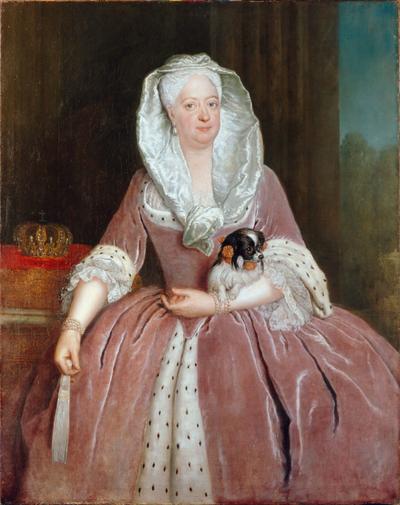
Sophia Dorothea Of Hanover
| Name | Sophia Dorothea Of Hanover |
| Title | Prussian royal consort of Frederick William I |
| Gender | Female |
| Birthday | 1687-03-16 |
| nationality | Germany |
| Source | https://www.wikidata.org/wiki/Q161131 |
| pptrace | View Family Tree |
| LastUpdate | 2025-11-12T01:14:57.645Z |
Family Tree
Tap  to expand more relatives
Introduction
Sophia Dorothea of Hanover was born on 16 March 1687 (Old Style calendar) in Hanover. She was the only daughter of George Louis of Hanover, who later became King George I of Great Britain, and his wife, Sophia Dorothea of Celle. At the time of her birth, her father was the grandson of a German prince, Ernest Augustus, Duke of Brunswick-Lüneburg. It was only in 1701 that legislation known as the Act of Settlement placed George Louis, through his mother, in line to inherit the British throne. By the time her father ascended as King George I in 1714, Sophia Dorothea was 27 years old and already a mother of multiple children and Queen in Prussia.
Following her parents' divorce and her mother’s imprisonment, she was raised in Hanover under the supervision of her paternal grandmother, Sophia of Hanover. Her education was overseen by Madame de Sacetot, a Huguenot teacher.
On 28 November 1706, Sophia Dorothea married her cousin, Crown Prince Frederick William of Prussia, heir apparent to the Prussian throne. The marriage was arranged following negotiations that favored her, and she was selected over Princess Ulrika Eleonora of Sweden. Their wedding by proxy took place in Hanover; she arrived in Berlin on 27 November 1706, where her bridal procession and festivities were held.
Physically described as tall with a slender figure, blue eyes, and gracious manners, she was considered attractive at the time of her marriage, though not regarded as a beauty. Her marriage to Frederick William was marked by differences in personality and interests; Sophia Dorothea was interested in arts, sciences, and fashion, whereas her husband was a militaristic and austere figure. Although never unfaithful, Frederick William reportedly failed to return her affections, and their marriage suffered from mutual disinterest and incompatibility. The birth of their first son, Frederick Louis, in 1707 was celebrated, and she demonstrated influence by successfully petitioning for the release of an imprisoned minister. She later bore several more children, including her son who would become King Frederick II of Prussia.
In 1713, upon the death of her father-in-law, Frederick I, she became Queen in Prussia when her husband Frederick William I ascended the throne. She resided primarily at the Berlin Palace and later in her own residence, Monbijou Palace, which she moved into in 1712. During her queenship, she participated in major events such as hosting Peter the Great during his visit to Berlin in 1717.
Her relationship with her husband was strained; he disapproved of her interests in entertainment and social activities, viewing them as frivolous. Frederick William was known for his parsimonious and austere lifestyle, and he discouraged her interference in political matters. Nonetheless, Sophia Dorothea had influence in court affairs, including attempts to secure marriage alliances for her children, especially her ambition to arrange marriages between her children and member royalty of Britain.
She played a key role in political intrigues, including her involvement in plans for marriage alliances with Britain. She was a proponent of the British alliance, advocating for her son Frederick to marry Princess Amelia of Great Britain, and for her daughter Wilhelmine to marry the future Prince of Wales. These ambitions led to diplomatic negotiations and various disputes with her husband and his favorites, such as Friedrich Heinrich von Seckendorff.
The queen experienced a significant political and personal crisis in 1730 when her eldest son, Prince Frederick, attempted to escape from Prussia. The failed escape led to Frederick’s imprisonment at Küstrin Fortress. During this period, she maintained correspondence with her son and attempted to influence political affairs. Her relationships with her children and her efforts to secure favorable marriages were consistent themes in her life.
In her later years, Sophia Dorothea continued to influence court affairs, although her political standing was challenged by court rivals and her husband's favorites. She also supported her daughters’ marriages and was present at their wedding ceremonies.
She was widowed in 1740 upon the death of Frederick William I. Her son, Frederick II (the Great), succeeded to the throne. As queen dowager, she maintained a prominent role at court, and her relationship with her son remained respectful and affectionate. Frederick II often expressed gratitude for her upbringing and support, and he preserved her high status at court, often preferring her company over others.
Sophia Dorothea died on 28 June 1757, after a period of declining health. She was buried with her husband in Berlin.
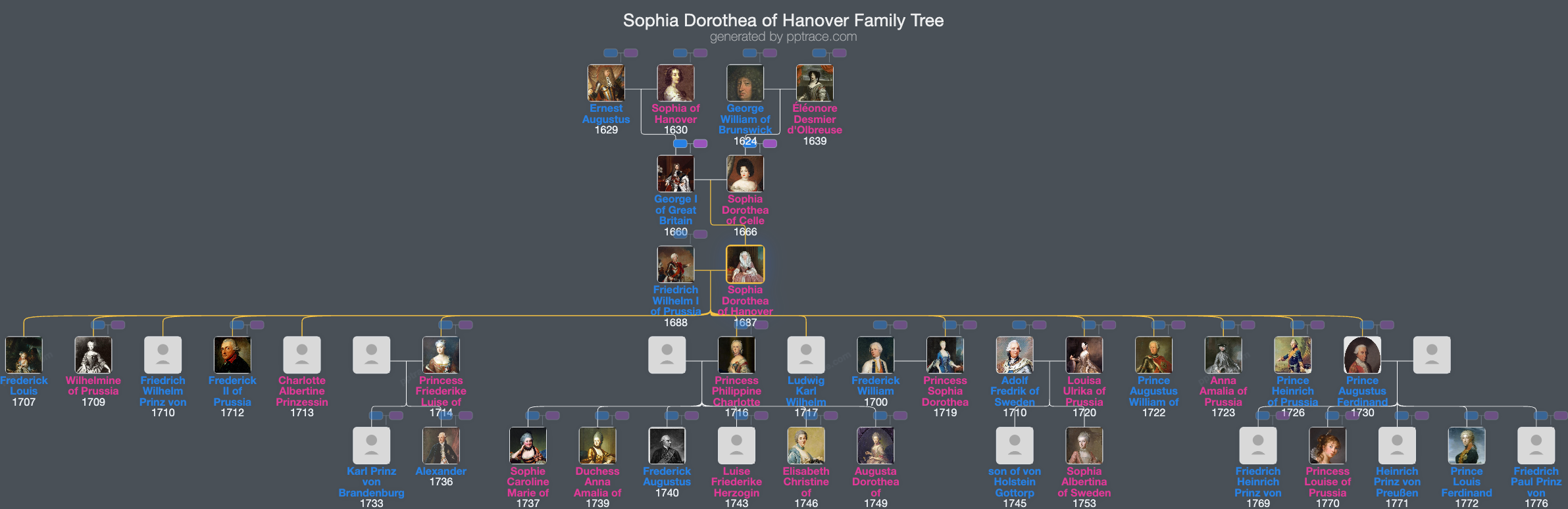
Children
- Anna Amalia Of Prussia
- Friedrich Wilhelm Prinz Von Preußen
- Prince Augustus Ferdinand Of Prussia
- Frederick II Of Prussia
- Prince Augustus William Of Prussia
- Princess Philippine Charlotte Of Prussia
- Princess Friederike Luise Of Prussia
- Prince Heinrich Of Prussia
- Charlotte Albertine Prinzessin Von Preußen
- Frederick Louis, Crown Prince Of Prussia
- Wilhelmine Of Prussia, Margravine Of Brandenburg-Bayreuth
- Princess Sophia Dorothea Of Prussia
- Louisa Ulrika Of Prussia
- Ludwig Karl Wilhelm Prinz Von Preußen