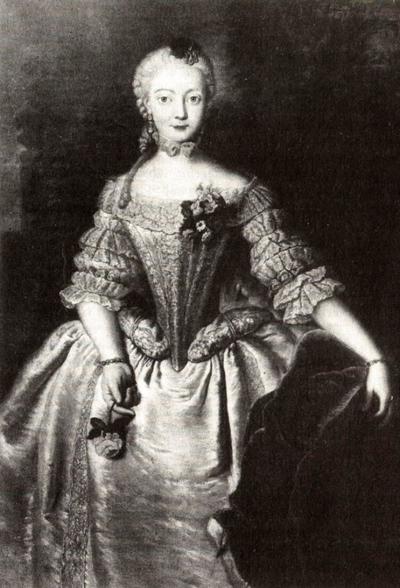
Wilhelmine Of Prussia, Margravine Of Brandenburg-Bayreuth
| Name | Wilhelmine Of Prussia, Margravine Of Brandenburg-Bayreuth |
| Title | Margravine of Brandenburg-Bayreuth (1709-1758) |
| Gender | Female |
| Birthday | 1709-07-03 |
| nationality | Germany |
| Source | https://www.wikidata.org/wiki/Q237740 |
| pptrace | View Family Tree |
| LastUpdate | 2025-11-12T01:15:27.564Z |
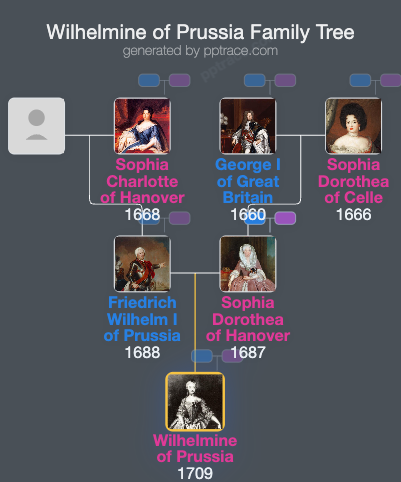
Family Tree
Tap  to expand more relatives
Introduction
Princess Wilhelmine of Prussia (Friederike Sophie Wilhelmine; July 3, 1709 – October 14, 1758) was a member of the Prussian royal family and a composer. She was the eldest daughter of Frederick William I of Prussia and Sophia Dorothea of Hanover, making her a granddaughter of George I of Great Britain. Wilhelmine was the elder sister of Frederick the Great.
Born in Berlin, Wilhelmine experienced an oppressive childhood, which she later documented. Her upbringing was marked by frequent abuse from her governess, whom she reported to have been physically abusive daily until a replacement was appointed following the governess’s threats concerning Wilhelmine's health. Her early life was also characterized by political marriage considerations; her mother, Queen Sophia Dorothea, desired her to marry her nephew, Frederick, Prince of Wales, an alliance that was opposed by the British court, which sought significant concessions. Her father favored a marriage into the Habsburg family.
In 1731, Wilhelmine married Frederick, Margrave of Brandenburg-Bayreuth. The marriage was arranged when her father replaced her sister Sophie with Wilhelmine as the bride for her husband's inheritance. Wilhelmine's acceptance of the marriage came under duress, and initially, the couple shared a happy relationship. However, the marriage later suffered from financial constraints and infidelity, notably her husband's affair with Dorothea von Marwitz, which caused a temporary estrangement between Wilhelmine and her brother Frederick the Great.
As Margravine of Brandenburg-Bayreuth, Wilhelmine played a significant role in transforming the town’s architecture and cultural landscape. She oversaw the reconstruction of several buildings, including her summer residence—part of what is now the Hermitage Museum—several theaters, the Bayreuth opera house, and the expansion of Bayreuth Palace. These projects adhered to the Rococo style and contributed to Bayreuth's reputation as an intellectual hub within the Holy Roman Empire. She also co-founded the University of Erlangen and cultivated a court that became a center for arts and learning, attracting figures like Voltaire and her brother Frederick the Great.
Wilhelmine maintained a close relationship with her brother, who provided her with an allowance in exchange for military support. Her political engagement intensified during the Seven Years’ War, especially during the Silesian War, when she met with Maria Theresa of Austria in 1745. Her diplomatic activities and relationship with Austria amid the tensions with Prussia caused strain with Frederick. Her visits to the Prussian court in 1750 and their subsequent last meeting in 1754 further exemplify her role as an intermediary and informant.
She acted as her brother’s correspondent and confidante in southern Germany until her death. Wilhelmine died in Bayreuth on October 14, 1758, coinciding with the Battle of Hochkirch, where Frederick’s forces suffered defeat. Her death deeply affected Frederick, who reputedly experienced severe illness afterward and fell into a lasting depression.
Wilhelmine authored memoirs titled "Memoires de ma vie," written or revised in French between 1748 and her passing. These memoirs are housed in the Royal Library of Berlin and have been translated into various languages, including English. The works offer insights into her life and court but are regarded by some scholars as entertaining yet not entirely reliable.
In addition to her literary works, Wilhelmine was a talented composer and musician. She was a lutenist, studying under Sylvius Leopold Weiss, and employed Bernhard Joachim Hagen as a musical supporter. Her compositions include a keyboard concerto in G minor and several chamber music pieces, such as a flute sonata and operatic works like "Argenore," composed around 1740.
Wilhelmine’s only child was Elisabeth Fredericka Sophie of Brandenburg-Bayreuth, born August 30, 1732. She married Karl Eugen, Duke of Württemberg, in 1748 but died childless on April 6, 1780.
Her life and contributions have been documented through memoirs, historical accounts, and fictionalized portrayals, including the 1909 novel "A Gentle Knight of Old Brandenburg" by Charles Major.