Frederick II Of Prussia
| Name | Frederick II Of Prussia |
| Title | King of Prussia from 1740 to 1786 |
| Gender | Male |
| Birthday | 1712-01-24 |
| nationality | Kingdom of Prussia |
| Source | https://www.wikidata.org/wiki/Q33550 |
| pptrace | View Family Tree |
| LastUpdate | 2025-11-12T01:15:30.324Z |
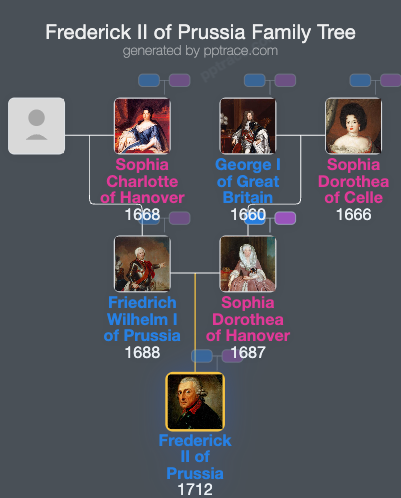
Family Tree
Tap  to expand more relatives
Introduction
Frederick II of Prussia, commonly known as Frederick the Great, was born on 24 January 1712 and died on 17 August 1786. He was the monarch of Prussia from 1740 until his death. During his reign, he declared himself King of Prussia after annexing Royal Prussia from the Polish–Lithuanian Commonwealth in 1772. His rule was marked by significant military, political, and cultural developments.
Frederick II was the son of Crown Prince Frederick William of Prussia and Sophia Dorothea of Hanover. He was born in the Berlin Palace and was baptized with the name Friedrich. His grandfather, Frederick I, welcomed his birth as his two previous grandsons had died in infancy. Frederick had nine siblings, including Wilhelmine, who became Queen of Sweden through marriage to King Adolf Fredrik, and brothers Augustus William and Henry.
His father, Frederick William I, was known as the "Soldier King" and ruled Brandenburg-Prussia with strict discipline and military focus. His mother, Sophia, was considered polite and charismatic. The differences between his parents influenced Frederick, particularly shaping his cultural interests and attitudes toward authority.
Frederick's early education included instruction in French and German, and he developed interests in music, philosophy, and literature, often clashing with his father's militaristic values. His tutors included Madame de Montbail, Jacques Duhan de Jandun, and Maturin Veyssière La Croze. Despite his father's Calvinist upbringing, Frederick was interested in the arts and thought independently about religion and philosophy.
At age 16, Frederick formed a close attachment to Peter Karl Christoph von Keith, his page, which is believed to have been homoerotic. His relationship with Keith ended when Keith was sent away following rumors of their intimacy. Frederick later became friends with Hans Hermann von Katte, with whom he may have also had a similar relationship. In 1730, Frederick plotted to flee Prussia with Katte but was arrested and imprisoned. He was forced to witness Katte's execution, which deeply affected him. Frederick was later pardoned, and his education in statecraft and administration was intensified.
Frederick married Elisabeth Christine of Brunswick-Bevern in 1733, but the marriage was troubled and they separated after he ascended the throne in 1740. He dedicated himself to military, administrative, and cultural pursuits upon becoming king.
Frederick's accession to the throne was marked by military conflicts, notably the War of the Austrian Succession and the Seven Years' War. He initiated the annexation of Silesia, expanding Prussian territory and strengthening its military power. His military tactics and campaigns are recognized for their innovation and effectiveness, and he is noted for his use of the oblique order of battle and operational strategies that emphasized speed and surprise.
As a supporter of Enlightenment ideas, Frederick modernized Prussian bureaucracy, legal system, and promoted religious tolerance, though his policies reflected pragmatic considerations and prejudices. He reformed taxation, encouraged immigration, supported arts and sciences, and patronized music and architecture, exemplified by the construction of Sanssouci, his summer palace.
Frederick was a talented musician and composer, playing the transverse flute and supporting prominent artists such as C. P. E. Bach. He reestablished the Prussian Academy of Sciences, fostering intellectual exchange and research.
He died in 1786 at Sanssouci and was buried there. Frederick's legacy has been interpreted variably, with a tradition of viewing him as a military genius and enlightened ruler, though modern scholarship emphasizes his complex actions and policies. His reputation was prominent in German history and was later co-opted by various political regimes, including the Nazis, before being reassessed in contemporary times.