
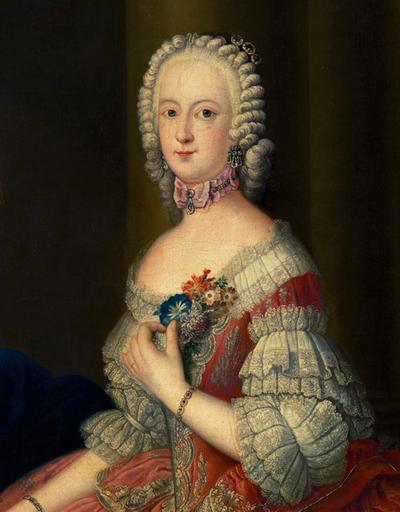
Princess Philippine Charlotte Of Prussia
| Name | Princess Philippine Charlotte Of Prussia |
| Title | Prussian princess |
| Gender | Female |
| Birthday | 1716-03-13 |
| nationality | Germany |
| Source | https://www.wikidata.org/wiki/Q62043 |
| pptrace | View Family Tree |
| LastUpdate | 2025-11-12T01:15:31.144Z |
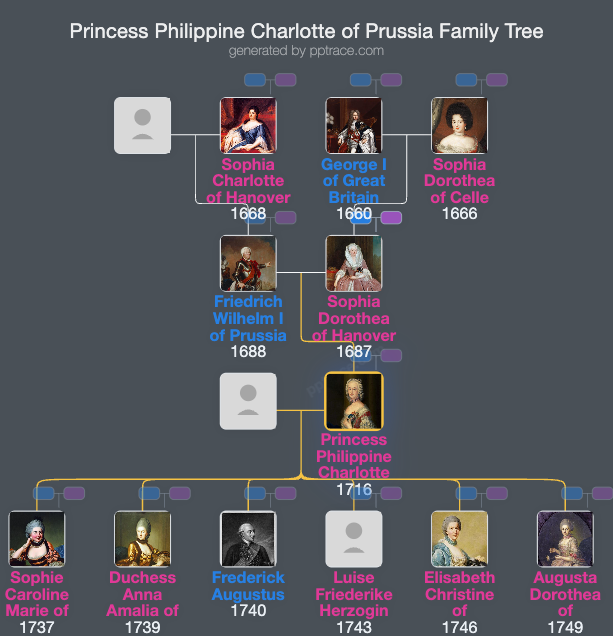
Family Tree
Tap  to expand more relatives
Introduction
Princess Philippine Charlotte of Prussia was born on March 13, 1716, in Berlin. She was the fourth child and third daughter of Frederick William I of Prussia and Sophia Dorothea of Hanover. She passed away on February 17, 1801, in Brunswick.
On July 2, 1733, in Berlin, she married Duke Charles of Brunswick-Wolfenbüttel. He was the eldest son of Ferdinand Albert II, Duke of Brunswick-Wolfenbüttel. When her husband inherited the dukedom in 1735 following his father's death, she became the Duchess of Brunswick-Wolfenbüttel.
Her marriage established a double alliance between Prussia and Brunswick, linking the House of Hohenzollern with the House of Brunswick through her marriage and through her brother Frederick's marriage to Elisabeth Christine, sister of Duke Charles. These dynastic ties contributed to the political alliance during the Seven Years' War and influenced the careers of her children in Prussian service.
Princess Philippine Charlotte was known for her education and intellectual pursuits, aligned with the ideals of the Enlightenment. She studied philosophical writings, notably those of Christian von Wolff, in French. She maintained close connections with prominent figures in German intellectual circles, including the poet Salomon Gessner and the poet Friedrich Gottlieb Klopstock. She was also part of a circle that included dramatist Gotthold Ephraim Lessing.
As Duchess consort, she hosted intellectual salons in her court at the Grauer Hof, engaging with scholars and literary figures. Her court life generally included social events such as operas and balls, though economic constraints limited such activities over time.
She raised her children in a humanist tradition, emphasizing education and virtue. Her son Charles became duke in 1780 after her husband's death, having served as regent since 1773. She was involved in his upbringing, sending him on a Grand Tour with archaeologist Johann Joachim Winckelmann as a companion.
Contemporary accounts from Swedish Princess Hedwig Elizabeth Charlotte describe Philippine Charlotte as an educated and respected woman, although by 1799, she was reportedly suffering from diminished memory due to old age.
Princess Philippine Charlotte contributed to the cultural and intellectual life of her time. She left her personal library containing approximately 4,000 volumes to the Wolfenbüttel Library. Her portrait, depicting her with a small dog at a harpsichord, is preserved in the Wittum Palace in Weimar. An embroidered fireplace screen created by her is kept in the concert room of the New Palace in Potsdam.
She is interred in Braunschweig Cathedral.
Children
- Duchess Anna Amalia Of Brunswick-Wolfenbüttel
- Frederick Augustus, Prince Of Brunswick-Wolfenbüttel-Oels
- Sophie Caroline Marie Of Brunswick-Wolfenbüttel
- Charles William Ferdinand, Duke Of Brunswick-Wolfenbüttel
- Luise Friederike Herzogin Von Braunschweig-Wolfenbüttel
- Elisabeth Christine Of Brunswick-Wolfenbüttel, Crown Princess Of Prussia
- Augusta Dorothea Of Brunswick-Wolfenbüttel