Anna Amalia Of Prussia
| Name | Anna Amalia Of Prussia |
| Title | German princess-abbess and composer |
| Gender | Female |
| Birthday | 1723-11-09 |
| nationality | Kingdom of Prussia |
| Source | https://www.wikidata.org/wiki/Q237754 |
| pptrace | View Family Tree |
| LastUpdate | 2025-11-12T01:15:28.484Z |
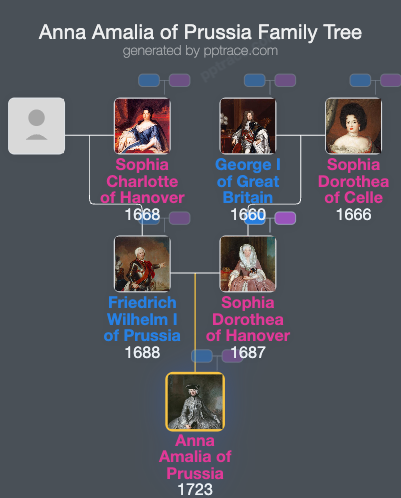
Family Tree
Tap  to expand more relatives
Introduction
Princess Anna Amalia of Prussia was born on November 9, 1723, in Berlin, Kingdom of Prussia. She was the twelfth child and seventh daughter of King Frederick William I of Prussia (1688–1740) and Princess Sophia Dorothea of Hanover (1687–1757). She had a total of thirteen siblings, ten of whom survived infancy, including Frederick the Great (1712–1786). Her upbringing was primarily based in Berlin at the Royal Palace, with regular visits to the royal hunting lodge in Königs Wusterhausen.
Anna Amalia's early life was marked by her father's strict and often violent behavior. Frederick William I was a soldier with an unpolished demeanor, characterized by an unpredictable temper, alcoholism, and a Calvinist religious outlook that valued simplicity and subjugation of women. He disapproved of music and cultural pursuits, considering them decadent. Conversely, her mother, Sophia Dorothea, was well-educated and appreciated art, theater, and French culture. It was through her mother’s influence and a French-staffed upbringing that Anna Amalia developed a keen interest in music. She received her initial musical training from Crown Prince Frederick, learning to play the harpsichord, flute, and violin.
Following the death of her father in 1740, her elder brother succeeded him as Frederick II of Prussia. In 1743–1744, a proposed marriage alliance linked her family to the Swedish monarchy; she was considered as a potential bride for Prince Adolf Frederick of Holstein-Gottorp, heir to the Swedish throne. Ultimately, her sister Louisa Ulrika was married by proxy to the Swedish crown prince.
In 1755, Anna Amalia was elected princess-abbess of the Imperial Abbey of Quedlinburg, a position that granted her wealth and influence and granted her the right to participate in the Imperial Diet. Despite her duties, she primarily resided in Berlin and dedicated herself to music. In 1758, she began formal studies in music theory and composition with Johann Kirnberger, a student of Johann Sebastian Bach.
She composed various works, including chamber music such as trios, marches, cantatas, songs, and fugues. Notable among her compositions is the passion cantata "Der Tod Jesu" ("The Death of Jesus"), based on a poem by Karl Wilhelm Ramler. Her surviving works are limited, partly because she described herself as timid and self-critical, and she may have destroyed many compositions. A potential additional collection of her works was uncovered in 2000 in the archives of the Sing-Akademie zu Berlin, which had been lost during World War II.
Princess Anna Amalia was also a music collector, accumulating over 600 volumes by prominent composers such as Johann Sebastian Bach, Handel, Telemann, Graun, and Emanuel Bach. Her library was divided after World War II between East and West Germany and was reunified in 1990, currently housed in the Berlin State Library.
Anna Amalia died on March 30, 1787, in Berlin at the age of 63 and was buried in Berlin Cathedral. She was succeeded as princess-abbess by her niece, Princess Sophia Albertina of Sweden (1753–1829).
Her musical compositions include a "Sonata in F Major" for flute and basso continuo (1771), a "Harpsichord Concerto in G major," and a "Divertimento in B-flat major" (circa 1780). The "Sonata in F Major" features three movements: Adagio, Allegretto, and Allegro ma non troppo, and is approximately 11 minutes long. The "Harpsichord Concerto" is scored for solo harpsichord, two flutes, two oboes, two bassoons, and strings, lasting around 13 minutes. The "Divertimento" shows possible influence from Mozart and might be among the earliest chamber works featuring the clarinet, opening with a tutti section led by the viola.