
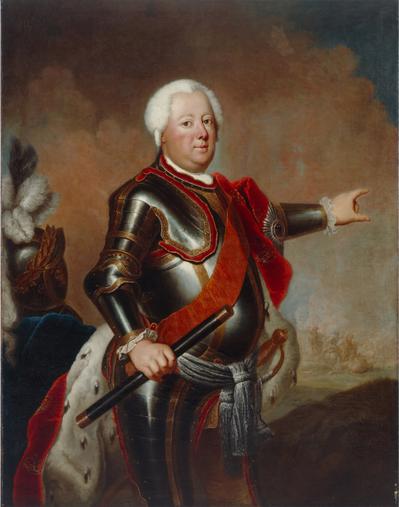
Friedrich Wilhelm I Of Prussia
| Name | Friedrich Wilhelm I Of Prussia |
| Title | king of Prussia |
| Gender | Male |
| Birthday | 1688-08-14 |
| nationality | Kingdom of Prussia |
| Source | https://www.wikidata.org/wiki/Q105013 |
| pptrace | View Family Tree |
| LastUpdate | 2025-11-12T01:15:32.887Z |
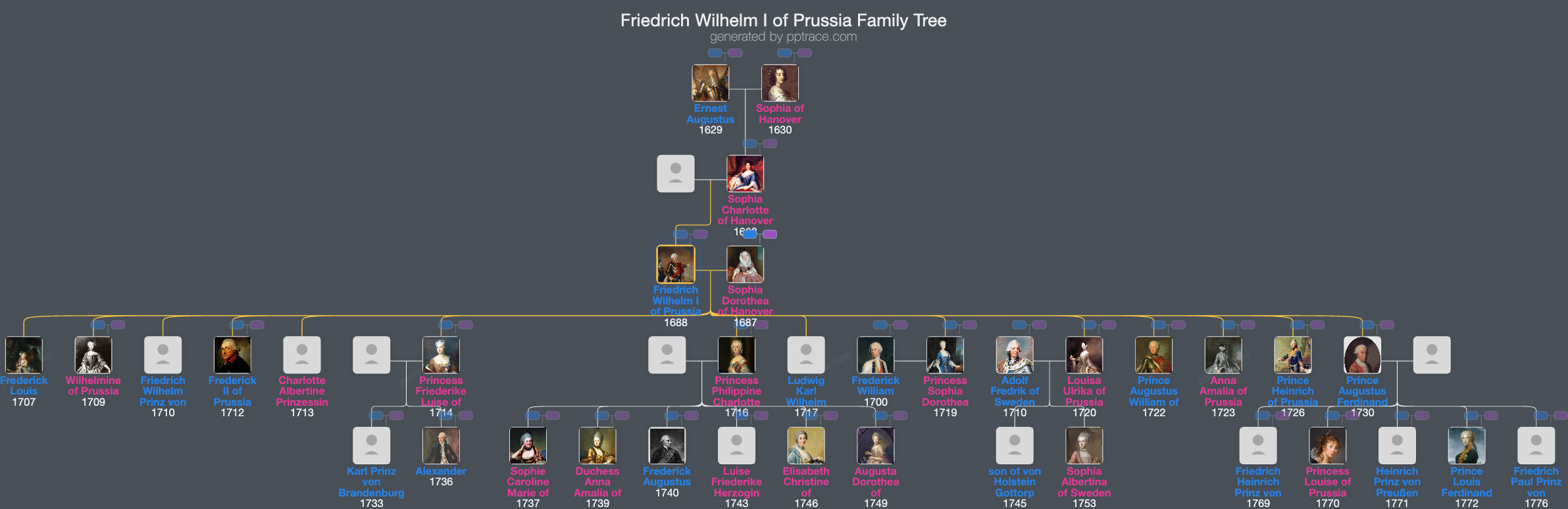
Family Tree
Tap  to expand more relatives
Introduction
Frederick William I of Prussia (German: Friedrich Wilhelm I.; born 14 August 1688, Berlin – died 31 May 1740) was King in Prussia and Elector of Brandenburg from 1713 until his death. He also held the title of Prince of Neuchâtel. His parentage included King Frederick I of Prussia and Princess Sophia Charlotte of Hanover. During his early childhood, he was raised by a Huguenot governess named Marthe de Roucoulle.
Frederick William's political consciousness developed notably during the Great Northern War period, amid a plague outbreak in Prussia. During this time, he challenged corruption and inefficiency within the government, leading to reforms aimed at strengthening the state's military and administrative structures. A key early event influencing his political outlook was the exposure of corruption among ministers, notably the misappropriation by Johann Kasimir Kolbe von Wartenberg. This incident heightened Frederick William's opposition to misconduct and inefficiency and marked his initial active participation in political affairs. Subsequently, he began to consolidate institutional reforms and centralized authority, especially in military matters.
Upon his accession to the throne in 1713, Frederick William inherited a financially strained state, largely due to the expensive campaigns and palace expansions undertaken by his father, Frederick I, including enlargements of the Berlin Palace, Charlottenburg Palace, and Königsberg Castle. To address the financial burdens, he dismissed his father's corrupt cabinet and implemented financial reorganization efforts. His reforms included increasing government revenues through higher taxes on excise and land, particularly among the nobility, and establishing clear regulations for public officials. These regulations outlined duties and penalties, aiming to improve efficiency and accountability in governance.
A major aspect of his reign was the significant expansion and professionalization of the Prussian military. He increased the army from 38,000 to approximately 80,000 soldiers, emphasizing strict discipline, training, and conscription reforms. Notable military reforms included the introduction of the canton system and innovations to infantry tactics, which laid the foundation for Prussia's future militarized state. He also expanded military obligations among peasants and replaced mandatory service with taxes among the middle classes. His reforms fostered Prussia's emergence as a regional power.
Frederick William I engaged in colonial affairs, notably selling the Brandenburg Gold Coast to the Dutch West India Company in 1717, reflecting his focus on military expansion over colonial investments. That same year, he revoked the charter for the Brandenburg Africa Company. He also fostered religious tolerance by inviting Salzburg Protestants to settle in East Prussia in 1732. He promoted immigration of these Protestants, providing them with land and welcoming them with hymns and community support.
In terms of foreign policy, he participated briefly in the Great Northern War, forming alliances to acquire ports on the Baltic Sea, especially the port of Stettin. His military reforms and expansion efforts enhanced Prussia's regional influence, setting the stage for future territorial gains.
Frederick William I was known for his physically harsh temperament, exacerbated by inherited health issues including gout and stomach pains. His relationship with his eldest son, Frederick II, who became King Frederick the Great, was strained. Frederick William sought to mold his son into a soldier and statesman but clashed over personal interests, education, and behavior. The prince’s youthful defiance, including a rumored romantic relationship and an attempted flight to England, led to severe disciplinary actions and imprisonment.
He was married to Sophia Dorothea of Hanover, his first cousin. The marriage was reportedly unhappy; Sophia Dorothea was wary of his temper and opposed his strict control. They had fourteen children, among whom was Frederick II. Frederick William was interred at the Garrison Church in Potsdam after his death. During World War II, his remains underwent multiple relocations before being finally laid to rest at the Kaiser Friedrich Mausoleum in the Church of Peace at Sanssouci.
His death in 1740 marked the end of a reign focused on military and administrative strengthening. His successor was his son, Frederick II.
Parents
Children
- Anna Amalia Of Prussia
- Friedrich Wilhelm Prinz Von Preußen
- Prince Augustus Ferdinand Of Prussia
- Frederick II Of Prussia
- Prince Augustus William Of Prussia
- Princess Philippine Charlotte Of Prussia
- Princess Friederike Luise Of Prussia
- Prince Heinrich Of Prussia
- Charlotte Albertine Prinzessin Von Preußen
- Frederick Louis, Crown Prince Of Prussia
- Wilhelmine Of Prussia, Margravine Of Brandenburg-Bayreuth
- Princess Sophia Dorothea Of Prussia
- Louisa Ulrika Of Prussia
- Ludwig Karl Wilhelm Prinz Von Preußen