Louisa Ulrika Of Prussia
| Name | Louisa Ulrika Of Prussia |
| Title | Swedish queen (1720-1782) |
| Gender | Female |
| Birthday | 1720-07-24 |
| nationality | Sweden |
| Source | https://www.wikidata.org/wiki/Q234251 |
| pptrace | View Family Tree |
| LastUpdate | 2025-11-12T01:15:22.929Z |
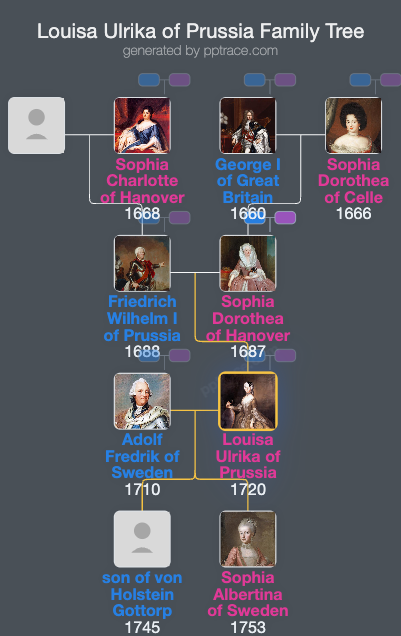
Family Tree
Tap  to expand more relatives
Introduction
Louisa Ulrika of Prussia (Swedish: Lovisa Ulrika; German: Luise Ulrike) was born on 24 July 1720 in Berlin and died on 16 July 1782. She held the title of Queen of Sweden from 1751 until 1771 and served as queen mother during the reign of her son, King Gustav III.
Early Life:
Louisa Ulrika was the daughter of Frederick William I of Prussia and Sophia Dorothea of Hanover. She was the younger sister of both Wilhelmine of Bayreuth and Frederick the Great. Her godmother was Queen Ulrika Eleonora of Sweden, after whom Louisa Ulrika was named. She maintained a correspondence with her godmother, and there were expectations that she might marry a Swedish prince, a hope that did not materialize.
She received an education aligned with the ideals of the French Enlightenment, instructed by French Huguenot tutors Marthe de Roucoulle and Maturin Veyssiére la Croze. Her father favored her intellectual pursuits, in contrast to his attitudes towards her brothers' interest in learning. Louisa Ulrika developed interests in science and culture and enjoyed a good relationship with her eldest brother, Frederick the Great. She shared her interest in scientific topics with her siblings and was introduced to figures such as Voltaire, with whom she maintained a lifelong correspondence.
Marriage Negotiations:
Early in her life, various dynastic marriage prospects were considered for her, including matches with Frederick Lewis of Great Britain, Charles III of Spain, and Louis of Hesse-Darmstadt, but none materialized. She was also appointed co-adjutrix of Quedlinburg Abbey in 1743, a position she did not support.
In 1743, negotiations took place for her marriage to a French candidate, Christian IV, Count Palatine of Zweibrücken, which fell through when he lost the Swedish throne election to the Russian candidate, Adolf Frederick of Holstein-Gottorp. Subsequently, plans emerged for her to marry the Swedish Crown Prince, Adolf Frederick, as part of an alliance between Sweden, Russia, and Prussia. The proposal was ultimately accepted, with her brother Frederick the Great's influence, and she was advised to convert to Lutheranism, which she did in 1744.
Crown Princess:
Louisa Ulrika married Crown Prince Adolf Frederick of Sweden via proxy on 17 July 1744 in Berlin. She traveled to Sweden, arriving in Swedish Pomerania, and was officially received by her future husband. Their marriage was reportedly harmonious, and she quickly gained popularity in Sweden through her beauty, wit, and interest in arts and sciences.
As Crown Princess, she was active culturally and politically. She founded the Royal Swedish Academy of Letters, History and Antiquities in 1753 and patronized notable figures such as Carl von Linné. Her court was lively, with interests in theater, science, and social gatherings. She established Drottningholm Palace as her summer residence and engaged in scientific activities, collecting natural specimens and maintaining correspondence with intellectuals.
Political Activities:
Louisa Ulrika was a pronounced supporter of absolute monarchy and disliked the constitutional systems in Sweden. She sought to increase royal power through influence at the Riksdag of the Estates. Her political strategies included forming alliances with the Hat party, attempting to sway votes through bribery, and planning coups to shift power toward the monarchy.
In 1748, she was involved in her first coup attempt, aiming to establish an absolute monarchy during a time of war and political instability. Her efforts included attempts to influence the succession and modify the constitution in favor of royal authority. She cultivated secret diplomacy with foreign powers like Prussia, France, and Russia to support her ambitions.
As Queen:
Louisa Ulrika's accession to the throne occurred in 1751 after her husband, King Adolf Frederick, swore an oath to respect the Swedish constitution. She continued her patronage of the arts and sciences and was known for her French cultural preferences. Her political ambitions persisted, leading to conflicts with the Riksdag and opposition parties, with several attempts at coups and constitutional challenges. Her involvement in planning coups and suspicion of her influence led to her decreasing popularity.
Later Years and Dowager:
Following her husband's death in 1771, Louisa Ulrika became Queen Dowager. Her son Gustav III ascended the throne the same year. During her widowhood, she remained politically active and engaged in efforts to restore or strengthen monarchical power, supporting her son's subsequent coup in 1772 that abolished the constitutional limits on royal authority.
Her relationship with her son deteriorated over time, particularly concerning her influence on his marriage and political stance. She was involved in scandals in her later years, including conflicts over succession and accusations of improper conduct, culminating in her death in Svartsjö in 1782.
Children:
Louisa Ulrika and Adolf Frederick had five children: a stillborn son in April 1745; Gustav III of Sweden (1746–1792); Charles XIII of Sweden (1748–1818); Frederick Adolf (1750–1803); and Sophia Albertine (1753–1829).
Ancestry:
Her lineage included notable European royal families, emphasizing her position within the Prussian and broader European dynastic networks.