Adelaide Of Saxe-Meiningen
| Name | Adelaide Of Saxe-Meiningen |
| Title | Queen of the United Kingdom from 1830 to 1837 |
| Gender | Female |
| Birthday | 1792-08-13 |
| nationality | Q164079 |
| Source | https://www.wikidata.org/wiki/Q57645 |
| pptrace | View Family Tree |
| LastUpdate | 2025-11-12T01:16:50.624Z |
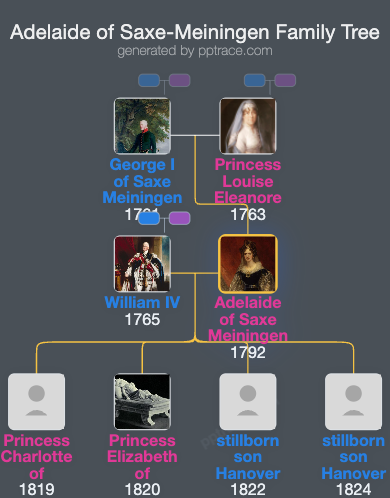
Family Tree
Tap  to expand more relatives
Introduction
Adelaide of Saxe-Meiningen (Adelaide Amelia Louise Theresa Caroline) was born on 13 August 1792 in Meiningen, Thuringia, Germany. She was the eldest child of Georg I, Duke of Saxe-Meiningen, and Luise Eleonore of Hohenlohe-Langenburg. Adelaide was baptized on 19 August 1792 in the castle chapel and was given the style Serene Highness as Princess Adelaide of Saxe-Meiningen, Duchess in Saxony. Her godparents included notable figures such as her mother, the Holy Roman Empress, and various duchesses and princes from German states.
Saxe-Meiningen was a small German state covering approximately 423 square miles (1,100 km²). It was recognized for its liberal policies, including permitting a free press and criticism of the ruler. At the time of Adelaide's birth, no law prohibited female rule in Saxe-Meiningen; such a law was enacted in 1800 following the birth of her brother, Bernhard.
By the end of 1811, King George III of the United Kingdom was incapacitated, leading to his son, Prince George, serving as regent. After the death of Princess Charlotte, the only legitimate granddaughter of George III, in 1817, the royal succession was uncertain. To ensure continuation of the lineage, arrangements were made for Prince William, Duke of Clarence, a son of George III, to marry. Adelaide's marriage to William was arranged after initial deals with other candidates fell through. The marriage was finalized in 1818; they wed in a double ceremony at Kew Palace, Surrey, on 11 July 1818, with William’s brother, Prince Edward Augustus, Duke of Kent, marrying Victoria, Dowager Princess of Leiningen.
William was 27 years her senior, and the couple had not been previously married. They resided initially in Hanover, where Adelaide adapted well to her new environment, and their marriage appeared to be amicable and devoted. Adelaide became pregnant, but her pregnancy was complicated by pleurisy, resulting in a stillbirth on 27 March 1819 at Fürstenhof Palace in Hanover. She miscarried again during the journey to England later that year.
In 1820, Adelaide gave birth to a second daughter, Elizabeth Georgiana Adelaide, at St James's Palace. Elizabeth died at less than three months old. The couple experienced subsequent stillbirths, and ultimately, they had no surviving children.
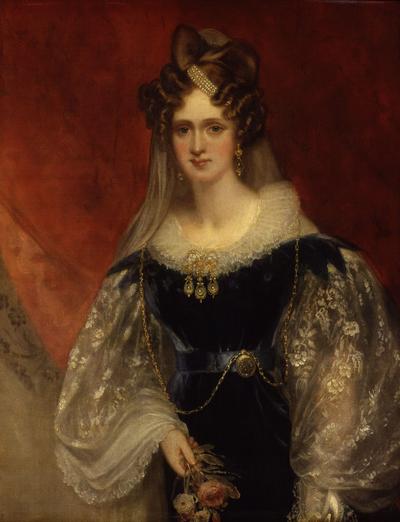
William became heir-presumptive after the death of his brother, Duke of York, in 1827. Upon the death of King George IV in 1830, William ascended to the throne as King William IV. Adelaide became queen consort on 26 June 1830 and was crowned on 8 September 1831 at Westminster Abbey. William reportedly disliked the ceremonial aspects of the coronation, whereas Adelaide conducted herself with dignity and grace. As queen, Adelaide was known for her piety, modesty, and charitable activities. She was granted a life interest in Bushy House and received a dower annuity of £100,000 from Parliament.
During William’s reign, Princess Victoria of Kent, later Queen Victoria, was regarded as the heir presumptive. Adelaide treated Victoria kindly despite the ongoing rivalry with Victoria’s mother, the Dowager Duchess of Kent. Tensions arose with the Duchess of Kent over court precedence and accommodations, leading to heated exchanges that damaged relations.
Adelaide was involved, albeit indirectly, in political affairs, aligning with Tory views. While publicly noncommittal, her perceived influence on political matters, including opposition to reform policies, contributed to her unpopularity among reformers. She also expressed conservative views on church reform, such as her opposition to reform of the Church of Ireland.
Following William’s death on 20 June 1837, Adelaide became queen dowager. She remained active in public duties and charity work, residing alternately at her residences, including Marlborough House, Witley Court, Cassiobury House, and Bentley Priory. She traveled to Malta in 1838, where she funded the construction of St Paul’s Pro-Cathedral. Adelaide’s health declined, and she suffered from chronic illnesses. She died on 2 December 1849 at Bentley Priory, Middlesex, and was interred in St George’s Chapel at Windsor Castle.
Adelaide’s legacy includes the naming of the city of Adelaide in South Australia during William IV’s reign. Numerous places and institutions worldwide bear her name, including streets, hospitals, and geographic features. Her influence persists in various memorials and the continued existence of organizations dedicated to her memory.