
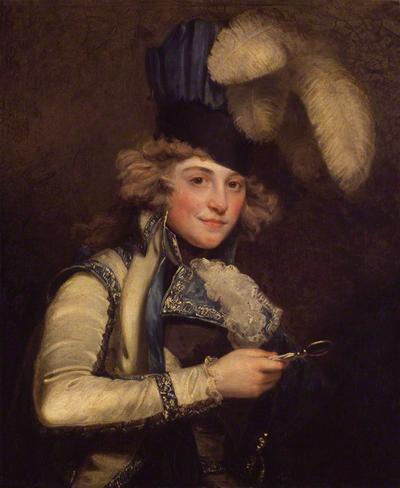
Dorothea Bland
| Name | Dorothea Bland |
| Title | Anglo-Irish actress and courtesan (1761–1816) |
| Gender | Female |
| Birthday | 1761-11-21 |
| nationality | United Kingdom of Great Britain and Ireland |
| Source | https://www.wikidata.org/wiki/Q262755 |
| pptrace | View Family Tree |
| LastUpdate | 2025-11-12T01:16:51.450Z |
Family Tree
Tap  to expand more relatives
Introduction
Dorothea Jordan, born Bland on 22 November 1761, was an Anglo-Irish actress and courtesan. She was baptized at St Martin in the Fields, Middlesex, on 5 December 1761. She was the third of six children born to Francis Bland and Grace Phillips. Her father, born in 1736, worked as a stagehand and abandoned the family before April 1774, when Jordan was approximately 13 years old; he subsequently married an Irish actress. Her mother, Grace Phillips, died in 1789 in Edinburgh. Jordan’s paternal grandparents included Nathaniel Bland, a Vicar General and judge, and his wife Lucy Heaton. Her maternal ancestry is unconfirmed, though she has been described as having Welsh clerical descent.
Her early life was marked by her family’s financial struggles following her father’s departure. Jordan adopted her mother’s maiden name, Phillips, in accordance with her father’s stipulation that her family not use his surname.
Jordan’s theatrical debut is not precisely documented. Some sources suggest she debuted in Dublin as Phoebe in *As You Like It* around 1777, while others record her first appearance as Lucy in *The Virgin Unmask'd* at the Smock Alley Theatre in Dublin on 3 November 1779. She played roles including Priscilla Tomboy in *The Romp*, Anne in *Richard III*, and Adelaide in *The Count of Narbonne*. She performed at the Smock Alley Theatre under Richard Daly’s management, sometimes portraying male roles in the theatre’s “reversed” cast. Her last Dublin appearance was in May 1782.
Before her departure from Ireland, and while pregnant with Daly’s illegitimate child, she was rumored to have fled to Leeds, where she was employed by Tate Wilkinson’s company in England. It was during this period that she adopted the surname "Jordan" and the courtesy title "Mrs." All women in the company, regardless of marital status, used this title. Her first recorded performance in England was as Calista in *The Fair Penitent* on 11 July 1782. Wilkinson paid her a weekly salary, and she gained popularity despite critics’ reservations about her performances in tragedy roles.
Jordan toured with Wilkinson’s Yorkshire Circuit until 1785, playing in cities such as Hull, York, Edinburgh, and other provincial venues. During this tour, she gave birth to her first daughter, Frances, in Hull. She faced social challenges and gossip that tarnished her reputation, but Wilkinson’s support helped her regain acceptance.
Her London debut occurred at Drury Lane, possibly as Lady Teazle in Sheridan's *The School for Scandal*, before 1785. Her first confirmed London appearance was as Peggy in *The Country Girl*. Critics noted her natural talent and playful manner, especially in comedic breeches roles such as Viola in *Twelfth Night* and Sir Harry Wildair in *The Constant Couple*. She was primarily recognized for her comedic talent but also performed Shakespearean and tragic roles including Ophelia, Imogen, Emilia, and Zara.
Jordan worked at notable theatres including Drury Lane, Covent Garden, and the Haymarket, until her retirement in 1815. She was also known for writing the song "The Bluebells of Scotland." During her career, she continued to perform in provincial circuits and in various roles across England.
Her personal life included relationships and extramarital children with several men. She had an affair with Dublin theatre manager Richard Daly, resulting in her illegitimate daughter Frances Daly (later Bettesworth). She also had a significant relationship with Sir Richard Ford, with whom she had three children: Dorothea Maria Ford, Lucy Hester Ford, and an infant who died at birth.
In 1790, she began a long-standing relationship with Prince William, Duke of Clarence. They had ten illegitimate children, all adopting the surname FitzClarence. Their children included George FitzClarence, Henry Edward FitzClarence, Sophia FitzClarence, Mary FitzClarence, Lord Frederick FitzClarence, Elizabeth FitzClarence, Lord Adolphus FitzClarence, Augusta FitzClarence, Lord Augustus FitzClarence, and Amelia FitzClarence. Jordan received an annual stipend from William but continued her stage performances until her separation from him in 1811. Following the separation, she was granted custody of her daughters, while William retained custody of their sons.
In her later years, Jordan returned to the stage in 1814 to assist her family during financial difficulties. Her stipend was revoked, and she moved to France, residing in Boulogne, Versailles, and Saint-Cloud. She was defrauded by her daughter and son-in-law, which, along with declining health, led to her deteriorating physical and mental state. She succumbed to a ruptured blood vessel from inflammation of the chest and died in Saint-Cloud on 5 July 1816. She was buried in the town cemetery of Saint-Cloud.

Parents
Children
- Henry FitzClarence
- Amelia Cary, Viscountess Falkland
- Lucy Hester Rachel Ford
- Lord Frederick FitzClarence
- Elizabeth Hay, Countess Of Erroll
- Dorothy Ford
- Frances Alsop
- George FitzClarence, 1st Earl Of Munster
- Sophia Sidney, Baroness De L'Isle And Dudley
- Lord Adolphus FitzClarence
- Lord Augustus FitzClarence
- Mary Fox
- Augusta FitzClarence Kennedy-Erskine