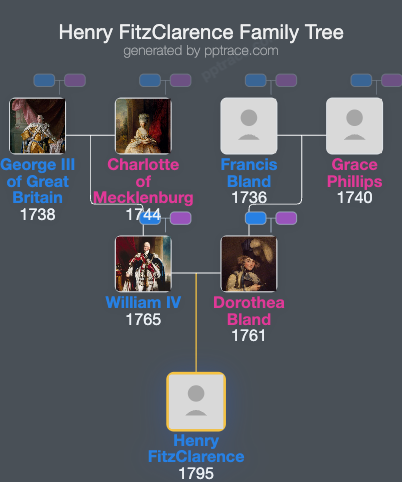
Henry FitzClarence
| Name | Henry FitzClarence |
| Title | British noble |
| Gender | Male |
| Birthday | 1795-03-27 |
| nationality | Great Britain |
| Source | https://www.wikidata.org/wiki/Q5721259 |
| pptrace | View Family Tree |
| LastUpdate | 2025-11-12T00:45:59.172Z |
Family Tree
Tap  to expand more relatives
Introduction
William IV, born William Henry on 21 August 1765 at Buckingham House, was the third son of King George III and Queen Charlotte of the United Kingdom. He was the younger brother of George IV and Prince Frederick, Duke of York and Albany. As a member of the House of Hanover, he held several titles during his lifetime, including Duke of Clarence and St Andrews, created in 1789.
Early Life and Naval Service:
William grew up primarily in Richmond and Kew Palace, receiving private education. At age thirteen, he joined the Royal Navy as a midshipman in Admiral Robert Digby's squadron. His naval experience included service in British North America and the Caribbean, with participation at the Battle of Cape St Vincent in 1780. He spent time in New York during the American War of Independence, becoming the only member of the British royal family to visit America during this period. His friendship with Admiral Nelson developed during his naval career, and he was promoted through the ranks to rear-admiral by 1791, subsequently commanding ships such as HMS Andromeda and HMS Valiant.
Relationships and Personal Life:
William was involved in a long-term relationship with Dorothea Jordan, an Irish actress, beginning around 1791. They cohabited for approximately twenty years and had ten illegitimate children—five sons and five daughters—who bore the surname FitzClarence. Despite their separation in 1811, William maintained close ties with her children. Before 1791, William had an illegitimate son whose mother remains unknown, and there are claims of a possible relationship with Caroline von Linsingen, though these lack historical confirmation.
Marriage:
In 1818, William married Princess Adelaide of Saxe-Meiningen, a union that lasted until his death and was regarded as harmonious. The couple had two daughters who died young and experienced two miscarriages. Adelaide managed William's finances, which had been strained by his debts accumulated from earlier relationships and attempts at securing wealthy marriage prospects.
Ascendancy to the Throne:
William's elder brothers, George, Prince of Wales, and Prince Frederick, Duke of York, died without legitimate heirs, leading William to become heir presumptive. After the death of George III in 1820, William served as Lord High Admiral starting in 1827. He succeeded his brother George IV as king on 26 June 1830 at the age of 64, becoming the last monarch of the House of Hanover in Britain. His accession marked the beginning of a reign characterized by parliamentary and social reforms.
Reign and Political Actions:
William IV’s reign saw significant reforms, including the updating of the Poor Law, restrictions on child labor, the abolition of slavery within the British Empire, and the passage of the Reform Act 1832, which restructured the electoral system. Although he was generally less involved in politics than his predecessors, he was the last British monarch to appoint a prime minister contrary to the will of Parliament, doing so in 1834 by appointing Sir Robert Peel. He also granted a short-lived liberal constitution to his German kingdom of Hanover.
Foreign Policy and the Kingdom of Hanover:
William supported Belgian independence and favored Prince Leopold of Saxe-Coburg and Gotha as the Belgian king. In Hanover, he declined to intervene in the conservative laws introduced by Austrian Chancellor Klemens von Metternich and signed a limited constitution in 1833, expanding parliamentary roles. His relationship with foreign powers was marked by a combination of diplomatic tact and distrust, particularly towards France.
Later Years and Death:
William’s health declined in his later years. In 1836, he expressed hopes of leaving power to Princess Victoria, the then-heiress presumptive. He died at Windsor Castle in the early hours of 20 June 1837 at the age of 71. His death ended the personal union between Britain and Hanover, transferring the British throne to his niece Victoria and the Hanoverian crown to his brother Ernest Augustus. William IV was buried in St. George's Chapel at Windsor.
Family and Succession:
William had no legitimate children who survived him; his eight surviving illegitimate children with Mrs. Jordan received some recognition and titles. His death resulted in the succession of Queen Victoria in Britain and ended the Hanoverian union that had lasted since 1714.