Princess Eleonore Erdmuthe Of Saxe-Eisenach
| Name | Princess Eleonore Erdmuthe Of Saxe-Eisenach |
| Title | Margravine of Brandenburg-Ansbach and Electress of Saxony (1662-1696) |
| Gender | Female |
| Birthday | 1662-04-13 |
| nationality | Germany |
| Source | https://www.wikidata.org/wiki/Q445211 |
| pptrace | View Family Tree |
| LastUpdate | 2025-11-12T01:16:13.123Z |
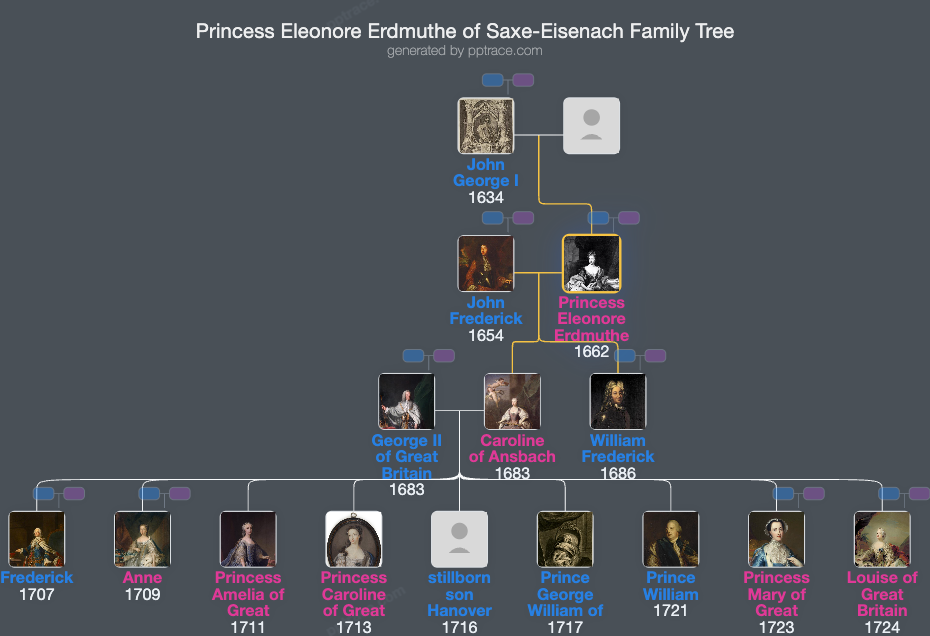
Family Tree
Tap  to expand more relatives
Introduction
Princess Eleonore Erdmuthe Louise of Saxe-Eisenach was born on 13 April 1662 and died on 9 September 1696. She was a member of the House of Wettin, the ruling dynasty of her family. Her parents were John George I, Duke of Saxe-Eisenach, and Countess Johannetta of Sayn-Wittgenstein. She was the eldest of eight children, of whom four siblings survived to adulthood, including Frederick August, Hereditary Prince of Saxe-Eisenach; John George II, Duke of Saxe-Eisenach; John William III, Duke of Saxe-Eisenach; and Fredericka Elisabeth, who became Duchess of Saxe-Weisselfels through marriage.
In Eisenach, she married firstly John Frederick, Margrave of Brandenburg-Ansbach, on 4 November 1681. This marriage made her Margravine of Brandenburg-Ansbach from 1681 until her husband's death in 1686. John Frederick was her second husband. After his death on 22 March 1686, the government of Brandenburg-Ansbach was administered by her stepson, Christian Albert, who was the eldest surviving son from her husband's first marriage. Christian Albert was a minor at the time and ruled under a regency. Due to tensions with her stepchildren, Eleonore and her children moved to Crailsheim and later returned to Eisenach. Her children were sent to Berlin, where they became companions to Frederick William, Electoral Prince of Brandenburg. In November 1691, Eleonore moved to Berlin to participate in negotiations related to her second marriage.
On 17 April 1692, in Leipzig, Eleonore married secondly John George IV, Elector of Saxony. Following this marriage, she moved to Dresden with her children. The marriage was arranged partly to secure political alliances and to end the liaison between John George IV and his mistress Magdalene Sibylle "Billa" of Neidschutz. The union was characterized by marital difficulties, with John George IV living openly with his mistress and the couple suffering two miscarriages and a phantom pregnancy. Rumors circulated suggesting that their marriage was not legitimate, as John George IV was allegedly already married to Billa at the time of his wedding with Eleonore. In response, John George IV claimed that any agreement with Billa was not a formal marriage. Throughout their marriage, John George IV sought to legitimize his relationship with Billa and attempted to extricate himself from his marriage with Eleonore. Consequently, she left Dresden for Pretzsch, fearing for her safety and that of her children.
John George IV died on 27 April 1694 from smallpox, having been infected by Billa, who was also dying at the time. Following his death, Frederick Augustus I, Elector of Saxony, allowed Eleonore and her children to remain in Pretzsch. Eleonore lived there until her death in 1696 and was subsequently buried at Freiberg Cathedral.
Her children included Wilhelmina Charlotte Caroline of Brandenburg-Ansbach, who married George II of Great Britain; William Frederick, Margrave of Brandenburg-Ansbach; and Frederick Augustus, Margrave of Brandenburg-Ansbach, who was born and died in infancy. After Eleonore's death, her children were sent to the court of their half-brother George Frederick II at Brandenburg-Ansbach. Her son William Frederick later inherited the Margraviate in 1703, and her daughter Caroline was raised at Charlottenburg Palace under the care of Frederick III, Elector of Brandenburg, and his wife, Sophia Charlotte of Hanover.
Her lifespan includes her birth in 1662 and her death in 1696, with her activities centered around her marriages, her role as Electress of Saxony, and her efforts to secure her children's future within the complex political landscape of late 17th-century German principalities.