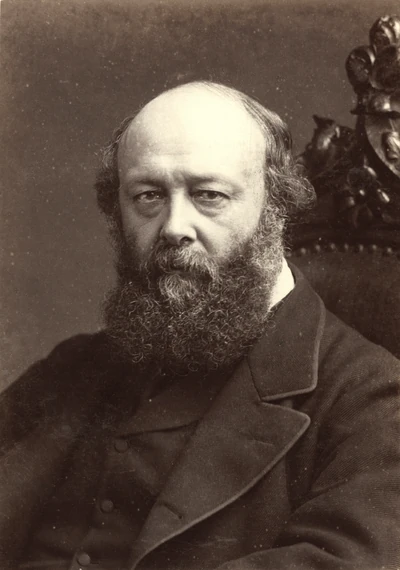
Robert Gascoyne-Cecil, 3rd Marquess Of Salisbury
| Name | Robert Gascoyne-Cecil, 3rd Marquess Of Salisbury |
| Title | British politician and prime minister (1830-1903) |
| Gender | Male |
| Birthday | 1830-02-03 |
| nationality | United Kingdom of Great Britain and Ireland |
| Source | https://www.wikidata.org/wiki/Q243705 |
| pptrace | View Family Tree |
| LastUpdate | 2025-11-26T23:30:22.384Z |
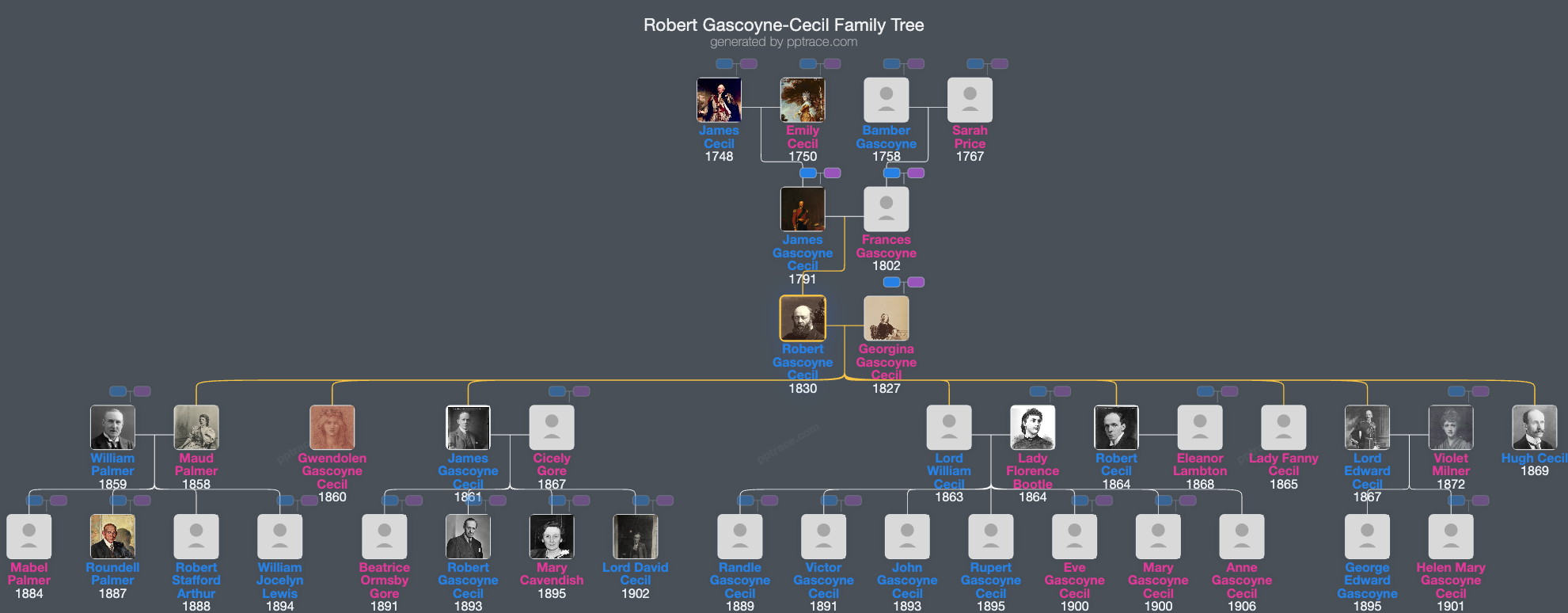
Family Tree
Tap  to expand more relatives
Introduction
Robert Arthur Talbot Gascoyne-Cecil, 3rd Marquess of Salisbury (3 February 1830 – 22 August 1903), was a British politician associated with the Conservative Party. Known commonly as Lord Salisbury, he served as Prime Minister of the United Kingdom in three separate terms, totaling over thirteen years. Prior to his premierships, Salisbury also held the position of Foreign Secretary for most of his political career.
Born at Hatfield House, Salisbury was the third son of the 2nd Marquess of Salisbury and Frances Mary Gascoyne. His family possessed extensive rural estates in Hertfordshire and Dorset, which contributed to their considerable wealth. His ancestry included prominent figures such as Lord Burghley and the 1st Earl of Salisbury, who served as chief ministers to Queen Elizabeth I.
Salisbury's early life was marked by an unhappy childhood, characterized by limited social connections and rigorous bullying at school. In 1840, he commenced education at Eton College, where he excelled academically but left in 1845 due to persistent bullying. He then attended Christ Church, Oxford, beginning in 1847, where he gained an honorary fourth-class degree in Mathematics owing to health issues. During his time at Oxford, Salisbury was influenced by the Oxford movement or "Tractarianism" and participated actively in the Oxford Union, serving as its secretary and treasurer. In 1853, he was elected a prize fellow of All Souls College.
In 1850, Salisbury joined Lincoln's Inn to study law but found the discipline unfulfilling. His health prompted him to travel extensively between 1851 and 1853, visiting regions such as Cape Colony, Australia—including Tasmania—and New Zealand. His observations during these travels included assessments of governance and indigenous populations. Notably, he viewed the Boer settlers negatively, believing self-governance for the Cape Colony was impractical due to demographic imbalances, and expressed admiration for the Māori in New Zealand as an "intellectual race," while criticizing their lack of theism.
Salisbury entered the House of Commons as a Conservative MP for Stamford in 1853. He served in this capacity until succeeding to his father’s peerages in 1868, after which he sat in the House of Lords. Throughout his parliamentary career, Salisbury was an outspoken critic of the foreign policy of Lord John Russell, advocating for a cautious and non-interventionist approach. He contributed numerous articles to the Saturday Review, the Quarterly Review, and the Standard, often anonymously, shaping conservative public opinion.
As a politician, Salisbury was involved in key government positions. He served as Secretary of State for India initially from 1866 to 1867 under Lord Derby, and again from 1874 under Benjamin Disraeli. In 1878, he became Foreign Secretary, participating notably in the Congress of Berlin. Following Disraeli’s death in 1881, Salisbury emerged as the Conservative leader in the House of Lords.
His first term as Prime Minister began in June 1885, succeeding William Ewart Gladstone. His government opposed Irish Home Rule and sought to expand British territorial holdings in Africa during the Scramble for Africa, avoiding war with other powers. He served as Prime Minister until January 1886, when Gladstone's government, which included Irish nationalists, took office.
Salisbury returned to the premiership in 1895 after the Conservatives' electoral victory. His tenure included overseeing Britain’s victory in the Second Boer War (1899–1902). In 1902, he transferred the office to his nephew, Arthur Balfour, and died the following year.
Throughout his leadership, Salisbury was recognized for his proficiency in foreign affairs and his commitment to conservative principles. Historians have ranked him among the upper tier of British prime ministers, noting his influence on foreign policy and his participation in shaping late 19th-century British politics.