Lord Edward Cecil
| Name | Lord Edward Cecil |
| Title | British Colonial administrator (1867–1918) |
| Gender | Male |
| Birthday | 1867-07-12 |
| nationality | South Africa |
| Source | https://www.wikidata.org/wiki/Q6679208 |
| pptrace | View Family Tree |
| LastUpdate | 2025-11-26T23:30:27.503Z |
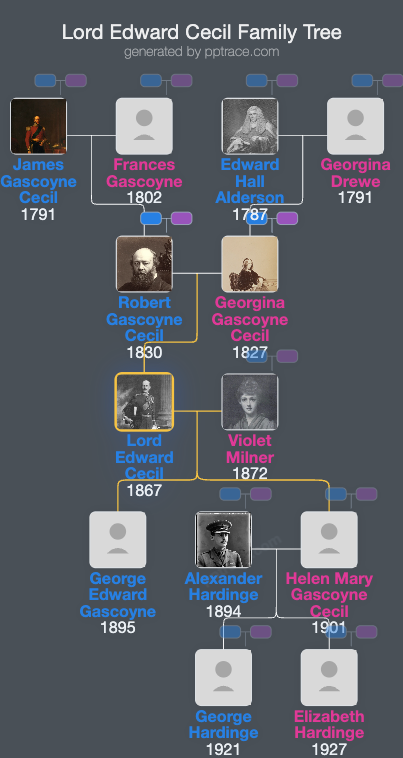
Family Tree
Tap  to expand more relatives
Introduction
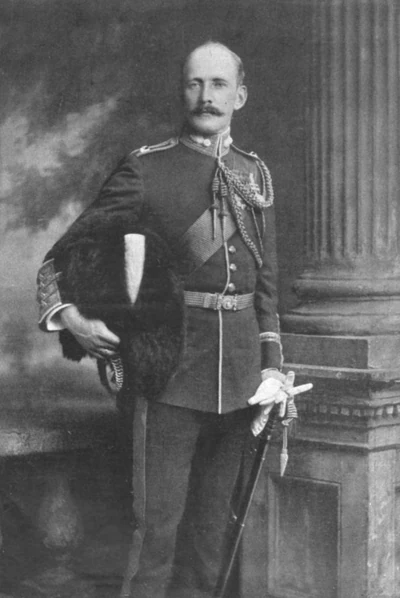
Lord Edward Herbert Gascoyne-Cecil (12 July 1867 – 13 December 1918), commonly known as Lord Edward Cecil, was an English military officer and colonial administrator. He was born in London, the fourth son of Robert Gascoyne-Cecil, 3rd Marquess of Salisbury, and Georgina Charlotte. His father designated the Earl of Carnarvon as his godfather upon his birth.
He attended Eton College but did not perform well academically and did not gain admission to the Royal Military College, Sandhurst. During his youth, his family colloquially referred to him as "Nigs," a nickname mentioned in correspondence by his mother. At age 11, Lord Edward authored a play on "The Eastern Question," based on his father's diplomatic papers, with a tone that reflected anti-Beaconsfield sentiments, and depicted Prime Minister Benjamin Disraeli as Dickens' 'Artful Dodger'.
In 1887, he was commissioned as a Second Lieutenant in the Grenadier Guards. He served in the regiment for four years before being promoted to First Lieutenant and joining the staff of Field Marshal Garnet Wolseley. During the 1896 Dongola Expedition in Egypt and Sudan, he served with distinction, being mentioned in despatches, promoted to Brevet Major, and awarded the Order of Medjidie 4th Class and the Khedive's Star with two clasps. He acted as aide-de-camp to Lord Kitchener during the Egyptian campaign of 1896, an experience that significantly influenced his career.
In 1897, Lord Edward was part of the Rodd Mission to Ethiopia, negotiating the Anglo-Ethiopian Treaty of 1897 with Emperor Menelik II. The following year, he participated in the Fashoda Incident, an international crisis involving a French expedition claiming territory in the White Nile region but ultimately leading to French withdrawal. Lord Edward arrived at Fashoda with Kitchener’s expeditionary force, and the confrontation was resolved in favor of British interests.
He took part in the Nile Expedition, which resulted in the annexation of Darfur and parts of Southern Sudan. He was promoted for his service at the Battle of Atbara and in the recapture of Khartoum during the Mahdist War, being mentioned in despatches and earning two clasps. Lord Edward was present at the Battle of Omdurman.
In the Second Boer War, Cecil was appointed Chief Staff Officer under Colonel Baden-Powell at Mafeking during the 1899–1900 siege. He played a crucial role in provisioning and military preparations during the siege, which lasted for nearly seven months. He established the Mafeking Cadet Corps, a precursor to Boy Scouts. During the siege, he contracted fever and was hospitalized. The relief of Mafeking was celebrated widely in Britain. After the siege, Cecil returned home in December 1900.
He continued his military career in South Africa, where he was involved in operations during the Second Boer War. Following the conflict, he was appointed Military Secretary to the Sirdar, Lord Kitchener, in Egypt in 1902.
Later, Cecil served as Agent-General to the Sudan Government and as Director of Intelligence in Cairo. He returned to Britain and joined the government service, holding positions such as Under-Secretary of War (from 1906), Under-Secretary of Finance (from 1907 to 1913), and Financial Advisor to the War Office (from 1912 to 1918). In 1915, he was awarded the Grand Cordon of the Order of the Nile.
Lord Cecil contracted tuberculosis and spent his final year receiving treatment in Switzerland, where he died on 13–14 December 1918.
He married Violet Georgina Maxse on 18 June 1894; she was the daughter of Admiral Frederick Augustus Maxse. The marriage was reportedly unhappy, and the couple had a son and a daughter. Their son, George Edward Gascoyne-Cecil, born in 1895, served as a second lieutenant in the Grenadier Guards and was killed in 1914 during World War I. Their daughter, Helen Mary Gascoyne-Cecil, born in 1901, became an author and married Alexander Hardinge, 2nd Baron Hardinge of Penshurst.