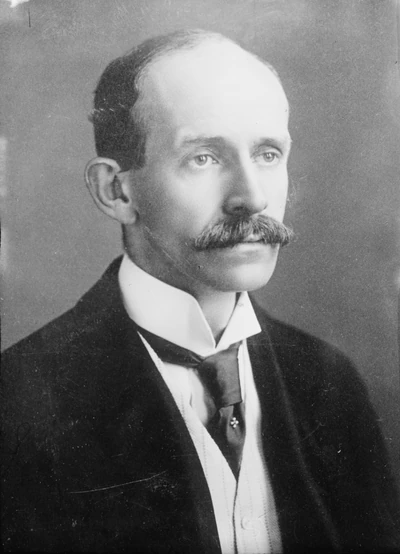
Hugh Cecil, 1st Baron Quickswood
| Name | Hugh Cecil, 1st Baron Quickswood |
| Title | British politician (1869-1956) |
| Gender | Male |
| Birthday | 1869-10-14 |
| nationality | United Kingdom |
| Source | https://www.wikidata.org/wiki/Q334182 |
| pptrace | View Family Tree |
| LastUpdate | 2025-11-26T23:30:23.325Z |
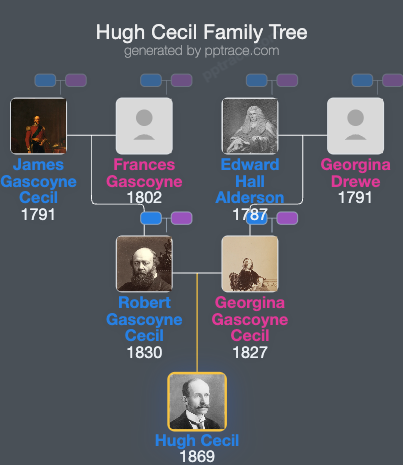
Family Tree
Tap  to expand more relatives
Introduction
Hugh Richard Heathcote Gascoyne-Cecil, 1st Baron Quickswood, PC, was born on October 14, 1869, and died on December 10, 1956. He was a British Conservative Party politician and was known until 1941 as Lord Hugh Cecil.
He was the youngest of eight children of Robert Gascoyne-Cecil, 3rd Marquess of Salisbury, who served as Prime Minister of the United Kingdom three times, and Georgina Alderson, daughter of Sir Edward Hall Alderson. Hugh Cecil’s siblings included James Gascoyne-Cecil, 4th Marquess of Salisbury; Lord William Cecil; Lord Cecil of Chelwood; and Lord Edward Cecil. He was also a first cousin of Prime Minister Arthur Balfour.
Hugh Cecil received his early education at Eton College and subsequently attended University College, Oxford. In 1891, he graduated with first-class honours in Modern History. Following his graduation, he was a fellow of Hertford College, Oxford, a position he held from 1891 until 1936. His fellowship was discontinued when he decided not to serve as Provost of Eton College while also being a Fellow of Hertford.
In 1891, he entered political service working in parliament. He served as Assistant Private Secretary to his father, then Foreign Secretary, from 1891 to 1892. After paying his subscription, Cecil was awarded his Master of Arts degree in 1894. He became the Member of Parliament (MP) for Greenwich in 1895 as a member of the Conservative Party.
Cecil was actively involved in ecclesiastical debates, supporting the interests of the Church of England. He expressed the view that religious cooperation between the Church of England and nonconformists was essential for resolving religious disputes, and he advocated for the upbringing of children in the religious beliefs of their parents. During the passage of Balfour's Education Bill of 1902, he objected to amendments granting school managers control over religious education in church schools, emphasizing the importance of church authority.
He was known among his peers as "Linky" and was a leading figure among the Hughligans, a group of young Conservative MPs critical of party leadership. The group included notable figures such as F. E. Smith, Arthur Stanley, Ian Malcolm, and Winston Churchill up until 1904. Cecil was the best man at Churchill's wedding in 1908. Churchill admired Cecil’s oratorical skills, citing them as superior to his own.
Cecil opposed Joseph Chamberlain’s tariff reform policies, advocating against the devaluation of the empire’s economic principles. This stance contributed to his defeat at Greenwich in the 1906 general election. In 1910, he was elected MP for Oxford University, a seat he held for 27 years.
Throughout his parliamentary career, Cecil opposed key legislative initiatives such as the Ministerial Veto Resolutions, the Parliament Bill of 1911, and the Welsh Church Bill. He also criticized the 1914 Home Rule Bill, describing Ireland’s status as one of reduced sovereignty.
During World War I, he served as a Lieutenant in the Royal Flying Corps. In 1916, he participated in the Mesopotamia Commission of Inquiry. He was sworn into the Privy Council on January 16, 1918. He also engaged in debates critical of government treatment of military personnel, notably General Trenchard in 1918.
Cecil was a devout Anglican, serving on the House of Laity of the Church Assembly from 1919. He received a Doctorate of Civil Law from Oxford in 1924. He was an advocate for leniency towards conscientious objectors during the war and sought to reduce their legal disabilities, although unsuccessfully.
In 1937, Cecil retired from the House of Commons upon appointment as Provost of Eton College, a role he held until 1944. He was created Baron Quickswood on January 25, 1941, with the peerage title of Quickswood, of Clothall in Hertford County. He also served as a trustee of the London Library and received honorary degrees from multiple universities, including Doctor of Laws from Durham, Edinburgh, and Cambridge. From 1944 until his death, he maintained an honorary association with New College, Oxford.
He never married. Hugh Cecil died on December 10, 1956, at the age of 87, at which point his barony became extinct.