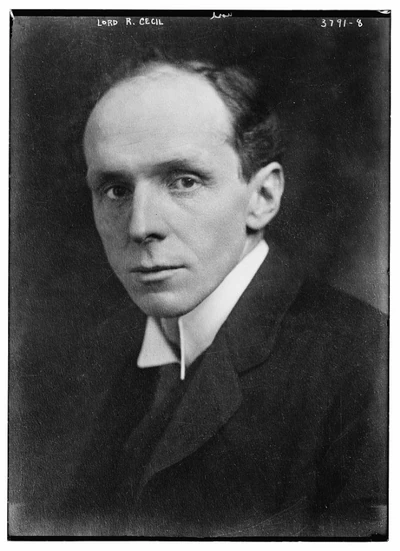
Robert Cecil
| Name | Robert Cecil |
| Title | lawyer, politician and diplomat in the United Kingdom (1864-1958) |
| Gender | Male |
| Birthday | 1864-09-14 |
| nationality | United Kingdom |
| Source | https://www.wikidata.org/wiki/Q12702 |
| pptrace | View Family Tree |
| LastUpdate | 2025-11-26T23:30:25.003Z |
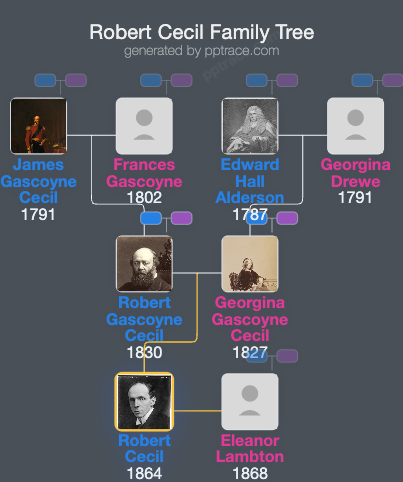
Family Tree
Tap  to expand more relatives
Introduction
Edgar Algernon Robert Gascoyne-Cecil, 1st Viscount Cecil of Chelwood (14 September 1864 – 24 November 1958), was a British lawyer, politician, and diplomat. He was born at Cavendish Square, London, as the sixth child and third son of Robert Gascoyne-Cecil, 3rd Marquess of Salisbury, and Georgina, daughter of Sir Edward Hall Alderson. His family had notable political connections; his brother was James Gascoyne-Cecil, 4th Marquess of Salisbury, and he was a cousin of Arthur Balfour.
Cecil was educated at home until age thirteen, followed by four years at Eton College. He studied law at University College, Oxford, where he was recognized as a prominent debater. His initial professional role was as a private secretary to his father during his tenure as prime minister from 1886 to 1888. In 1887, Cecil was called to the bar by the Inner Temple. He married Lady Eleanor Lambton, daughter of George Lambton, 2nd Earl of Durham, on 22 January 1889.
He practiced civil law, including work in Chancery and parliamentary law, from 1887 to 1906. On 15 June 1899, he was appointed Queen's Counsel. During the Second Boer War, he enrolled as a recruit in the Inns of Court Rifles in February 1900 but did not participate in active combat. He contributed to the legal literature with a book titled *Principles of Commercial Law*. In 1910, he was appointed to the General Council of the Bar and became a Bencher of the Inner Temple. The following year, he was appointed Chairman of the Hertfordshire Quarter Sessions.
Cecil held firm beliefs in free trade, opposing Joseph Chamberlain's advocacy of Tariff Reform. He expressed concerns about the alliance of imperialism and protectionist policies. In the 1906 general election, he was elected as a Conservative Member of Parliament representing Marylebone East. He maintained his free-trade stance and was involved in discussions advocating for its preservation within the Unionist party. Although he did not contest the Marylebone seat in 1910, he unsuccessfully ran in Blackburn and Wisbech that year.
In 1911, Cecil was elected as the Member of Parliament for Hitchin, Hertfordshire, as an Independent Conservative, serving until 1923. During World War I, he worked for the Red Cross and was appointed Vicar-General to the Archbishop of York, reflecting his religious convictions and pacifist stance. Following the formation of the 1915 coalition government, he was appointed Parliamentary Under-Secretary of State for Foreign Affairs on 30 May 1915, and was sworn into the Privy Council on 16 June. He was promoted to Assistant Secretary in 1918–19 and served as Minister of Blockade from 23 February 1916 to 18 July 1918, developing procedures to apply economic pressure against Germany.
Postwar, Cecil was awarded an Honorary Fellow and an Honorary Doctorate of Civil Law from University College, Oxford. He played a significant role in the early development of the League of Nations. In September 1916, he circulated a memorandum advocating alternative methods to war for resolving international disputes, emphasizing peaceful procedures and sanctions, and later articulated proposals for maintaining peace post-World War I. He was instrumental in forming committees to consider League proposals and presented ideas to President Woodrow Wilson and the American government.
Cecil's advocacy included advocating for international conference systems and collective sanctions, with the aim of preventing future conflicts. He resigned from the British government in late 1918 over Welsh disestablishment but continued his efforts to promote the League of Nations outside parliamentary service. In December 1918, he was appointed head of the League of Nations section at the Foreign Office. His work contributed significantly to the conceptual foundation of the League, and he was recognized as a key British architect of the organization. He was awarded the Nobel Peace Prize in 1937 for his efforts in promoting peace through the League of Nations.