James Gascoyne-Cecil, 4th Marquess Of Salisbury
| Name | James Gascoyne-Cecil, 4th Marquess Of Salisbury |
| Title | British politician (1861-1947) |
| Gender | Male |
| Birthday | 1861-10-23 |
| nationality | United Kingdom |
| Source | https://www.wikidata.org/wiki/Q4381482 |
| pptrace | View Family Tree |
| LastUpdate | 2025-11-26T23:30:25.863Z |
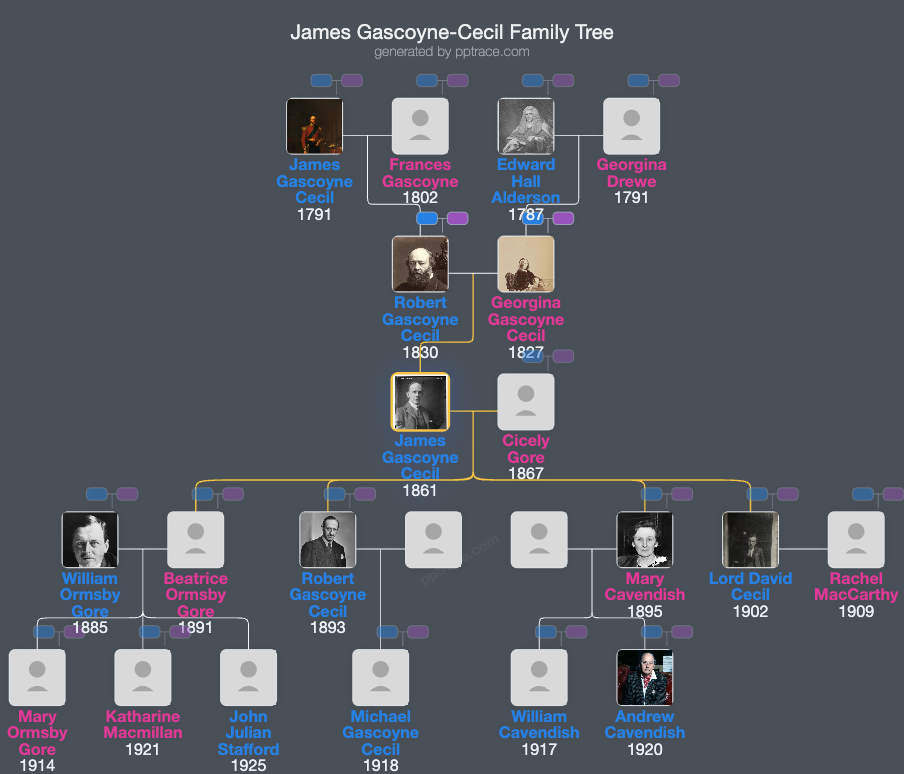
Family Tree
Tap  to expand more relatives
Introduction
James Edward Hubert Gascoyne-Cecil, 4th Marquess of Salisbury, was born on October 23, 1861, in London. He was the eldest son of Robert Gascoyne-Cecil, 3rd Marquess of Salisbury, who served as Prime Minister of the United Kingdom, and Georgina (née Alderson). His family included younger brothers: The Right Reverend Lord William Cecil, Lord Cecil of Chelwood, and Lord Quickswood, as well as a first cousin, Arthur Balfour, who also served as Prime Minister.
He received his education at Eton College and University College, Oxford, graduating with a Bachelor of Arts degree in 1885.
During his early years, Gascoyne-Cecil accompanied his father to the Constantinople Conference (1876–1877) and the Congress of Berlin (1878). His political career began when he sat as a Conservative Member of Parliament for Darwen, representing North-East Lancashire from 1885 until 1892; he lost the seat in the 1892 general election. Subsequently, he was elected as MP for Rochester in a by-election in 1893, serving until 1903, when he succeeded his father, and was elevated to the House of Lords.
On October 29, 1892, Lord Cranborne was appointed lieutenant-colonel of the 4th (Militia) Battalion of the Bedfordshire Regiment, formerly the Hertfordshire Militia. His father held the position of Honorary Colonel. He commanded the battalion during its active service in South Africa from March to November 1900, during the Second Boer War. The battalion, consisting of 24 officers and 483 men, departed from Queenstown aboard the transport Goorkha on February 27, 1900, arriving in Cape Town the following month. For his service, he was awarded the Queen's South Africa Medal and appointed a Companion of the Order of the Bath (CB). In July 1902, he received the Honorary Freedom of Hertford Borough as recognition of his military service.
He maintained a military role during World War I, commanding the 61st (2nd South Midland) Division in the UK from September 1915 to December 1916. Additionally, he was involved with the Hertfordshire Volunteer Regiment as Colonel during wartime and served as Honorary Colonel of the 86th (East Anglian) (Hertfordshire Yeomanry) Field Regiment, Royal Artillery, and of the 48th (South Midland) Divisional Engineers of the Territorial Force.
Gascoyne-Cecil served in several governmental roles. He was an ADC (Aide-de-Camp) to King Edward VII and King George V until 1929. From 1900 to 1903, he was Parliamentary Under-Secretary of State for Foreign Affairs. He served as Lord Privy Seal from 1903 to 1905, and as Lord President of the Board of Trade in 1905. In 1903, he was sworn into the Privy Council. In December 1908, he was appointed a deputy lieutenant of Hertfordshire. He was involved in the opposition to the People's Budget and the Parliament Bill of 1911.
He commanded the Territorial Force's 61st Division (2nd South Midland) in the UK from September 1915 to December 1916. He maintained active involvement with the Territorial Army, holding honorary colonelcies of the Hertfordshire Yeomanry's Field Regiment and the 48th Divisional Engineers. In 1917, he was appointed a Knight of the Garter.
During the 1920s, he held office under Prime Ministers Bonar Law and Stanley Baldwin. He was Chancellor of the Duchy of Lancaster from 1922 to 1923, Lord President of the Council from 1922 to 1924, Lord Privy Seal from 1924 to 1929, and Leader of the House of Lords from 1925 to 1929. He resigned as leader of the Conservative peers in June 1931.
He opposed Indian Home Rule and was involved in deputations to Prime Minister Stanley Baldwin and Chancellor Neville Chamberlain in 1936 concerning British rearmament amidst the rising threat from Nazi Germany. Gascoyne-Cecil served as Lord High Steward at the coronation of King George VI and Queen Elizabeth in 1937.
On May 17, 1887, he married Lady Cicely Alice Gore, second daughter of Arthur Gore, 5th Earl of Arran. She served as a Lady of the Bedchamber to Queen Alexandra from 1907 to 1910 and was appointed an Officer of the Order of St John of Jerusalem and Justice of the Peace for Hertfordshire. They had four children: Lady Beatrice Edith Mildred Gascoyne-Cecil (1891–1980), Robert Arthur James Gascoyne-Cecil, 5th Marquess of Salisbury (1893–1972), Lady Mary Alice Gascoyne-Cecil (1895–1988), and Lord Edward Christian David Gascoyne-Cecil (1902–1986).
James Gascoyne-Cecil died on April 4, 1947, at the age of 85. His eldest son succeeded him as the 5th Marquess of Salisbury. Lady Cicely Gascoyne-Cecil died in February 1955. The Marquess was the grandfather of actor Jonathan Cecil through his youngest son, Lord David Cecil.