Maud Palmer, Countess Of Selborne
| Name | Maud Palmer, Countess Of Selborne |
| Title | British political and women's rights activist |
| Gender | Female |
| Birthday | 1858-04-11 |
| nationality | — |
| Source | https://www.wikidata.org/wiki/Q19887415 |
| pptrace | View Family Tree |
| LastUpdate | 2025-11-26T23:30:26.684Z |
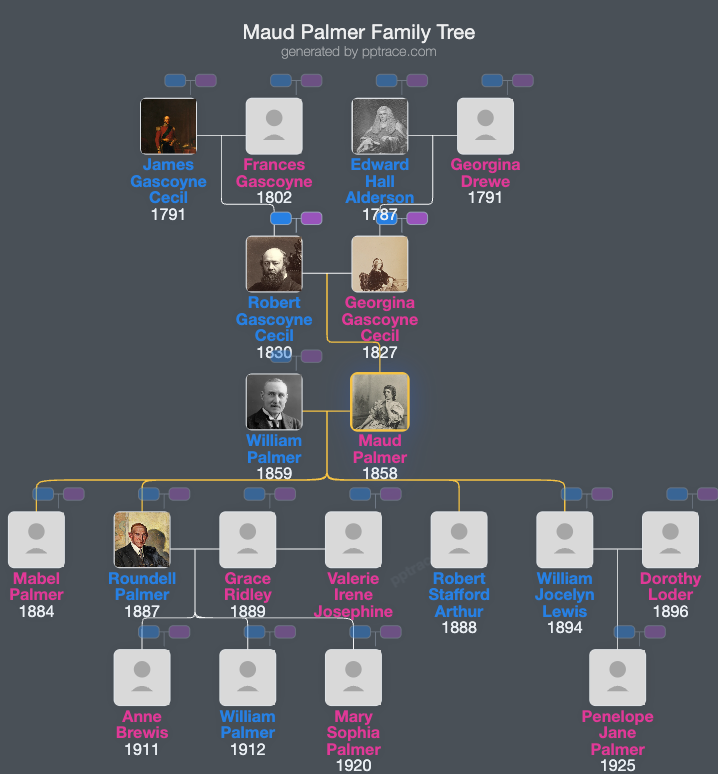
Family Tree
Tap  to expand more relatives
Introduction
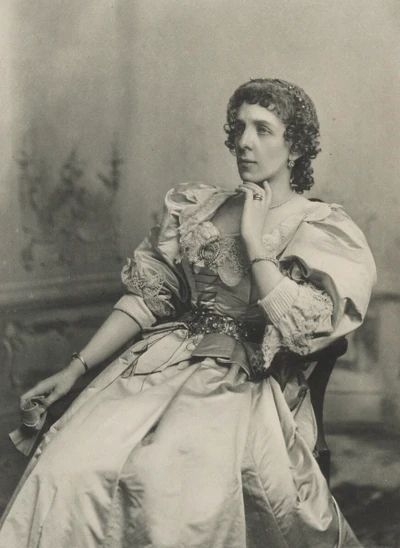
Beatrix Maud Palmer, Countess of Selborne (born Beatrix Maud Gascoyne-Cecil; 11 April 1858 – 27 April 1950), was a British figure involved in political and women's rights activities.
**Early Life and Family Background**
She was born in Marylebone, London. Her parents were Robert Gascoyne-Cecil, who later became Prime Minister of the United Kingdom, and Georgina Alderson. As the eldest child, she was not formally educated but developed an interest in conservatism and political affairs through her family connections and her involvement with the Primrose League, a conservative political organization.
**Marriage and Children**
In 1883, she married William Palmer, who was then styled as Viscount Wolmer. The couple had four children: three sons and one daughter. Their children included Lady Mabel Laura Georgiana Palmer (b. 1884), who married Charles Grey, 5th Earl Grey; Roundell Cecil Palmer (b. 1887), who became the 3rd Earl of Selborne; the Honorable Robert Stafford Arthur Palmer (b. 1888), who was killed in 1916 during military service; and Hon. William Jocelyn Lewis Palmer (b. 1894), who married Hon. Dorothy Cicely Sybil Loder. William Palmer succeeded as Earl of Selborne in 1895, following which she became the Countess of Selborne.
**Political Involvement and Women's Rights Activism**
Her husband was elected as a Liberal Member of Parliament in the 1885 general election, representing the Liberal Party. Although her initial political support was for the Conservative Party, she influenced her husband to shift towards the Liberal Unionist faction, which later aligned with the Conservative Party's right wing.
From 1905, William Palmer held various senior roles in South Africa, prompting the couple to relocate there. During this period, Maud engaged with local charities. Upon their return to the United Kingdom in 1910, she became president of the Conservative and Unionist Women's Franchise Association. In this capacity, she toured the country advocating for women's suffrage. Her initial stance prioritized voting rights for wealthy, single women, but she later supported enfranchisement for married women, contending that many married women held conservative views. She resigned from her position in 1913.
**World War I and Later Activities**
During World War I, her focus shifted to promoting patriotism within the country. After the war, she became a Justice of the Peace in Hampshire and served as president of the National Council of Women of Great Britain & Ireland during 1920–1921.
**Legacy and Memorials**
Her contribution to the women's suffrage movement is recognized through her inclusion on the plinth of the statue of Millicent Fawcett in Parliament Square, London, a monument unveiled in 2018 that commemorates 59 women's suffrage supporters.
The name Lady Selborne is associated with a place near Pretoria, South Africa, called Lady Selborne, which was established during the colonial era but was largely demolished during apartheid. Following reparations efforts, some former residents have reclaimed their land, though many received compensation instead.
**Death**
Beatrix Maud Palmer, Countess of Selborne, died on 27 April 1950.
**References**
[The original source and references are not listed here, but would typically include bibliographical citations in a full encyclopedia entry.]