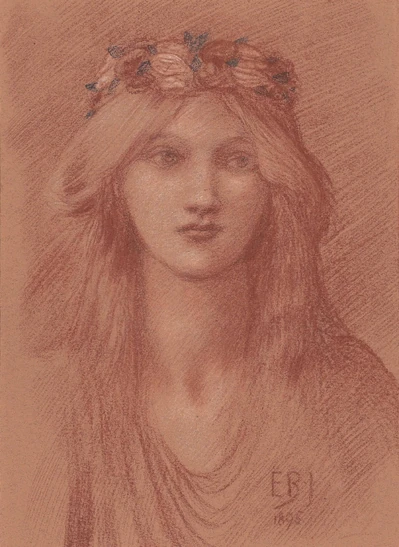
Gwendolen Gascoyne-Cecil
| Name | Gwendolen Gascoyne-Cecil |
| Title | noblewoman; British biographer (1860-1945) |
| Gender | Female |
| Birthday | 1860-07-02 |
| nationality | United Kingdom |
| Source | https://www.wikidata.org/wiki/Q19265353 |
| pptrace | View Family Tree |
| LastUpdate | 2025-11-26T23:30:24.244Z |
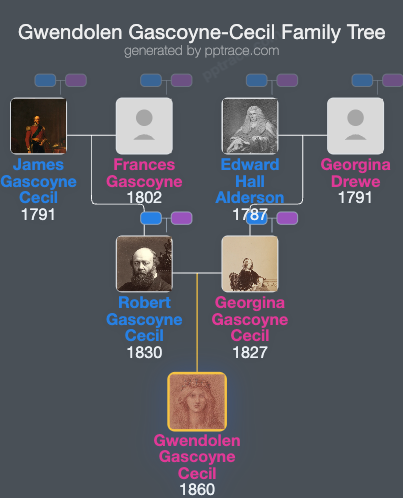
Family Tree
Tap  to expand more relatives
Introduction
Lady Gwendolen Georgiana Gascoyne-Cecil was born on July 3, 1860, in St Pancras, London. She was the second of seven surviving children of Robert Gascoyne-Cecil, the 3rd Marquess of Salisbury, and his wife, Georgina Alderson. She was baptized on July 28, 1860, at St Mary Magdalene church in Camden, London.
Her family was notable for its intellectual achievements. Her elder sister was Maud Palmer, Countess of Selborne, a suffragist. Her brothers included James Gascoyne-Cecil, the 4th Marquess of Salisbury, a British aristocrat and politician; Reverend Lord William Cecil, Bishop of Exeter; Robert Cecil, 1st Viscount Cecil of Chelwood, who was awarded the Nobel Peace Prize; Lord Edward Cecil, involved in military reform; and Hugh Cecil, 1st Baron Quickswood, also engaged in politics.
Lady Gwendolen engaged in literary work, most prominently authoring a four-volume biography of her father titled "Life of Robert, Marquis of Salisbury." The first two volumes were published in 1921 and received positive reviews. The third volume appeared in July 1931, covering the years 1880 to 1886, and provided insights into Lord Salisbury's family life and political career, including events such as Lord Randolph Churchill's resignation as Chancellor of the Exchequer. The fourth volume was published in December 1931, covering the years 1887 to 1892, with a focus on Salisbury’s foreign policy.
Aside from her biography, Lady Gwendolen authored a short story titled "The Little Ray" in the August 1894 edition of Pall Mall Magazine. She was also the revealed author of "The Closed Cabinet," a work initially considered anonymous, which gained recognition in 1895.
In 1878, she hosted British Prime Minister Benjamin Disraeli at her family home. Disraeli wrote to Queen Victoria praising her and her sister as "more intelligent and agreeable women."
Lady Gwendolen was recognized for her talents in mathematics and her intellectual pursuits. She passed away on September 28, 1945, at Hatfield House. Following her death, her sister-in-law Violet Milner, Viscountess Milner, eulogized her in a letter to The Times, highlighting her intellect, her zest for life and politics, and her compassionate nature. Milner described her as a central figure within her family, especially after her mother’s death, noting her kindness toward her nephews and nieces and her ability to bring comfort and insight to those around her.
Lady Gwendolen’s contributions to literature and her role within her aristocratic family are documented through her writings and the recollections of those who knew her.