Higashifushimi Kunihide
| Name | Higashifushimi Kunihide |
| Title | Titular head of the Higashifushimi-no-miya, an extinct branch of the Imperial House of Japan, and a Buddhist monk |
| Gender | Male |
| Birthday | 1910-05-16 |
| nationality | Japan |
| Source | https://www.wikidata.org/wiki/Q11525976 |
| pptrace | View Family Tree |
| LastUpdate | 2025-11-29T01:01:48.802Z |
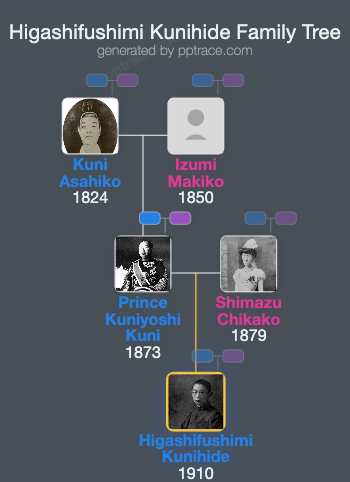
Family Tree
Tap  to expand more relatives
Introduction
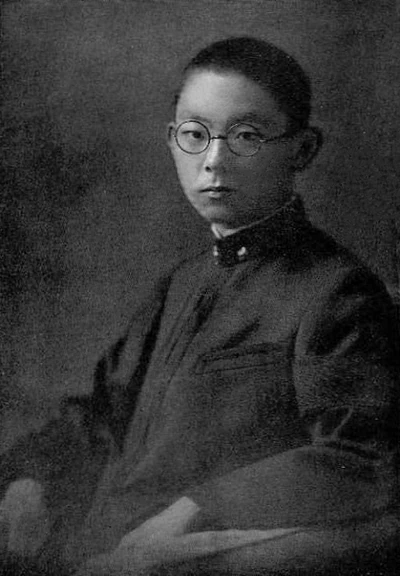
Count Higashifushimi Kunihide (東伏見 邦英; born Kuni Kunihide; 16 May 1910 – 1 January 2014) was a Japanese nobleman and Buddhist monk. He was the titular head of the Higashifushimi-no-miya, an extinct branch of the Imperial House of Japan. He was the youngest sibling of Empress Kōjun and the maternal uncle of Emperor Emeritus Akihito.
Born in 1910 as Prince Kuni Kunihide, he was the youngest son of Lieutenant Colonel Prince Kuniyoshi Kuni (1873–1929) and Shimazu Chikako (1879–1956). His paternal lineage traced to the Kuni-no-miya family, a cadet branch of the Imperial House of Japan. His paternal uncle was Admiral Prince Higashifushimi Yorihito, who headed the Higashifushimi-no-miya line. Since Hirohito, Emperor Showa, requested that members of the Higashifushimi line relinquish their imperial status to preserve the imperial family lineage, Kunihide was given to the custody of his great-uncle and his wife on 26 October 1919, although he was not formally adopted into the family.
In 1930, upon reaching the age of majority, he sat in the House of Peers as an imperial prince. The following year, the Emperor, his cousin, and his brother-in-law, requested that he relinquish his imperial status to perpetuate the Higashifushimi name. Consequently, he was ennobled as Count Higashifushimi and received the Grand Cordon of the Order of the Paulownia Flowers. He retained the title of count until October 1947, when the new post-war constitution abolished the kazoku peerage system and the aristocratic statuses of nobility and cadet branches of the imperial family were abolished.
He graduated from Kyoto Imperial University with a degree in history and subsequently served as a lecturer at the same university until 1952. That year, he took vows as a Buddhist priest at the Zenkō-ji daikanshin in Nagano. The following year, he became the abbot of Shōren'in Temple in Kyoto, affiliated with the Tendai tradition, adopting the Dharma name Jigō (慈洽). He earned a PhD in Asuka period art from Kyoto University in 1956.
In 1985, he was appointed chairman of the Kyoto Association of Buddhist Temples, a position he held until his death. As chairman, he opposed the imposition of a ¥50 temple admission fee by the city of Kyoto, asserting it was inconsistent with the principles of separation of church and state and religious freedom; the fee was subsequently repealed. In 2004, he passed the position of abbot of Shōren'in to his second son, Jiko Higashifushimi, becoming its emeritus abbot.
His wife, Yasuko, died on 29 September 2009 at the age of 91. Kunihide experienced health issues from 2006 due to orthostatic hypotension and was largely bedridden in his later years. He died on 1 January 2014 at the age of 103. As of 4 July 2012, when he surpassed Naruhiko Higashikuni in age, he was recognized as the longest-lived member of the Imperial House of Japan.