Princess Kuni Satoko
| Name | Princess Kuni Satoko |
| Title | (1906-1989) |
| Gender | Female |
| Birthday | 1906-09-01 |
| nationality | Japan |
| Source | https://www.wikidata.org/wiki/Q11439098 |
| pptrace | View Family Tree |
| LastUpdate | 2025-11-29T01:01:50.620Z |
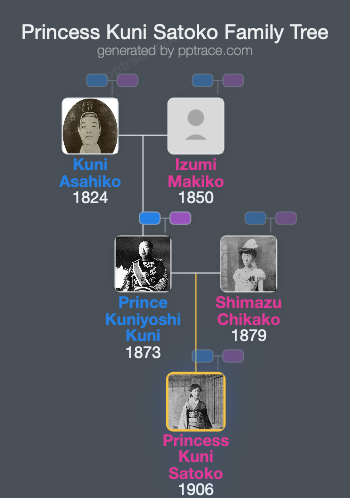
Family Tree
Tap  to expand more relatives
Introduction
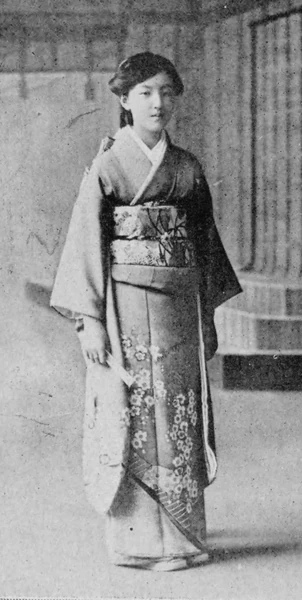
Tomoko Otani (Otani Satoko, September 1, 1906 – November 15, 1989) was a member of the Japanese imperial family and nobility. She was born as the third daughter (fifth child) of Prince Kunikuni and Princess Kuniko. She is known as the Countess Otani Mitsunaga, the 24th Head Priest of Higashi Hongan-ji, and served as a behind-the-scenes administrator of temple affairs. Her former title was Princess Satoko (Satoko Joō), and before leaving the imperial family, her court rank was princess. The honorific "Her Highness" (Denka) was used within the Imperial Household. She was the sister of Empress Shōjun and thus the aunt of Emperor Akihito (the 125th Emperor) and great-aunt of Emperor Naruhito (the 126th and current Emperor).
Life
Imperial Family Period
On September 1, 1906, at 7:30 pm, she was born in Kyoto Prefecture as the third daughter of Prince Kunikuni and Princess Kuniko. Seven days after birth, she was named "Satoko." The Kuni family she belonged to had many siblings and was not financially wealthy. Like her older sisters Princess Ryōko and Princess Nobuko, she spent her childhood together with them, developing deep affection for her sister. In February 1918 (Taishō 7), when Princess Ryōko was engaged to Crown Prince Hirohito, Satoko received education at the Imperial Palace's scholarly institution, studying alongside her sister and friends. However, she later reflected that a significant incident related to the engagement caused a somber atmosphere in her family.
At age 12, she became engaged to Otani Mitsunaga, a descendant of Shinran, the founder of Jōdo Shinshū Buddhism, and a hereditary head priest of Higashi Hongan-ji. She moved to Kyoto. After graduating from Kyoto Prefectural Daiichi High School (now Kyoto Prefectural Kamogawa High School), she married Mitsunaga on May 3, 1924. The wedding was grand, and photos of the ceremony are included in the photo album *Kuni no Miya Satoko Joō Tei no Daibu Nii no Rei Gaho* ("Young Princess Satoko of the Imperial Kuni Family, New Head Priest of Higashi Hongan-ji: Celebration Photographs").
Supporting Roles at Higashi Hongan-ji
The year after her marriage, her father-in-law, Mitsunaga's father Otani Mitsue, incurred enormous debts and was forced to resign as head priest. Consequently, in October 1925 (Taishō 14), Mitsunaga became the head priest. Satoko also took on the role of the chief lady of the temple, managing various temple affairs. At that time, she served as president of the Women's Dharma Talk Association, advocating for exemplary conduct among women. Her teachings reflected the prevailing values of the time and have sometimes been critiqued from modern perspectives.
In January 1938 (Showa 13), during Mitsunaga's visit to China to offer慰問 (慰問) (慰問)慰問 (慰問)慰問 (慰問)慰問 (慰問)慰問 (慰問)慰問 (慰問)慰問 (慰問)慰問 (慰問)慰問 (慰問)慰問 (慰問)慰問 (慰問)慰問 (慰問)慰問 (慰問)慰問 (慰問)慰問 (慰問)慰問 (慰問)慰問 (慰問)慰問 (慰問)慰問 during a trip to China, Satoko departed from Nagasaki to accompany him. While visiting China, she supported efforts to promote Japanese-Chinese friendship and activities of the Buddhist Women's Association, participating in events in Tianjin and Beijing. In Beijing, she met with Chen Baohui and sought cooperation in establishing a girls' school based on Buddhist spirit. Thus, she became involved in the founding of the Beijing Hoshō Girls' Middle School and served as its honorary principal. Her involvement as a former member of the imperial family in Sino-Japanese relations drew widespread attention.
In Manchuria and North China, Mitsunaga and Satoko conducted missionary visits and toured various sites, serving as honorary principal to promote exchanges between Japan and China. Notably, in October 1938, they participated in touring activities held in Manchuria and North China, promoting Buddhist exchanges.
Through her career, Satoko played a recognized role within the realms of religion and international exchange as a member of the Japanese imperial and noble classes.