Sanjōnishi Nobuko
| Name | Sanjōnishi Nobuko |
| Title | (1904-1945) |
| Gender | Female |
| Birthday | 1904-03-00 |
| nationality | Japan |
| Source | https://www.wikidata.org/wiki/Q29410798 |
| pptrace | View Family Tree |
| LastUpdate | 2025-11-29T01:01:51.490Z |
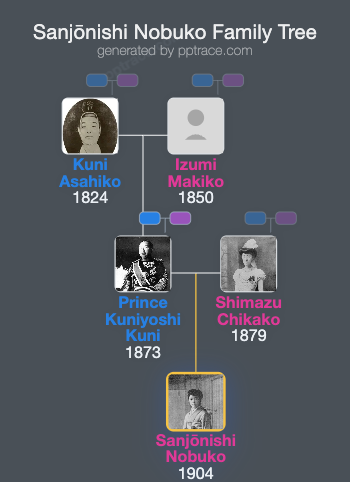
Family Tree
Tap  to expand more relatives
Introduction
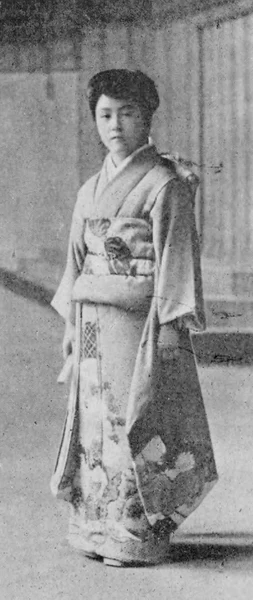
Sanjo Nishinobuko (さんじょうにし のぶこ, March 30, 1904 – November 8, 1945) was a member of the Japanese Imperial family and of noble descent. She was born as the second princess (fourth child) to Prince Kuni Kunihiko and his wife, Princess Yuko. Her former name was Princess Nobuko (信子女王). Before her departure from the Imperial family registry, her rank was princess, and the honorific used based on the Imperial Household Law was "Her Highness." She was the sister of Empress Kōjun (Herasen), and is the aunt of the 125th Emperor Akihito (Emperor Emeritus) and the great-aunt of the 126th Emperor Naruhito.
Life
On March 30, 1904, at 3 a.m., she was born in Tokyo City, which is present-day Tokyo, as the daughter of Prince Kuni Kunihiko and Princess Yuko. Four days after her birth, on April 5, she was named Nobuko. Although the Kuni family had many siblings, their financial circumstances were not particularly affluent. She was raised alongside her older sister, Princess Ryuko, and her younger sister, Princess Tomiko. She admired Princess Ryuko deeply and sometimes imitated her behavior.
In January 1918, when Princess Ryuko's engagement to Crown Prince Hirohito was announced, Princess Ryuko began her education at a study hall built within the Kuni residence. Nobuko and Princess Tomiko also received education alongside Princess Ryuko's classmates.
On December 9, 1924, Princess Nobuko married Count Kōsuke Sanjo Nishinomiya (1901–1984), a nobleman from the Count family. He was the eldest son of Count Sanjo Nishinomiya Sanjō. After marriage, she held the title of Countess Kōsuke Sanjo Nishinomiya.
On September 9, 1936, she was recommended and accepted as the chairperson of the Japan Women’s Association for Moral Improvement, a women’s educational organization. The following year, in 1937, she became its president. The organization was dissolved at the end of 1941 (Showa 16), and in February 1942 (Showa 17), it was merged into the Greater Japan Women's Association. During this period, she also served as an evaluator for the Central League for the Mobilization of the Spirit of the People, alongside Yayoi Yoshioka.
She died on November 8, 1945, at the age of 41. Following her death, members of the Imperial family, including Empress Kōjun, observed mourning rites.
Children
Princess Nobuko had several children:
- Eldest son: Sanjo Motohiro
- Eldest daughter: Shizuko (married Takasada Shijo)
- Second daughter: Hako (married Toshihiro Kinoshita)
- Second son: Kuni no Imayoshi (adopted son of Kuni no Kunihiko, and took the name Imayoshi)
- Her brother Kunihiko was the biological uncle of Imayoshi.
- Imayoshi's child includes Noriyoshi Kuni.
- Third daughter: Yoko (eldest son of Kitatama Takataka, wife of Hidetaka Kitajima)
- Fourth daughter: Sumiko
Genealogy and Honors
On November 17, 1924, she received the Order of the Rising Sun, Second Class, with the Paulownia Blossom (also known as the Order of the Crown).
References
- "History of the Evolution of the Japanese Women’s Association for Moral Improvement," Japan Women’s Association for Moral Improvement, 1942.
- "The Empress Dowager of Showa: Her Life of Love and Turmoil with Emperor Showa," Kobunsha, July 2000.
Notes
Related topics include the practice of Kado (flower arranging) and movements such as the National Spirit Mobilization Movement.