Kōjun
| Name | Kōjun |
| Title | Japanese empress |
| Gender | Female |
| Birthday | 1903-03-06 |
| nationality | Japan |
| Source | https://www.wikidata.org/wiki/Q230697 |
| pptrace | View Family Tree |
| LastUpdate | 2025-11-17T06:48:40.384Z |
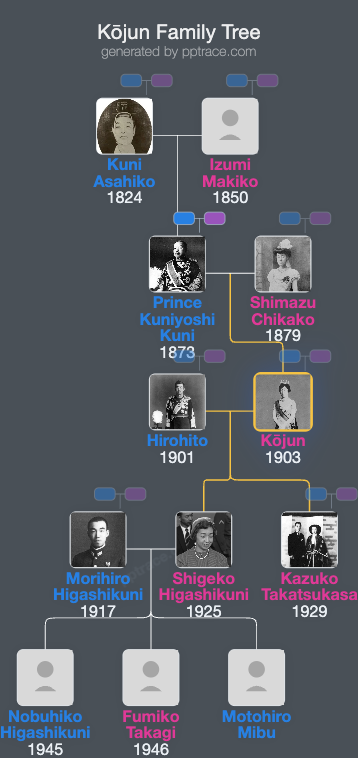
Family Tree
Tap  to expand more relatives
Introduction
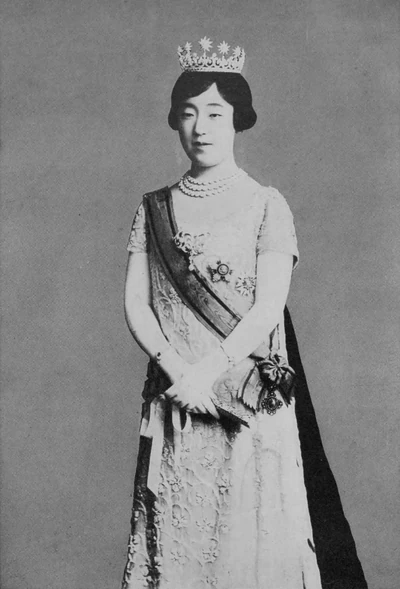
Nagako (良子; 6 March 1903 – 16 June 2000), posthumously honored as Empress Kōjun (香淳皇后, Kōjun Kōgō), was a member of the Imperial House of Japan. She was the wife of Emperor Hirohito and the mother of Emperor Emeritus Akihito. Nagako served as Empress of Japan from 1926 until her husband's death in 1989, holding the longest tenure among Japanese empress consorts in history.
Early Life
Princess Nagako was born on 6 March 1903 in the family residence of the Kuni-no-miya in Tokyo, Japan. She was a member of one of the Ōke cadet branches of the Imperial House of Japan, which were eligible to provide potential heirs to the throne through adoption. Her father was Kuniyoshi, Prince Kuni (1873–1929), and her mother was Chikako (1879–1956). Her father was a descendant of the imperial family, while her mother descended from daimyō, the feudal military aristocracy. Nagako was among the last to experience life within the aristocracy prior to World War II.
As a child, Nagako attended the Girls' Department of the Peers' School in Tokyo, now known as Gakushūin. This institution was established specifically for the daughters of the aristocracy and imperial family. Among her contemporaries was Yi Bangja, Crown Princess of Korea (then Princess Masako Nashimoto). At the age of fourteen, following her betrothal to the Crown Prince, Nagako was withdrawn from school and began a six-year training program designed to cultivate the accomplishments deemed essential for a future empress.
Marriage and Children
Nagako was betrothed at a young age to her distant cousin, Crown Prince Hirohito. The marriage was arranged by their parents, a common practice at the time, primarily considering her lineage and her father's military career. Hirohito was permitted to choose his bride independently, breaking with tradition, though Nagako had no influence over the decision. In 1917, at age 14, she participated in a tea ceremony at the Tokyo Imperial Palace, where Hirohito observed from behind a screen and ultimately selected her as his bride. Opposition from figures such as Prime Minister Yamagata Aritomo, from a rival clan, was reported due to concerns over her maternal relatives' health issues, including color blindness.
The engagement was officially announced in January 1919. During their six-year engagement, they met only nine times under supervision. Nagako married Crown Prince Hirohito on 26 January 1924, after which she became Crown Princess of Japan. Her marriage was delayed due to the 1923 Great Kantō earthquake and an assassination attempt on Hirohito. This union marked one of the last instances of a future empress marrying from a minor princely family traditionally providing brides for the imperial line.
She ascended to the position of Empress when Hirohito became Emperor on 25 December 1926. The couple had seven children—two sons and five daughters—with three predeceasing Nagako. Although courtiers urged Hirohito to take concubines due to the lack of a male heir, he remained monogamous. The birth of their son, Akihito, on 23 December 1933, was celebrated across Japan and was described by Nagako as "the happiest moment" in her life.
Empress Consort
As Empress, Nagako performed her ceremonial duties according to traditional protocols. She lived in the imperial palace during a period when the language spoken was archaic and attended key ceremonies such as the 2600th anniversary of Japan's legendary founding in 1940 and the conquest of Singapore in 1942. During World War II, she was largely confined within palace grounds and participated in tending to wounded generals and writing to families of war casualties. The family was relocated to an imperial air-raid shelter, and Nagako engaged in vegetable gardening and poultry raising. Her personal views on the war are not extensively documented, though she reportedly described it as "the hardest time of my life."
Following Japan's surrender, Nagako received English language lessons from American tutors and toured Japan to meet affected families and orphans. Her relationship with her son Akihito's wife, Michiko Shōda, was reported to be strained, partly due to differences in lifestyle and upbringing. Nagako was traditionalist, criticizing Michiko’s public breastfeeding and child-rearing practices, which led to tensions and a nervous breakdown for Michiko in 1963.
International Travel and Personal Interests
Nagako was the first Japanese empress consort to travel abroad, accompanying Hirohito on a European tour in 1971 and on a state visit to the United States in 1975. She was also known as a talented artist, signing her paintings as Toen or Peach Garden, with collections published during her lifetime. She presented a work to Queen Elizabeth II in 1971. Additionally, she enjoyed singing and played multiple musical instruments, including the piano, violin, and Japanese harp.
Later Life and Death
Nagako suffered a fall in July 1977 that injured her spine, followed by another serious fall that confined her to a wheelchair from 1980 onward. The last public event she attended was her husband's 86th birthday in April 1987. Upon Hirohito’s death on 7 January 1989, Nagako became empress dowager. Due to her declining health, she was in seclusion and unable to attend the funeral. She was confined to a wheelchair and was reported to possibly have suffered from dementia or Alzheimer’s disease.
In 1995, Nagako became the longest-living empress dowager of Japan, surpassing the longevity of Empress Kanshi from 868 years earlier. She died on 16 June 2000 at the age of 97, with her family present. The Imperial Household Agency announced her cause of death as "old age." Her death was followed by a national period of mourning and various public commemorations.