H. H. Asquith
| Name | H. H. Asquith |
| Title | Prime Minister of the United Kingdom from 1908 to 1916 |
| Gender | Male |
| Birthday | 1852-09-12 |
| nationality | United Kingdom |
| Source | https://www.wikidata.org/wiki/Q166714 |
| pptrace | View Family Tree |
| LastUpdate | 2025-11-26T23:31:20.774Z |
Family Tree
Tap  to expand more relatives
Introduction
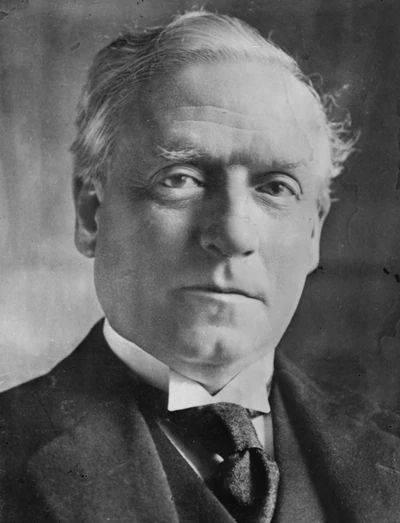
Herbert Henry Asquith, 1st Earl of Oxford and Asquith, born on 12 September 1852 in Morley, Yorkshire, and deceased on 15 February 1928, was a British politician affiliated with the Liberal Party. He served as Prime Minister of the United Kingdom from 1908 to 1916. He was the last Liberal Party Prime Minister to lead a majority government and the most recent Liberal to serve as Leader of the Opposition.
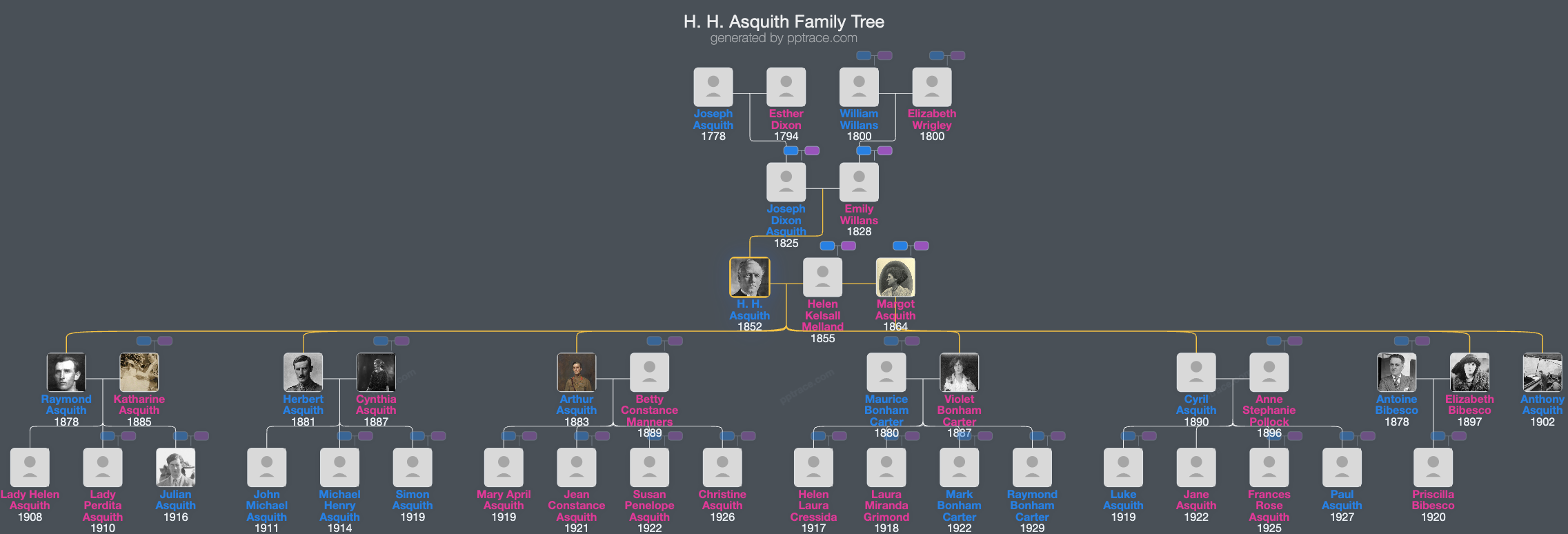
Asquith was the son of Joseph Dixon Asquith and Emily Willans. His family's background was rooted in Yorkshire's wool trade, with both families being middle-class, Congregationalist, and politically progressive. His father, Dixon Asquith, inherited the Gillroyd Mill Company, and his maternal family, the Willans, operated a successful wool-trading business in Huddersfield. Herbert and his siblings were educated at home until 1860, after which they attended Huddersfield College briefly before becoming boarders at Fulneck School near Leeds. Following the death of his father in 1864, Herbert was cared for by his uncle, John Willans, residing in London, an arrangement that disconnected him from his Yorkshire roots.
He later attended the City of London School, where he excelled academically, particularly in classics and English, and demonstrated early talent in oratory and debate. In November 1869, he secured a classical scholarship to Balliol College, Oxford, entering advanced studies in October 1870. At Oxford, Asquith was influenced by T. H. Green's liberal political philosophy and engaged actively in debating societies. He served as Treasurer and later President of the Oxford Union, known for his eloquence and rhetorical skill.
In 1874, he narrowly missed winning the Hertford and Ireland Prizes in classical studies but was awarded a special prize of books in recognition of his performance. He graduated from Oxford with distinguished academic credentials, which laid the foundation for his legal and political career.
Following university, Asquith pursued a legal career, becoming a barrister. He was elected Member of Parliament for East Fife in 1886, a seat he held for over thirty years. His political reputation grew rapidly, and in 1892, he was appointed Home Secretary in William Ewart Gladstone’s fourth ministry, serving until the Liberals lost power in 1895.
During the early 1900s, Asquith became a prominent figure within the Liberal Party. When Sir Henry Campbell-Bannerman became Prime Minister in 1905, Asquith was appointed Chancellor of the Exchequer. He succeeded Campbell-Bannerman as Prime Minister in 1908. His government implemented key liberal reforms and sought to reduce the powers of the House of Lords, which led to the passage of the Parliament Act of 1911.
His tenure as Prime Minister encompassed significant events, notably the onset of the First World War in 1914. He authorized the UK’s involvement following Germany’s invasion of Belgium. His leadership during the war included overseeing military mobilization and industrial strategy, but was criticized for strategic indecisiveness, particularly concerning the Gallipoli Campaign and munitions shortages. In 1915, he formed a coalition government with the Conservative and Labour parties but was unable to effectively manage wartime challenges. He was replaced by David Lloyd George in December 1916 and thereafter engaged in political rivalry.
Asquith’s role in establishing social reforms between 1906 and 1911 is notable, though his perceived weaknesses as a wartime leader have been emphasized by historians. His period as Prime Minister remains significant in British political history, characterized by the length of his continuous leadership during that era.
Early Life:
Asquith was born into an established Yorkshire family with a tradition of nonconformist religious beliefs and political radicalism. His family faced early tragedy with the death of his father when he was young, leading to his upbringing partly with relatives and academically excelling at the City of London School before attending Oxford.
Education:
He secured a classical scholarship to Balliol College, Oxford, where he studied starting in 1870. His university years included active participation in debating society, distinguished academic performance, and developing an interest in liberal political philosophy.