
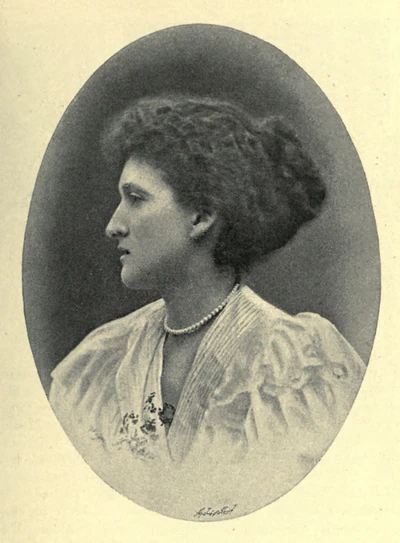
Margot Asquith
| Name | Margot Asquith |
| Title | British socialite, author and wit (1864-1945) |
| Gender | Female |
| Birthday | 1864-02-02 |
| nationality | United Kingdom |
| Source | https://www.wikidata.org/wiki/Q1396333 |
| pptrace | View Family Tree |
| LastUpdate | 2025-11-26T23:31:26.983Z |
Family Tree
Tap  to expand more relatives
Introduction
Emma Alice Margaret Asquith, Countess of Oxford and Asquith (née Tennant), was born on 2 February 1864 and died on 28 July 1945. She was a British socialite and author, known for her association with the aristocratic and intellectual group "The Souls" and for her marriage to British Prime Minister H. H. Asquith.
Early Life and Family Background:
Emma Tennant was born at The Glen, her family’s country estate in Peeblesshire. She was the twelfth and youngest child of Sir Charles Tennant, 1st Baronet, an industrialist and politician, and Emma Winsloe. She had five sisters and six brothers, of whom several died young. She was of Scottish and English descent and was a great-great-granddaughter of John Walter, founder of The Times newspaper. Raised at The Glen, she was described as a venturesome child, engaging in activities such as roaming the moors, climbing onto the roof at night, riding horses, and playing golf. Alongside her sister Laura, she was considered a prominent figure within “The Souls,” a social group of aristocratic intellectuals.
Marriage and Family:
On 10 May 1894, Emma Tennant married H. H. Asquith. The marriage integrated her into a prominent political and social sphere. She became a significant social influence, contrasting with her husband's earlier marriage to Hannah Tennant. Emma, known as Margot, became a stepmother to five of Asquith’s children and was the mother of her own two children, Elizabeth (born 1897) and Anthony (born 1902). Elizabeth married Prince Antoine Bibesco of Romania in 1919 and was a writer; Anthony became a film director. The Asquith family resided in a large house in Cavendish Square, London, with a staff of fourteen servants. In 1912, they acquired The Wharf in Sutton Courtenay, Oxfordshire, which served as their weekend retreat and intellectual gathering place.
Political Views and Activities:
H. H. Asquith served as Prime Minister from April 1908 to December 1916. Emma Asquith was publicly opposed to women's suffrage; she expressed dismissive opinions about women’s reasons for voting and was known to have been sarcastic toward suffragettes. She and her husband witnessed suffragette activity during holidays and events, including suffragette protests on their property. During her husband's tenure as Prime Minister, she attended debates on women's suffrage and was implicated in a notable incident where suffragettes followed the couple in Wales and at sea. During World War I, her outspoken remarks and visits to German POW camps, as well as accusations about her stepson Herbert’s sobriety, drew public criticism and may have contributed to her husband's political downfall. In 1918, she was publicly accused in court by MP Noel Pemberton Billing of associations with supposed homosexual conspirators, which drew further media attention.
Later Life and Titles:
In 1920, she moved from Cavendish Square to 44 Bedford Square. In 1925, her husband was granted a peerage, and she became the Countess of Oxford and Asquith. She authored her autobiography in 1920, which received mixed reviews and was subject to parody.
Writings:
Asquith published numerous works, including her autobiography, autobiographical volumes, personal impressions of America, and collected memories. Her 1920 autobiography, "The Autobiography of Margot Asquith," was part of a trend of contemporaneous, revelatory political literature. She also published "Marge Askinforit," a parody of her memoirs, and her diaries of the First World War, which were posthumously published in 2014 as "Margot Asquith's Great War Diary 1914–1916: The View from Downing Street."
Financial and Later Years:
By the late 1920s, Asquith and her husband faced financial difficulties, owing large sums and relying on support from friends and family. Her husband left her a modest inheritance, and she struggled financially, earning income through advising on interior design and promoting cigarette brands. She eventually resided in rooms at the Savoy Hotel and later in Thurloe Place, Kensington. Her final years were marked by the death of her daughter Elizabeth from pneumonia in 1945. Margot Asquith died three months later, in July 1945.
Her life was characterized by active social and political engagement, literary pursuits, and notable public controversies, with her autobiography and diaries serving as significant primary sources.
