Elizabeth Bibesco
| Name | Elizabeth Bibesco |
| Title | British writer, and Romanian princess |
| Gender | Female |
| Birthday | 1897-02-26 |
| nationality | United Kingdom |
| Source | https://www.wikidata.org/wiki/Q529558 |
| pptrace | View Family Tree |
| LastUpdate | 2025-11-26T23:31:22.450Z |
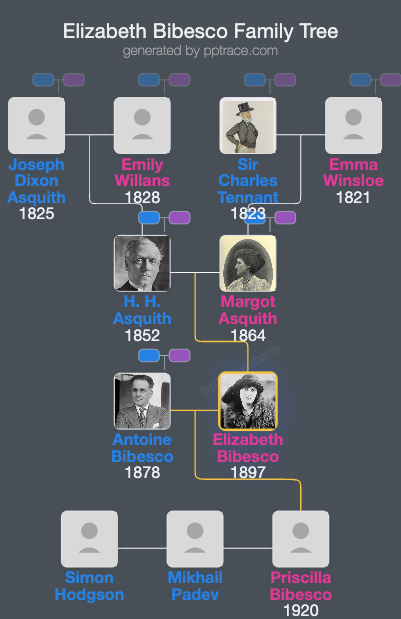
Family Tree
Tap  to expand more relatives
Introduction
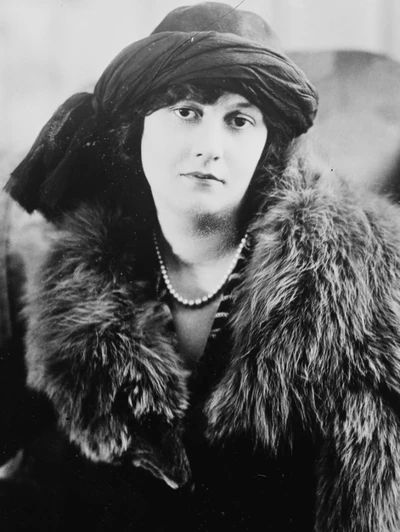
Elizabeth Charlotte Lucy Asquith, known as Elizabeth, Princess Bibesco, was born on February 26, 1897, and died on April 7, 1945. She was an English socialite, actress, and writer active primarily between 1921 and 1940.
She was the daughter of H. H. Asquith, who served as the Prime Minister of the United Kingdom from 1908 to 1916, and Margot Asquith, a writer. Elizabeth was the first child of her parents' second marriage. Her childhood included early exposure to public life and society, as detailed in her mother's autobiography published in 1920. She was described as a precocious child with an uncertain temper, and her early engagement with the arts and society was notable.
At age 12, she engaged with George Bernard Shaw, asking him to write a play for a charity benefit, resulting in his play "The Fascinating Foundling," which she directed at a young age. By age 14, The Times reported that she had made acquaintances in political circles and showed an interest in political matters. During World War I, she organized and performed in events to support servicemen and participated in acting in silent films, including D. W. Griffith's "Hearts of the World" and "The Great Love," in 1918.
On April 29, 1919, Elizabeth married Prince Antoine Bibesco, a Romanian diplomat and member of the House of Bibescu. The wedding took place at St. Margaret’s, Westminster, and was a significant social event attended by prominent figures including Queen Mary and George Bernard Shaw. After their marriage, the couple resided in Paris at a townhouse located at 45 Quai Bourbon on the Île St-Louis, decorated with works by Édouard Vuillard.
Her husband was a close friend of Marcel Proust. Elizabeth became a confidante of the reclusive writer and was highly regarded for her intelligence. Proust visited them frequently, and Elizabeth wrote an obituary for him in the November 1922 issue of the New Statesman. She traveled with her husband to Washington, D.C. (1920–1926), where her husband served as Romanian ambassador, and later to Madrid (1927–1931). Their only child, Priscilla Helen Alexandra Bibesco (later Hodgson), was born in London in 1920 and died in Paris in 2004.
As a writer, Elizabeth Bibesco published three collections of short stories, four novels, two plays, and a book of poetry between 1921 and 1940. Her writing has been described as highly compressed, capturing detailed aspects of characters and situations. Her notable works include the short story collections "I Have Only Myself to Blame" (1921), "Balloons" (1922), her novel "The Fir and the Palm" (1924), and her final novel, "The Romantic," published in 1940. The latter was dedicated to Jose Antonio Primo de Rivera, the founder of Falange Española, whom she knew during her time in Madrid.
In 1951, a posthumous collection titled "Haven" was published, comprising her stories, poems, and aphorisms, with an introduction by Elizabeth Bowen. Bowen remarked on the distinctive milieu of Bibesco's characters.
Elizabeth Bibesco died of pneumonia in Romania in 1945 at the age of 48 and was buried in the Bibesco family graveyard at Mogoșoaia Palace outside Bucharest. Her epitaph is the line "My soul has gained the freedom of the night," from her 1927 collection. Her death marked the end of her mother's life as well, as Margot Asquith died within months.
There are two known portraits of Elizabeth by Augustus John, painted in 1919 and 1924. The first depicts her as a lively debutante, while the second presents a more pensive image, with her eyes averted, suggestive of a more restrained demeanor.
Selected works by Elizabeth Bibesco include "I Have Only Myself to Blame" (1921), "Balloons" (1922), "The Painted Swan" (1922), "The Fir and the Palm" (1924), "The Whole Story" (1925), "There is No Return" (1927), "Points of View" (1927), "Poems" (1927), "Portrait of Caroline" (1931), and "The Romantic" (1940).