Cyril Asquith, Baron Asquith Of Bishopstone
| Name | Cyril Asquith, Baron Asquith Of Bishopstone |
| Title | English barrister, judge (1890-1954) |
| Gender | Male |
| Birthday | 1890-02-05 |
| nationality | United Kingdom |
| Source | https://www.wikidata.org/wiki/Q759134 |
| pptrace | View Family Tree |
| LastUpdate | 2025-11-26T12:49:54.901Z |
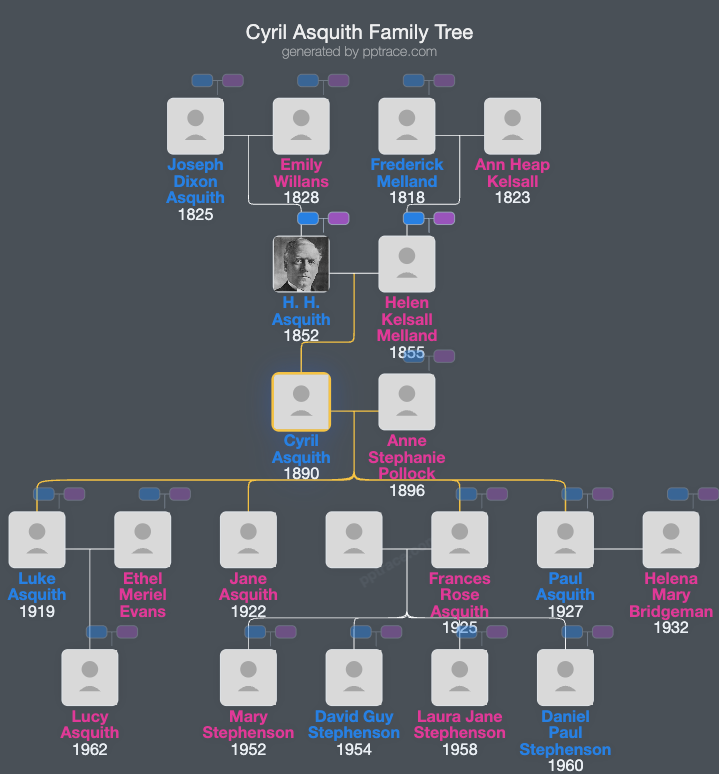
Family Tree
Tap  to expand more relatives
Introduction
Cyril Asquith, Baron Asquith of Bishopstone, PC (5 February 1890 – 24 August 1954), was an English barrister and judge. He served as a Lord of Appeal in Ordinary from 1951 until his death in 1954.
Born in Hampstead, London, Cyril Asquith was the youngest child of H. H. Asquith, who later became Prime Minister of the United Kingdom and was created Earl of Oxford and Asquith. His mother was Helen Kelsall Melland, who died in 1891, a year after his birth.
He received education at Summer Fields School and Winchester College, where he was a scholar. He attended Balliol College, Oxford, as a foundation scholar, earning first-class honours in Classical Moderations in 1911 and in literae humaniores in 1913. During his time at Oxford, he won the Hertford, Craven, Ireland, and Eldon scholarships. In 1913, while still an undergraduate, he was elected a fellow of Magdalen College, Oxford.
In 1914, at the outbreak of the First World War, Asquith was commissioned as a second lieutenant in the 1/16th (County of London) Battalion, The London Regiment (Queen's Westminster Rifles), eventually attaining the rank of captain. Due to medical reasons, he was deemed unfit for service abroad and was employed by the Ministry of Munitions from 1916 to 1918. During this period, he also served on the British War Mission in the United States.
After the war, Asquith was called to the bar at the Inner Temple in 1920. He was a pupil in chambers of William Jowitt, who later recommended him for judicial appointments. His practice at the common law bar was modest in size. Between 1925 and 1938, he served as Assistant Reader in Common Law to the Council of Legal Education. He took silk in 1936, becoming a King's Counsel, and was appointed Recorder of Salisbury in 1937. In 1939, he was elected a bencher of the Inner Temple and was involved in the Liberal Party Council from 1936.
His judicial career began with his appointment as a Justice of the High Court on 28 March 1938, assigned to the King's Bench Division. He was knighted shortly afterward. His appointment was considered somewhat unexpected, and Lord Hewart, the Lord Chief Justice, expressed some concerns about proper consultation. As a judge, Asquith handled criminal trials at the Old Bailey and was noted for his ability to explain legal issues to juries, although occasionally criticized for leniency.
During World War II, he provided legal advice to King George VI regarding the royal power of dissolution in 1939. In 1941, he presided over the in-camera trial of two German spies at the Old Bailey and sentenced them to death. He also chaired various tribunals and commissions, including the High Court's General Claims Tribunal, the Advisory Committee on the internment of enemy aliens, the Commission on Higher Education in Colonies, and the Royal Commission on Equal Pay.
Following the death of Lord Justice MacKinnon in 1946, Asquith was appointed a Lord Justice of Appeal and sworn of the Privy Council. On 23 April 1951, on the recommendation of Lord Jowitt, he was appointed a Lord of Appeal in Ordinary and created a life peer as Baron Asquith of Bishopstone. In 1952, he contributed to the Law Reform Committee and served as chairman of the Political Honours Scrutiny Committee.
In October 1951, he was offered the position of Lord Chancellor by Winston Churchill but declined due to health concerns and personal reasons. His family urged him to accept, but he refused, believing Churchill should not be burdened with a "lame duck" on the Woolsack. The post was ultimately given to Lord Simonds.
Asquith remained a judge until his death at his London home on 24 August 1954. He was survived by his wife, Anne Stephanie Pollock, and their four children, including his younger daughter, Frances Rose Asquith, who married John Stephenson, later a Lord Justice of Appeal.
He authored several works, including "Trade Union Law for Laymen" (1927), a Latin translation of poems from "A Shropshire Lad" (1929), and the authorized biography of his father, "Life of Herbert Henry Asquith" (1932), co-authored with J. A. Spender. He also contributed to The Times through unsigned leaders and letters.