Anthony Asquith
| Name | Anthony Asquith |
| Title | English film director (1902-1968) |
| Gender | Male |
| Birthday | 1902-11-09 |
| nationality | United Kingdom |
| Source | https://www.wikidata.org/wiki/Q360844 |
| pptrace | View Family Tree |
| LastUpdate | 2025-11-26T23:31:24.263Z |
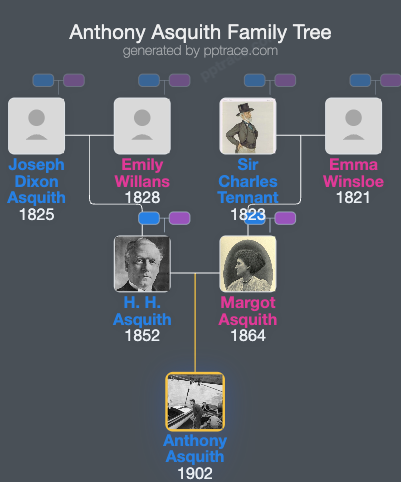
Family Tree
Tap  to expand more relatives
Introduction
Anthony Asquith (9 November 1902 – 20 February 1968) was an English film director. He was born in London, England, and was the son of H. H. Asquith, who served as Prime Minister of the United Kingdom from 1908 to 1916. His mother was Margot Asquith, and he had four siblings, including a sister named Elizabeth who survived to adulthood. From his father's first marriage, he had five half-siblings.
Asquith was educated at Eaton House, Winchester College, and Balliol College, Oxford. During his youth, the film industry was generally regarded as disreputable, and reports suggest that Asquith entered the field in part to distance himself from his family background. His early career in film began in the late 1920s with the direction of four silent films, culminating in "A Cottage on Dartmoor" (1929), which gained recognition for its detailed and emotionally expressive frame composition.
His notable work includes directing "Pygmalion" (1938), an adaptation of George Bernard Shaw's play, featuring Leslie Howard and Wendy Hiller. He also directed "French Without Tears" (1940), "The Way to the Stars" (1945), and a 1952 adaptation of Oscar Wilde’s "The Importance of Being Earnest." Asquith frequently collaborated with playwright Terence Rattigan; together they worked on ten films, including "The Winslow Boy" (1948) and "The Browning Version" (1951). He also worked with producer Anatole de Grunwald.
Throughout his career, Asquith held several industry positions, including President of the Association of Cinematograph, Television and Allied Technicians and a Governor of the British Film Institute. His filmography extends to various genres and includes feature films such as "Underground" (1928), "Tell England" (1931), "Dance Pretty Lady" (1932), "Letting in the Sunshine" (1933), "Unfinished Symphony" (1934), "Moscow Nights" (1935), and "Libel" (1959), among others.
In addition to his work in feature films, Asquith directed short films including "The Story of Papworth" (1935) and "Channel Incident" (1940). His later years included work on films like "The V.I.P.s" (1963) and "The Yellow Rolls-Royce" (1965).
Asquith struggled with alcoholism and was described by actor Jonathan Cecil as a repressed homosexual. He was working as the director of "The Shoes of the Fisherman" at the time of his illness. He died from cancer on 20 February 1968 in London and was buried at All Saints Churchyard in Sutton Courtenay, Berkshire, England.