Marie De' Medici
| Name | Marie De' Medici |
| Title | Queen of France, second wife of King Henry IV of France (1575-1642) |
| Gender | Female |
| Birthday | 1575-04-26 |
| nationality | France |
| Source | https://www.wikidata.org/wiki/Q182021 |
| pptrace | View Family Tree |
| LastUpdate | 2025-11-12T01:14:46.884Z |
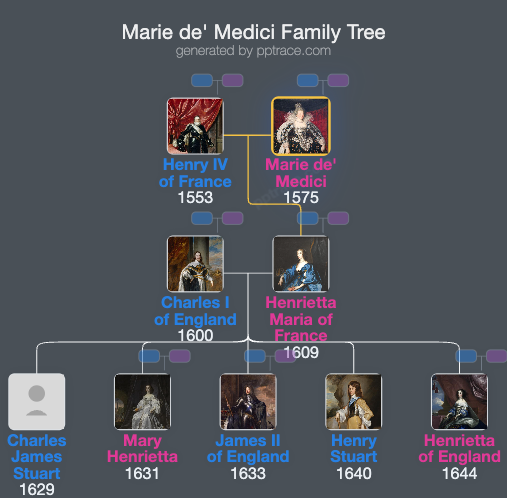
Family Tree
Tap  to expand more relatives
Introduction
Marie de' Medici was born on 26 April 1575 at the Palazzo Pitti in Florence, Italy. She was the sixth daughter of Francesco I de' Medici, Grand Duke of Tuscany, and Archduchess Joanna of Austria. Her family was a prominent branch of the Medici dynasty, which ruled Tuscany, and she was related to the Habsburgs through her mother. Her early childhood was marked by the deaths of several siblings; her father and mother died in 1587, leaving her orphaned at the age of twelve.
Following the death of her parents, Marie was under the care of her uncle Ferdinando I de' Medici, Grand Duke of Tuscany, and received a comprehensive education, with interests spanning mathematics, philosophy, astronomy, arts, and music. She was trained in drawing by Jacopo Ligozzi and was also talented in music and theater.
In 1600, Marie de' Medici married King Henry IV of France after negotiations that linked political and financial interests. The marriage contract was signed in March 1600, with subsequent ceremonies in Tuscany and France. Marie left Florence in October 1600 to join Henry IV, traveling via Livorno, Marseille, and Lyon, ultimately arriving in Paris in December 1600. The marriage produced six children, including Louis XIII, born on 27 September 1601, who succeeded Henry IV as king, and several daughters who married into European royal families. Despite producing heirs, the marriage was fraught with personal and political tensions, including Henry IV's infidelities and communication issues.
Henry IV was assassinated on 14 May 1610, the day after Marie’s coronation as Queen of France. Following his death, Marie de' Medici was appointed regent for her underage son, Louis XIII, in 1610. Although her regency was legally limited to 1614, she continued to hold power until 1617, refusing to relinquish her authority despite her son's attainment of majority. Her regency period was characterized by political intrigue, reliance on Italian advisors and favorites such as Concino Concini and Leonora Dori, and efforts to maintain her influence at court.
Her policies included maintaining religious tolerance through the Edict of Nantes, and she sought to forge alliances with Spain through diplomatic marriages for her children. Her political actions led to opposition from the French nobility, especially from princes of the blood and Protestant factions. In 1614, the Estates General was convened, but it failed to resolve conflicts, leading to her loss of power, although she retained control over the Conseil du Roi.
In 1616, conflicts intensified, leading to her arrest and imprisonment in the Bastille, as well as a subsequent exile after her escape from prison in 1619. During her exile, she traveled through various European countries, seeking support and attempting to influence French affairs from abroad. Her political influence waned, and in her later years, she sought refuge in the Spanish Netherlands, England, and Germany.
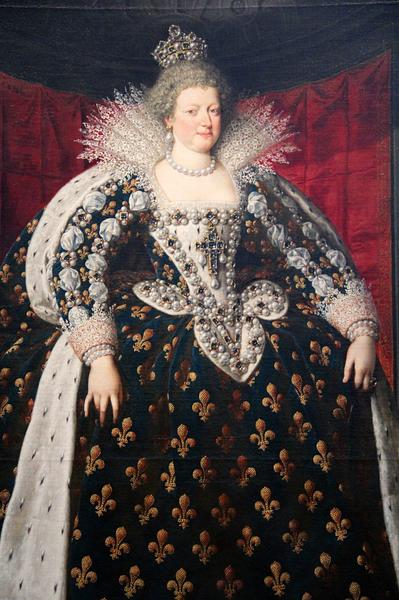
Marie de' Medici was also known for her patronage of the arts. She commissioned numerous works, notably from Peter Paul Rubens, including the famous "Marie de' Medici cycle" which depicted her life and reign and is now housed in the Louvre Museum. She also focused on building projects such as the Luxembourg Palace in Paris, which became a center of artistic activity and her residence.
Her relationship with Cardinal Richelieu deteriorated over time, culminating in her exile in 1631 after the "Day of the Dupes" when Richelieu gained influence over the king. She attempted to rally opposition against Richelieu from abroad but was ultimately unable to return to France. She spent her last years traveling across courts in Europe, maintaining her claims and influence indirectly, but she died impoverished of pleurisy on 3 July 1642 in Cologne, in the Holy Roman Empire.
Marie de' Medici was buried in the Basilica of Saint Denis in France in 1643, with her heart sent to La Flèche per her late husband's wishes. Her remains were later desecrated during the French Revolution, but her bones were reinterred in Saint Denis in 1817.