Henry IV Of France
| Name | Henry IV Of France |
| Title | King of France and Navarre; first French monarch of the House of Bourbon (1553-1610) |
| Gender | Male |
| Birthday | 1553-12-13 |
| nationality | Kingdom of France |
| Source | https://www.wikidata.org/wiki/Q936976 |
| pptrace | View Family Tree |
| LastUpdate | 2025-11-12T01:14:47.784Z |
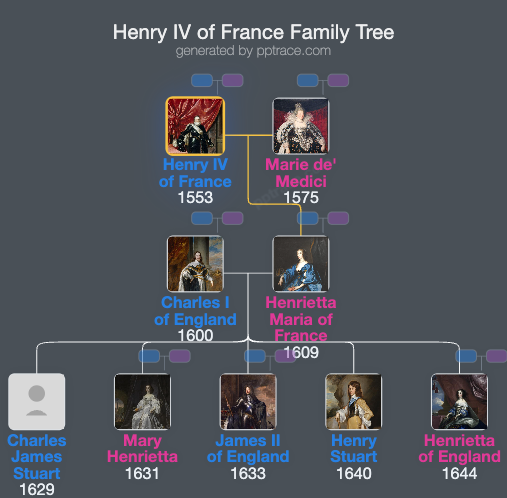
Family Tree
Tap  to expand more relatives
Introduction
Henry IV (French: Henri IV; 13 December 1553 – 14 May 1610) was a monarch who held the titles of King of Navarre from 1572 and King of France from 1589 until his death in 1610. He was the first king of France from the House of Bourbon, a cadet branch of the Capetian dynasty. His reign marked the end of the French Wars of Religion and the beginning of the Bourbon dynasty's rule in France.
Early Life
Henry was born on the night of 12 to 13 December 1553 in Pau, the capital of the joint Kingdom of Navarre and the Principality of Béarn. His birthplace was the Château de Pau. He was the son of Jeanne III of Navarre (also known as Jeanne d'Albret) and Antoine de Bourbon, Duke of Vendôme. Henry was baptized as a Catholic but was raised as a Huguenot (French Calvinist) by his mother. He inherited the throne of Navarre upon his mother's death in 1572 and was given the title Prince of Viana.
During his childhood, Henry spent time in both Béarn and at the French court. His early education was influenced by his mother's adherence to Calvinism, and he later participated in military campaigns during the French Wars of Religion.
Marriage and Personal Life
In 1572, Henry married Margaret of Valois, daughter of Henry II of France and Catherine de' Medici. The marriage was politically motivated and faced difficulties; the couple was childless and separated before Henry ascended to the French throne.
He had a relationship with Gabrielle d'Estrées, with whom he fathered three children; her death in 1599 led to the annulment of his marriage to Margaret. In 1600, Henry married Marie de' Medici, daughter of Francesco I de' Medici. They had six children, including his successor, Louis XIII.
Religious and Political Career
Henry inherited the kingdom of Navarre in 1572 and became engaged in the French Wars of Religion, a series of conflicts between Catholics and Protestants. He survived the St. Bartholomew's Day massacre in 1572, thanks in part to the protection of his wife and his promise to convert to Catholicism.
He became king of France in 1589 after the death of Henry III. At the time, he was a Protestant, the only French king to maintain that faith during his reign. Facing opposition from the Catholic League, Henry converted to Catholicism in 1593, reportedly stating, "Paris is well worth a Mass." His conversion secured his recognition as king and facilitated the end of religious conflicts.
In 1598, Henry issued the Edict of Nantes, granting religious tolerance to Protestants and ending the Wars of Religion. His policies aimed at stabilizing and strengthening France included efforts to reform the financial system, promote agriculture, and develop infrastructure. He supported trade and industry, initiated public works such as roads, bridges, and canals, and began colonization efforts in North America.
Foreign Policy
Henry IV sought to establish peace in Europe and expanded France's influence through alliances with Protestant states, including the Dutch Republic and several German principalities. He concluded the Peace of Vervins in 1598 with Spain, which ended a long conflict. His foreign policy also involved supporting enemies of Spain and funding expeditions to develop trade with Asia.
Assassination and Death
Henry IV was assassinated in 1610 by François Ravaillac, a Catholic zealot. Ravaillac was immediately executed after the attack. Henry was buried at the Basilica of Saint-Denis, and his death led to the accession of his son, Louis XIII. His widow, Marie de' Medici, served as regent until 1617.
Legacy
Henry IV's reign contributed to the political and religious stabilization of France. His efforts in economic development, infrastructure, and colonization laid foundations for future growth. His policies of religious tolerance through the Edict of Nantes marked a significant move toward religious coexistence in France. In popular memory, he was known by epithets such as "Good King Henry" and "Henry the Great." Statues and monuments honoring him, including the one on the Pont Neuf in Paris, were erected and later restored after periods of revolution and upheaval. His influence extended into cultural references, and his life remains a significant chapter in French history.
Genealogical Background
Henry was the son of Jeanne III of Navarre and Antoine de Bourbon. His paternal lineage links to the House of Bourbon, which later became the ruling dynasty of France. His ancestry included notable figures from the Capetian line, and through his mother, he was connected to the royal lineages of Navarre and Béarn.
Marriages and Children
His first marriage was to Margaret of Valois in 1572; the union was childless and later dissolved. With Gabrielle d'Estrées, he fathered three children: César, Duke of Vendôme; a stillborn son; and a posthumously born daughter. His second marriage to Marie de' Medici produced six children, among them Louis XIII of France.
Conclusion
Henry IV's rule marked a turning point in French history, transitioning from religious conflict to political consolidation and economic development. His policies and actions influenced subsequent monarchs and the trajectory of France as a unified state.
[Word Count: approximately 560 words.]