Mary Henrietta, Princess Royal
| Name | Mary Henrietta, Princess Royal |
| Title | eldest daughter of Charles I of England and his wife, Henrietta Maria of France; mother of William III of England (1631-1660) |
| Gender | Female |
| Birthday | 1631-11-04 |
| nationality | Kingdom of England |
| Source | https://www.wikidata.org/wiki/Q236930 |
| pptrace | View Family Tree |
| LastUpdate | 2025-11-12T01:14:40.588Z |
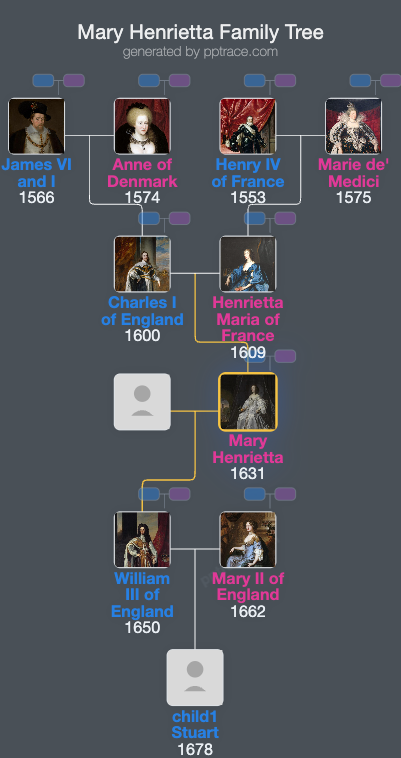
Family Tree
Tap  to expand more relatives
Introduction
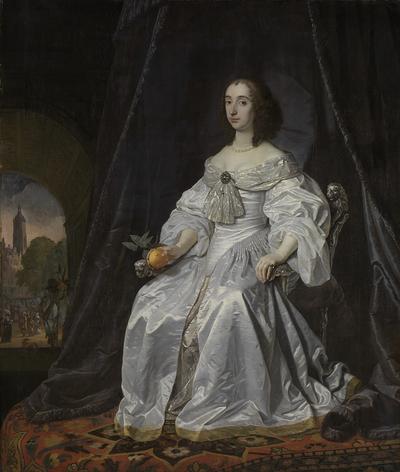
Mary, Princess Royal (Mary Henrietta Stuart), was born on 4 November 1631 at St. James's Palace, London. She was the eldest daughter of King Charles I of England and Queen Henrietta Maria of France. Mary was baptized on the same day of her birth, with William Laud, Archbishop of Canterbury, presiding. Her first public appearance occurred in 1640 at her brother Henry's baptism, where she served as the only godmother.
Mary's early education was overseen by Jean Ker, Countess of Roxburghe. She was noted for her physical grace and manners, with particular proficiency in dancing. Her knowledge of sciences was limited. Queen Henrietta Maria sought to convert her daughter to Catholicism, but King Charles I opposed these efforts.
In January 1640, at age eight, Mary received her first marriage proposal from William, the eldest son of Frederick Henry, Prince of Orange, who was fourteen at the time. Her father initially rejected the proposal in favor of a union with Balthasar Charles of Spain. However, negotiations resumed in 1641, culminating in her marriage to William on 2 May 1641 in a ceremony at Whitehall Palace, London. Mary was 9 years old, and William was 14. The marriage contract allowed her to remain in England until age 12, with her husband providing her personal expenses and support in case of his early death.
In 1642, due to rising political tensions, Mary and her parents took refuge in Hampton Court, and she soon traveled to The Hague in the Netherlands with her mother. She remained in Dutch custody for the duration of the English Civil War. Her marriage to William was solemnized again in The Hague in November 1643, and it was consummated in 1644. During her time in the Netherlands, Mary was active in court functions and diplomatic receptions.
In 1647, William inherited the titles of Prince of Orange and Stadtholder of several Dutch provinces. That same year, her father, King Charles I, was executed in England. Mary continued her support for her family's royalist cause, maintaining correspondence with her father and aiding English Royalists in exile.
In November 1650, William died of smallpox, just days after his attempt to seize Amsterdam. Eight days later, on her 19th birthday, Mary gave birth to her son William III of Orange. She became the guardian of her child and was designated Princess Royal, a title established for the eldest daughter of the English crown.
Following her husband's death, Mary experienced conflicts over her son's guardianship and the Dutch political landscape. She shared guardianship with her mother-in-law, Amalia of Solms-Braunfels, with the Supreme Court in 1651 assigning the role also to Elector Frederick William of Brandenburg. She was generally disliked in the Netherlands, partly due to her royalist sympathies and her relations with the republican government. The outbreak of war with England in 1652, along with Cromwell's Act of Seclusion, further complicated her position.
In her later years, Mary traveled to Paris in 1656, where she was received at the French court. She was also approached by several suitors, including European nobility and Cardinal Mazarin, though she remained unmarried after her widowhood.
The political situation in England changed with the Restoration of Charles II in 1660. Mary allied with her family, greeting the return of the monarchy, and was recognized as a member of the line of succession. On 30 September 1660, she sailed to England and was received with honors. Her visit was brief; she was distressed upon learning that her brother recognized his illegitimate children with James, Duke of York, as heirs apparent.
Mary contracted smallpox during her stay, and despite efforts to treat her, she died on 24 December 1660. She was buried in Westminster Abbey beside her brother, Henry, Duke of Gloucester. Her will designated her son William as her heir, with her mother-in-law as his guardian. Her son later became King William III of England, Scotland, and Ireland, reigning jointly with Mary II, after the Glorious Revolution in 1688.