Henrietta Of England
| Name | Henrietta Of England |
| Title | English princess, duchesse of Orléans (1644-1670) |
| Gender | Female |
| Birthday | 1644-06-16 |
| nationality | France |
| Source | https://www.wikidata.org/wiki/Q230921 |
| pptrace | View Family Tree |
| LastUpdate | 2025-11-12T01:14:39.709Z |
Family Tree
Tap  to expand more relatives
Introduction
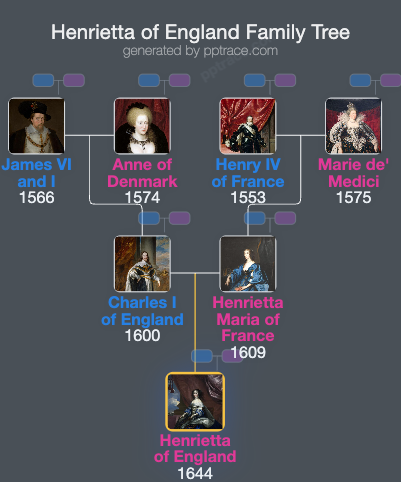
Henrietta of England, also known as Henrietta Anne Stuart, was born on 16 June 1644 (Julian calendar) in Exeter, England. She was the youngest child of King Charles I of England and Henrietta Maria of France. Her birthplace was Bedford House in Exeter, located in the County of Devon. Her father was the reigning monarch of England, Scotland, and Ireland, and her mother was the youngest daughter of Henry IV of France and Marie de' Medici.
Henrietta's early life was marked by her family's involvement in the English Civil War. Shortly before her birth, her mother relocated from Oxford to Exeter, where her health was considered vulnerable. Following a difficult birth, Henrietta was baptised as Henrietta at Exeter Cathedral on 21 July 1644, with a canopy of state erected for her. She was initially cared for by Anne Villiers, Countess of Morton, known then as Lady Dalkeith. Her first encounter with her father, King Charles I, occurred on 26 July 1644, after her arrival at Falmouth, Cornwall, where her mother had retreated for safety amid ongoing conflict.
As a child, Henrietta was taken to Oatlands Palace outside London, where she lived for three months before she and her mother fled to France in June 1646. Henrietta was then raised at the French court, where she was given the name Anne in honor of her aunt, Queen Anne of Austria. In France, her status was recognized as a princess of England, and she was known as Henrietta d'Angleterre or the princesse d'Angleterre. Her family received an annual pension and apartments at the Louvre and Château de Saint-Germain-en-Laye.
Her mother, Henrietta Maria, expressed interest in arranging her marriage to Louis XIV of France; however, this did not materialize. Instead, after the English monarchy was restored in 1660 with her brother Charles II's ascension, arrangements were made for her marriage to Philippe I, Duke of Orléans. The marriage contract was signed on 30 March 1661, and the wedding took place on 31 March 1661 at the Palais Royal, after which she was styled Madame, la duchesse d'Orléans.
Henrietta and Philippe's marriage produced several children, notably Marie Louise d'Orléans (born 26 March 1662), who married Charles II of Spain and died in 1689 at age 26, and Anne Marie d'Orléans (born 27 August 1669), who married Victor Amadeus II of Savoy and became the mother of Louis XV. Her son Philippe Charles, Duke of Valois, was born in 1664 but died in infancy in 1666.
Throughout her life, Henrietta was engaged in cultural pursuits and corresponded with notable writers such as Molière, Racine, and La Fontaine. She was also known for her interest in gardening and art collection, including works by Van Dyck and Correggio. Her personal health declined during 1667–1670, with complaints of pain and digestive issues.
In 1669, her mother Queen Henrietta Maria died of an overdose of opiates. Henrietta responded with grief, and her circumstances grew more complex with her husband's increasing influence and rivalries within his household. In May 1670, Henrietta traveled to England to aid her brother Charles II in diplomatic negotiations, notably signing the Secret Treaty of Dover on 1 June 1670, which aligned England with France against the Dutch.
On 29 June 1670, Henrietta experienced a sudden painful condition after drinking iced chicory water, which led to her death early on 30 June 1670 at Saint-Cloud, France. The official attribution was gastroenteritis caused by a ruptured ulcer, though rumors of poisoning persisted. She was buried at the Basilica of St Denis on 4 July 1670 in a funeral attended by prominent figures, and her funeral oration was delivered by Bishop Bossuet.
Her death had significant repercussions, and her descendants include claimants to various European thrones and pretenders, including the Jacobite line and the royal families of Spain, Belgium, and Luxembourg. Henrietta's daughter Anne Marie continued her lineage, which included further notable European figures.