Melusine Von Der Schulenburg, Duchess Of Kendal
| Name | Melusine Von Der Schulenburg, Duchess Of Kendal |
| Title | British duchess |
| Gender | Female |
| Birthday | 1667-12-25 |
| nationality | Great Britain |
| Source | https://www.wikidata.org/wiki/Q64228 |
| pptrace | View Family Tree |
| LastUpdate | 2025-11-12T01:14:58.535Z |
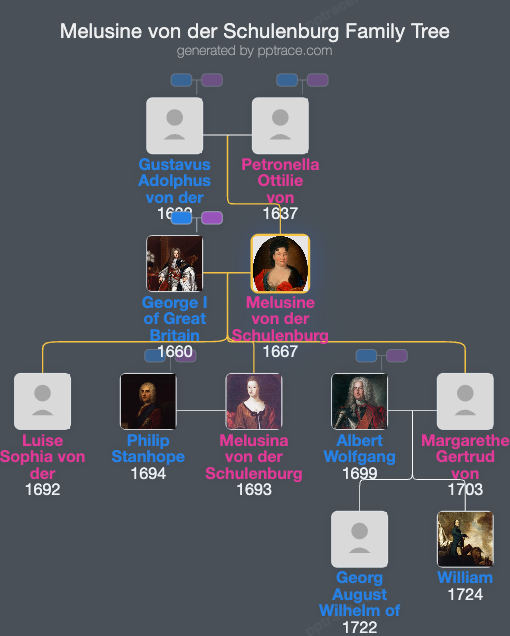
Family Tree
Tap  to expand more relatives
Introduction
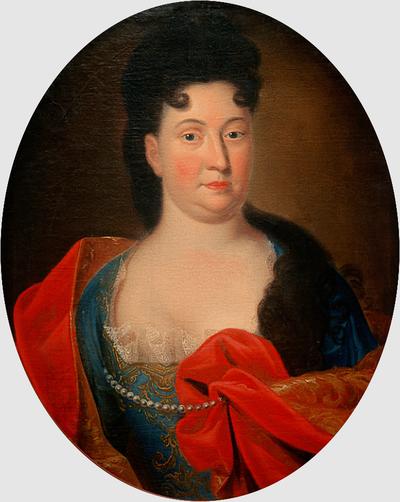
Ehrengard Melusine von der Schulenburg (25 December 1667 – 10 May 1743) was a noblewoman who held the titles of Duchess of Kendal and Duchess of Munster in her own right. She was born in Emden, located in the Duchy of Magdeburg. Her parents were Gustavus Adolphus, Baron von der Schulenburg, who served as Privy Councillor to the Elector of Brandenburg, and his wife Petronella Ottilie von Schwencken. She had several siblings, including two brothers, Marshal Johann Matthias Imperial Count von der Schulenburg and General Daniel Bodo Count von der Schulenburg, as well as three sisters: Margarethe Gertrud von der Schulenburg (married to Friedrich Achaz von der Schulenburg und Hehlen), Sophia Juliane von der Schulenburg (married to Rabe Christoph von Oeynhausen), and Anna Elisabeth von der Schulenburg (married to Georg Friedrich von Spörcken). Her middle name "Melusine" likely references the legends of Melusine, a figure from European folklore.
In 1690, Melusine was appointed Maid of Honour to Electress Sophia of Hanover. She became a mistress to the Electoral Prince, George Louis, in 1691. George Louis ascended as Elector of Hanover in 1698 and later became King George I of Great Britain in 1714. Melusine followed him to England, where she was granted several noble titles: on 18 July 1716, she was made Duchess of Munster, Marquess of Dungannon, Countess of Dungannon, and Baroness Dundalk in the Peerage of Ireland. Subsequently, on 19 March 1719, she was created Duchess of Kendal, Countess of Feversham, and Baroness Glastonbury within the Peerage of Great Britain. Additionally, in 1723, she was granted the title Princess of Eberstein by Holy Roman Emperor Charles VI. These titles and her elevated status are sometimes interpreted as indications of her possibly having married King George I in a secret marriage.
Throughout her life in England, she resided mainly at Kendal House in Isleworth, Middlesex. She was known for acquiring considerable wealth by selling public offices, titles, and patents, including rights related to Ireland’s coinage, which she sold to William Wood. This sale led to the proliferation of inferior copper coins in Ireland, prompting Jonathan Swift to write the Drapier’s Letters. Melusine exerted influence over political affairs; for example, she was paid £10,000 (equivalent to approximately £1.98 million in 2023) to facilitate the recall of Viscount Bolingbroke from exile.
She was known by various nicknames reflecting her appearance; in Germany as "the Scarecrow" and in England as "the Maypole." She was also negatively referenced by Jacobites as "the Goose," notably in the Scottish ballad "Cam Ye O'er Frae France." Melusine was reputed to have had three illegitimate children with King George I: Anna Luise Sophie von der Schulenburg (later Countess of Dölitz), Petronilla Melusina von der Schulenburg (who married Philip Stanhope, 4th Earl of Chesterfield), and Margarethe Gertrud von Oeynhausen (who married Count Albrecht Wolfgang of Schaumburg-Lippe). These children were officially acknowledged as offspring of her sisters and their respective husbands, rather than her own.
Following King George I’s death, Melusine retained a raven she believed to be the spirit of the late king. She died unmarried on 10 May 1743.