Frederick III Of Denmark
| Name | Frederick III Of Denmark |
| Title | King of Denmark and Norway from 1648 to 1670 |
| Gender | Male |
| Birthday | 1609-03-18 |
| nationality | Q62651 |
| Source | https://www.wikidata.org/wiki/Q157812 |
| pptrace | View Family Tree |
| LastUpdate | 2025-11-12T01:14:24.424Z |
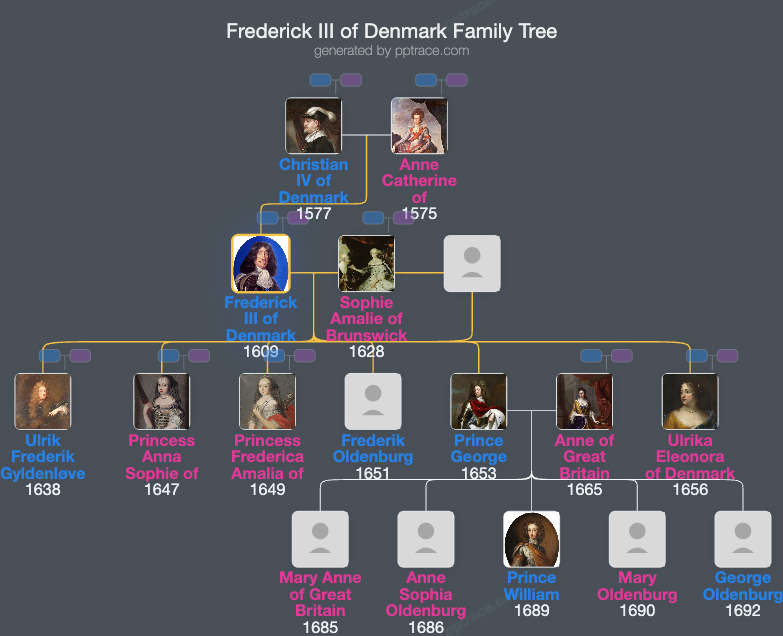
Family Tree
Tap  to expand more relatives
Introduction
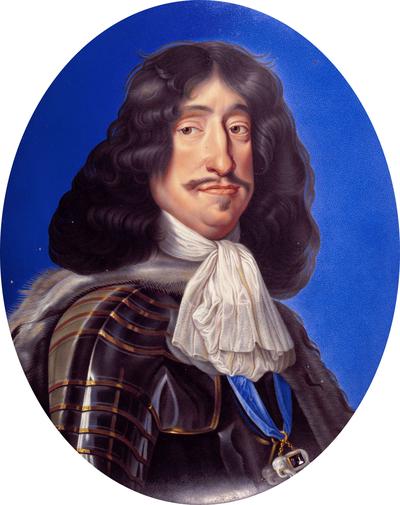
Frederick III (Danish: Frederik; 18 March 1609 – 9 February 1670) was the King of Denmark and Norway from 1648 until his death in 1670.
Born at Haderslev in Slesvig, he was the second-eldest son of Christian IV and Anne Catherine of Brandenburg. In his early years, Frederick was supervised by Beate Huitfeldt and received education at Sorø Academy, studying later in the Netherlands and France. His interests included theology, natural sciences, and Scandinavian history. He was characterized as reserved and introspective, seldom displaying overt emotion or speech.
In 1643, he married Sophie Amalie of Brunswick-Lüneburg, daughter of George, Duke of Brunswick-Lüneburg. The marriage produced eight children, including Christian V of Denmark. He also had an illegitimate son, Ulrik Frederik Gyldenløve, with Margarethe von Pape.
In his youth, Frederick held several administrative positions within the Holy Roman Empire, managing the Prince-Archbishopric of Bremen (1635–45), the Prince-Bishopric of Verden (1623–29 and again 1634–44), and serving as coadjutor of Halberstadt. He gained early military experience during the Torstenson War (1643–45), although his command was unsuccessful.
He became heir apparent after the death of his older brother Christian in 1647. Upon the death of his father, Christian IV, in 1648, Frederick was elected king after negotiations with the Danish Estates and the Rigsraadet. He was crowned on 23 November 1648. His accession was marked by the signing of the Haandfæstning, a charter that limited royal prerogative and increased the influence of the Rigsraadet.
Frederick's reign was marked by conflicts with Sweden, including the Dano-Swedish Wars of 1657–1658 and 1658–1660. The Swedish invasion in 1658 led to the Treaty of Roskilde, which ceded significant Danish territory, including Scania, Halland, and Blekinge, to Sweden. He resisted the Swedish assault on Copenhagen in 1658, notably defending the city from a Swedish landings and siege, which was ultimately lifted following support from Dutch forces in the Battle of the Sound.
Following these conflicts, Frederick capitalized on popular support from his defense efforts to strengthen royal authority. In 1660, he instituted the Revolution of 1660, transforming Denmark into an absolute monarchy by abolishing the elective monarchy and constitutional limitations established by the Haandfæstning. This formalized the power of the king through the Kongeloven (Lex Regia) of 1665, which declared the monarch as the supreme ruler, above all human laws and councils, with divine right.
During his later years, Frederick's administration was characterized by efforts to centralize authority and reform governance structures, including replacing fiefs with counties and reducing the powers of traditional councils. His foreign policy included involvement in protecting the Return Fleet from Dutch and English interference, although decisions during this period were influenced by negotiations and alliances, such as collaboration with the English and Dutch.
Frederick III died in Copenhagen Castle on 9 February 1670 and was buried in Roskilde Cathedral.