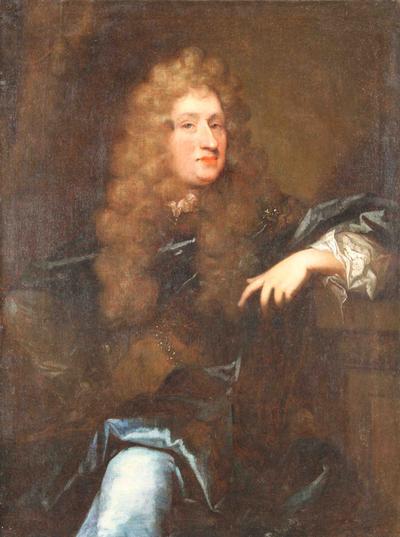
Ulrik Frederik Gyldenløve
| Name | Ulrik Frederik Gyldenløve |
| Title | Danish noble and general (1638-1704) |
| Gender | Male |
| Birthday | 1638-07-20 |
| nationality | Kingdom of Denmark |
| Source | https://www.wikidata.org/wiki/Q70892 |
| pptrace | View Family Tree |
| LastUpdate | 2025-11-12T01:14:27.110Z |
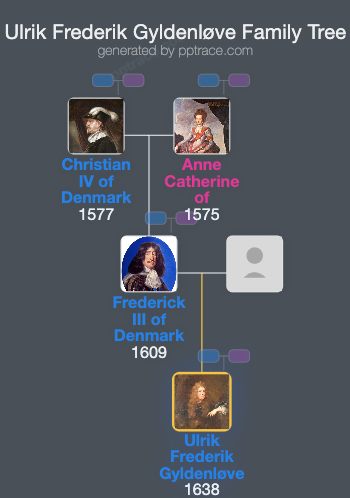
Family Tree
Tap  to expand more relatives
Introduction
Ulrik Frederik Gyldenløve, Landgrave of Laurvig, was born on 20 July 1638 in Bremen, Germany. He was the illegitimate son of Prince Frederick, who later became King Frederick III of Denmark-Norway, and Margrethe von Pape, a minor German noblewoman. His mother was granted the title of Baronesse of Løvendal by King Christian IV in 1620. When his father ascended to the Danish throne in 1648, Ulrik Frederik adopted the surname Gyldenløve, a designation used by illegitimate sons of Danish monarchs.
In the early 1650s, Gyldenløve traveled through Europe, visiting France, Italy, and Spain. He attended the University of Siena in 1654 and studied in Rome in 1655. He was naturalized as a Danish noble on 21 August 1655.
His military career began in 1657 when he became colonel in Norway. He served in the Dano-Swedish War (1658–1660), distinguishing himself at the Battle of Nyborg on 14 November 1659. In 1661, he was appointed to command at Vordingborg and Kalø Castle at Århus. He was placed in charge of Vordingborg in 1661 and became colonel in Norway.
In 1664, Gyldenløve was appointed viceroy (Statholder) of Norway, replacing Iver Krabbe. During his tenure, he studied Norwegian conditions extensively and promoted significant reforms, including simplifying the tax system and establishing a separate Court of appeals in Norway. He was responsible for constructing and improving nine fortresses along the Swedish border.
Gyldenløve participated in several 17th-century conflicts, notably playing a successful role at the Battle of Nyborg in 1659 and serving as commander-in-chief of the Norwegian army during the Scanian Wars (1675–1679). He implemented reforms initiated by Hannibal Sehested, which affected taxation, defense, justice, and protection for tenant farmers.
In 1671, he founded the city of Laurvig (modern-day Larvik) and was granted the title of Count of Laurvig. In Larvik, he oversaw the construction of Larvik Church, inaugurated in 1677, and Laurvig Manor House, built from 1674 and completed for his third wedding in 1677 with Antoinette Augusta von Aldenburg. He also issued a gift to the church, with the interest used for its maintenance.
Gyldenløve’s influence extended to Denmark, where he spent considerable time away from Norway, mainly in Copenhagen or on diplomatic missions. He was appointed Lord Chamberlain in 1671 and was awarded the honors of Blue Knight (1661) and White Knight (1671). He played a notable role in Danish politics, helping to influence the fall of Christoffer Gabel in 1670. A dispute with Peder Schumacher Griffenfeld led to his return to Norway in 1673. He moved back to Copenhagen in 1679 and visited Norway only a few times afterward.
His Danish land holdings included Kalø, Østrup im Asminderød, Mørup in Fjenneslev, Tybjerggaard at Præstø, Christiansholm, Turø, Gyldenlund, Skjoldenæsholm near Ringsted, and Sorgenløss at Kongens Lyngby. In 1669, King Christian V presented him with a large parcel of land in Copenhagen on Kongens Nytorv, where he constructed a mansion known as Charlottenborg Palace, built from 1672 to 1683. The adjacent Nyhavn canal was initially called Gyldenløve's Canal. Later, in 1700, Gyldenløve sold the mansion to Queen Charlotte Amalie.
Gyldenløve was married three times. His first marriage was in 1659 to Sophie Urne, which ended in 1670. His second marriage was to Marie Grubbe in 1660, from which he divorced in 1670. His third marriage was to Countess Antoinette Augusta von Aldenburg in 1677. He had children with his wives, including Woldemar Gyldenløve and Carl Løvendal with Sophie Urne, and Charlotte Amalie af Danneskiold-Samsøe, Ulrikke Amalie Antoinette af Danneskiold-Samsøe, and Ferdinand Anton Danneskiold-Laurvig with Countess Antoinette Augusta von Aldenburg. He also had illegitimate children, among them notable descendants such as the Dukes of Augustenborg and the German Empress Augusta.
Gyldenløve died on 17 April 1704 in Hamburg and was buried in the Church of Our Lady in Copenhagen. His remains were later destroyed during the British bombardment of Copenhagen in 1807. Fragments of his sarcophagus remain.