Prince George, Duke Of Cumberland
| Name | Prince George, Duke Of Cumberland |
| Title | husband of Queen Anne, who reigned over Great Britain from 1702 |
| Gender | Male |
| Birthday | 1653-04-02 |
| nationality | Kingdom of Denmark |
| Source | https://www.wikidata.org/wiki/Q317499 |
| pptrace | View Family Tree |
| LastUpdate | 2025-11-12T01:14:14.993Z |
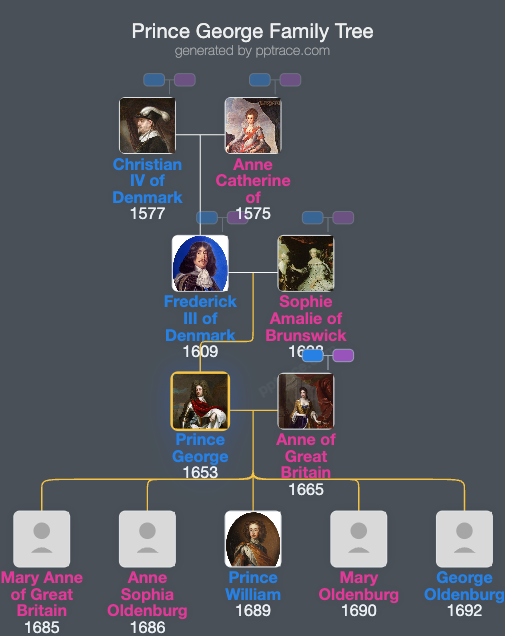
Family Tree
Tap  to expand more relatives
Introduction
Prince George of Denmark and Norway, Duke of Cumberland (Danish: Jørgen; 2 April 1653 – 28 October 1708), was born at Copenhagen Castle as the younger son of Frederick III, King of Denmark and Norway, and Sophie Amalie of Brunswick-Lüneburg. His maternal uncle was Ernest Augustus, Duke of Brunswick-Lüneburg, later Elector of Hanover. From 1661, his governor was Otto Grote, who was later Hanoverian minister to Denmark; Grote was replaced in 1665 by Christen Lodberg. George received military training and undertook a Grand Tour of Europe, spending eight months in France in 1668–1669 and mid-1669 in England. He was in Italy at the time of his father's death in 1670, after which his elder brother Christian V inherited the Danish throne. George returned to Denmark via Germany.
In 1672–1673, he traveled through Germany visiting his sisters Anna Sophia and Wilhelmine Ernestine, who were married to the electoral princes of Saxony and the Palatinate. In 1674, backed by King Louis XIV of France, George was a candidate for the Polish elective throne, but his staunch Lutheranism was a barrier in predominantly Catholic Poland, leading to the election of John Sobieski. During the Scanian War against Sweden in 1677, George served with distinction alongside his brother Christian.
George's marriage to Lady Anne, niece of King Charles II of England, was arranged in the early 1680s as part of a strategy to develop an Anglo-Danish alliance aimed at countering Dutch maritime power. The marriage was conducted on 28 July 1683 at St James's Palace, London, with notable guests including King Charles II, Queen Catherine, and the Duke and Duchess of York. Anne and George's marriage was reportedly a devoted and faithful one. However, it was marked by personal tragedy, including the death of several of their children: out of seventeen pregnancies, twelve resulted in miscarriages or stillbirths, four infants died shortly after birth, and their only surviving son, Prince William, Duke of Gloucester, died at age eleven.
Following King Charles II's death in 1685, George's father-in-law ascended the throne as James II. George was appointed to the Privy Council and attended Cabinet meetings, although he held no real influence. In 1688, during the Glorious Revolution, George sided with William of Orange, whom he accompanied during William's invasion of England. He defected from King James and supported William and Mary, leading to William's joint accession in 1689. Subsequently, George was naturalized as an English subject through the Naturalization and Precedence Act 1688 and was granted the titles of Duke of Cumberland, Earl of Kendal, and Baron of Okingham by William III.
George's relationship with William was characterized by mistrust. He held mortgages on properties in Schleswig-Holstein, which he surrendered under the peace of Altona negotiated by William. During the Williamite War in Ireland, George participated at his own expense but was excluded from military command and was blocked from serving in the navy by his brother-in-law. After the death of Queen Mary in 1694, George's relationship with William improved temporarily when Anne became the heir apparent.
In 1702, Queen Anne ascended the throne after William's death. George was appointed generalissimo of the English military forces and Lord High Admiral, though actual control of the navy was exercised by George Churchill, the Duke of Marlborough. He was supportive but had limited influence on political affairs, remaining disciplined and modest—traits remarked upon by contemporaries. During her reign, Queen Anne's government sought to balance political factions; George supported the Whigs in some elections and votes, but he generally maintained a non-partisan presence.
George suffered from recurrent asthma and chronic lung disease. He was seriously ill in March and April of 1706 but appeared to recover. His participation in the 1707 naval disaster highlighted mismanagement at the Admiralty. He died on 28 October 1708 at Kensington Palace due to his health issues. Queen Anne was profoundly affected by his death, which temporarily strained their relationship. He was buried privately in Westminster Abbey.
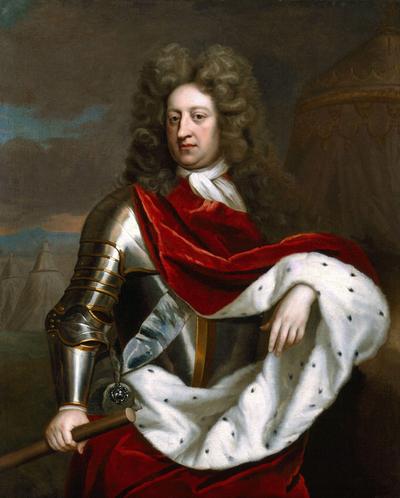
His legacy included the composition of The Prince of Denmark's March by Jeremiah Clarke and the naming of Prince George's County, Maryland, after him in 1696. Portraits of him by Sir Godfrey Kneller are held at the National Maritime Museum and other institutions. His personal traits were characterized as quiet, modest, and non-ambitious; he was interested in navigation and maritime welfare. His marriage to Queen Anne was a partnership of mutual respect despite personal tragedies and limited personal influence on political or military affairs.
He held the titles His Royal Highness Prince George of Denmark and Norway (from 1653) and His Royal Highness Prince George of Denmark and Norway, Duke of Cumberland (from 1689). He was a Knight of the Elephant and a Knight of the Garter. His arms featured the royal coat of Denmark-Norway with a label of three points, surmounted by the crown of a prince of Denmark and Norway.