Ulrika Eleonora Of Denmark
| Name | Ulrika Eleonora Of Denmark |
| Title | queen consort of Sweden (1656-1693) |
| Gender | Female |
| Birthday | 1656-09-11 |
| nationality | Kingdom of Denmark |
| Source | https://www.wikidata.org/wiki/Q174256 |
| pptrace | View Family Tree |
| LastUpdate | 2025-11-12T01:14:28.885Z |
Family Tree
Tap  to expand more relatives
Introduction
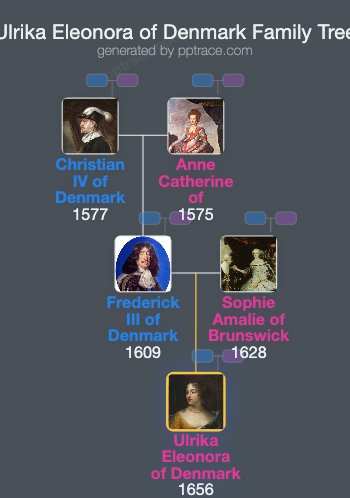
Ulrika Eleonora of Denmark (11 September 1656 – 26 July 1693) was Queen of Sweden through her marriage to King Charles XI. She was the daughter of King Frederick III of Denmark-Norway and Queen Sophie Amalie of Brunswick-Lüneburg. Her early education included lessons in multiple languages, drawing, and painting, under the guidance of her mother.
In 1675, she became engaged to Charles XI of Sweden. The engagement was politically motivated, intended to prevent Denmark from forming alliances against Sweden. Her brother, King Christian V of Denmark-Norway, was initially opposed to the match but deferred to his wife, Queen Sophie Amalie, who favored it. The engagement was announced on 13 July 1675. During the Scanian War (1675–1679), she was encouraged to break the engagement; her brother did so in 1676, but she maintained her commitment, exhibiting compassion toward Swedish prisoners of war, whom she supported financially by pawning her jewelry, including her engagement ring.
The marriage negotiations resumed during the peace process in 1679, and the marriage between Ulrika Eleonora and Charles XI was finalized. They signed the marriage contract on 6 February 1680, and she was escorted to Sweden. The wedding took place at Skottorp Manor on 6 May 1680, in a brief ceremony intended to avoid diplomatic complications involving France. She was crowned Queen of Sweden on 25 November 1680 at Storkyrkan in Stockholm.
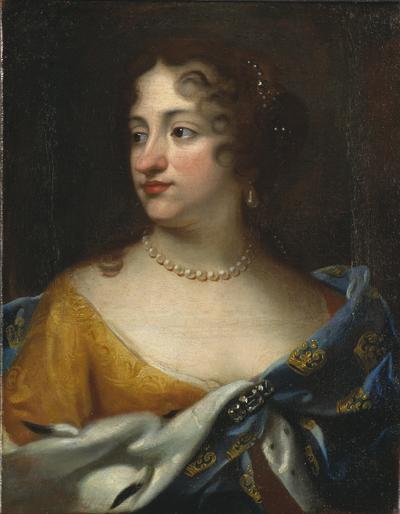
Initially, King Charles XI was disappointed with her appearance but was assured by courtiers of her inner qualities. She was described as religious, patient, mild, and charitable. Her popularity among the Swedish public increased due to her personal virtues and acts of charity. She was known for her calmness during a maritime incident when her boat nearly sank, and she sought to show humility by relinquishing her personal entourage, insisting that she did not need anything from Denmark. She gave up control over her personal finances and household, trusting the Swedish authorities to provide for her.
Ulrika Eleonora's relationship with her mother-in-law, Queen Dowager Hedvig Eleonora, was characterized by tension. Hedvig Eleonora maintained a higher social rank and position at court, which caused some rivalry. Ulrika Eleonora demonstrated humility by insisting on modest participation in court ceremonies.
Her health was fragile, often affected by pregnancies. Despite her weak condition, she engaged in cultural pursuits such as patronage of theatre and dance, and played a role in the introduction of French Classicism to Sweden through support of theatrical performances. She was involved in charitable work, founding institutions like the tapestry school at Karlberg Palace and homes for widows and the poor, as well as providing aid to regions suffering from crop failures and famine.
She had several children, though many died in infancy. Among her surviving children were Hedwig Sophia Augusta and Ulrika Eleonora, who later married Prince Frederick of Hesse-Kassel. Her other children included Charles (who died unmarried and without issue), Gustav, Ulric, Frederick (both of whom died young), and Charles Gustav.
Ulrika Eleonora's health declined after her childbirths, and she became bedridden in 1690. She died at Karlberg Palace on 26 July 1693, after a period of illness. On her deathbed, she advised her children to be humble and compassionate, and she requested a simple funeral funded from her own assets. She was buried in Riddarholm Church. Her death was mourned widely, and her reputation was characterized as saintly due to her charitable efforts and compassionate nature. Following her death, King Charles XI fell ill, and he refused to remarry despite societal pressure.