Sophie Amalie Of Brunswick-Lüneburg
| Name | Sophie Amalie Of Brunswick-Lüneburg |
| Title | Queen consort of Denmark and Norway |
| Gender | Female |
| Birthday | 1628-03-24 |
| nationality | Kingdom of Denmark |
| Source | https://www.wikidata.org/wiki/Q231764 |
| pptrace | View Family Tree |
| LastUpdate | 2025-11-12T01:14:25.286Z |
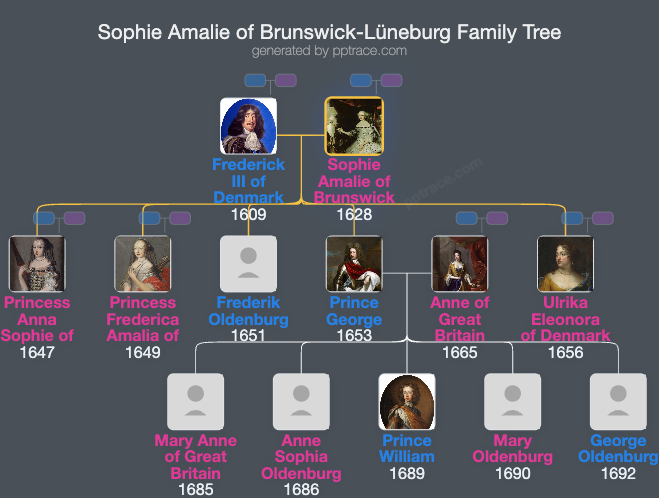
Family Tree
Tap  to expand more relatives
Introduction
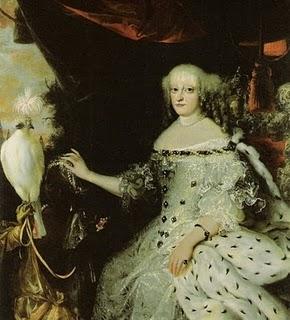
Sophie Amalie of Brunswick-Calenberg (24 March 1628 – 20 February 1685) was Queen of Denmark and Norway as the consort of King Frederick III of Denmark. She was born at Herzberg Castle in Herzberg am Harz, her parents being George, Duke of Brunswick-Calenberg, and Anne Eleonore of Hesse-Darmstadt. Details of her childhood are not documented.
She married Prince Frederick at Castle Glücksburg on 1 October 1643. The marriage was arranged in 1640 and was considered a political match, although the specific purpose is not known. At the time of marriage, Frederick was the Prince-bishop of Bremen and not the heir to the Danish throne. They had eight children, among whom were Christian V of Denmark and Ulrike Eleonora of Denmark, who married King Charles XI of Sweden.
Following their marriage, the couple initially resided in Bremen. During the war between Denmark-Norway and Sweden (1646–47), they lived in humble circumstances in Flensborg after fleeing Bremen. In 1647, Frederick was elected heir to the Danish throne, and in 1648, Sophie Amalie moved with him to Denmark.
In 1648, Frederick and Sophie Amalie ascended as King and Queen of Denmark and Norway. Her tenure as queen was marked by her active role in court life and cultural patronage. She replaced medieval court entertainments with opera and ballet, bringing these art forms to Danish court festivities. She favored fashion, parties, and theatre, introducing French tastes and remodeling the court based on French and German models. She ordered new court items in 1649, hired several foreign musicians and performers, and engaged a French theatre company. Although she did not speak Danish, she was proficient in German and French, studied singing and dancing with instructors from France and Italy, and conversed with her children in French. Her attire was arranged by French maids, and she had a French chaplain. Her court life included ballet, masquerades, amateur theatre, and participation in performances, with notable instances such as her performing five roles in a ballet in 1655.
Sophie Amalie's cultural influence extended beyond court festivities, contributing to a broader secularization of Danish society's artistic culture. She was involved in disputes with her Catholic brother, John Frederick, and was recognized for her wit, charm, and artistic taste. Descriptions from contemporary visitors and diplomats highlight her attractiveness and diplomatic skill.
She was known for her playful nature, disguising herself to observe events incognito, including the travel of Queen Christina of Sweden in 1654 and a trip to Hamburg during wartime. An avid hunter, she maintained a hunting lodge at Hørsholm, once killing thirty deer in a single day.
As a hostess, she hosted grand parties that showcased her political and cultural influence. Her court festivities aimed to bolster royal authority and attract noble followers, especially among the German nobility, whom she helped elevate into Danish nobility despite opposition. The parties faced criticism during Denmark’s economic depression in the 1650s.
Politically, Sophie Amalie was influential and actively participated in state affairs with her husband's approval. Her political objectives included weakening noble power, defeating Sweden, and expanding royal absolutism. Her influence was evident in the power struggles between the crown and the nobility, notably in the conflicts involving the Svogerpartiet, a noble faction. Her involvement in the war against Sweden in 1657 and her presence during the Siege of Copenhagen in 1658 were significant.
She is credited with supporting the move toward absolute monarchy in Denmark, especially during the 1660 state of emergency. She reportedly persuaded Frederick III to proceed with union and centralization measures, although she was not involved in drafting the constitution (Kongeloven). After the formal establishment of absolutism in 1665, her political influence waned, especially after Christoffer Gabel replaced her as the king's chief adviser. She was not appointed regent during her son Christian V's minority and was perceived as favoring her younger son, Georg.
During her son's reign, she maintained influence through court life and behind-the-scenes political activities, including efforts to secure a marriage alliance with Sweden. Her relationships with her daughter-in-law Charlotte Amalie were strained, characterized by disputes over precedence and court rank.
As queen dowager after Frederick III's death in 1670, Sophie Amalie continued to host court festivities and maintained her social prominence. She resided in Sophie Amalienborg in Copenhagen and summered at Nykøbing Slot or Hørsholm. Her influence persisted in cultural and courtly circles until her death in Copenhagen in 1685; she was buried in Roskilde Cathedral. After her death, her influence contributed to the eventual release of Leonora Christina Ulfeldt from twenty-two years of imprisonment.