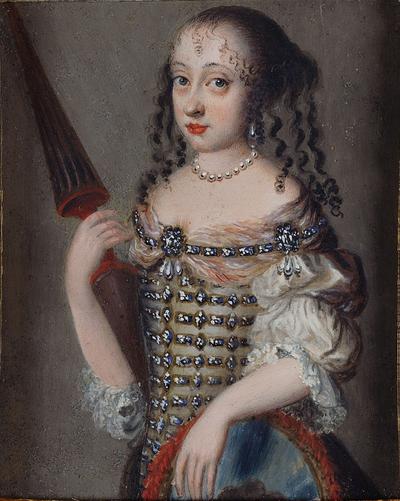
Princess Anna Sophie Of Denmark
| Name | Princess Anna Sophie Of Denmark |
| Title | electress consort of Saxony |
| Gender | Female |
| Birthday | 1647-09-01 |
| nationality | Kingdom of Denmark |
| Source | https://www.wikidata.org/wiki/Q235828 |
| pptrace | View Family Tree |
| LastUpdate | 2025-11-12T01:14:26.224Z |
Family Tree
Tap  to expand more relatives
Introduction
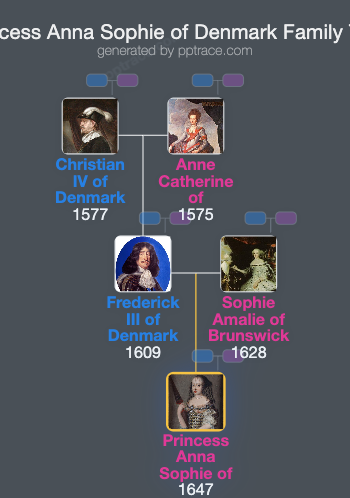
Princess Anna Sophie of Denmark and Norway was born on 1 September 1647 in Flensburg. She was the eldest daughter of King Frederick III of Denmark and Sophie Amalie of Brunswick-Lüneburg. Her father ascended to the Danish throne following the death of her paternal grandfather, King Christian IV, when Anna Sophie was approximately six months old. The Danish royal council and Estates elected her father as king after months of deliberation, and he was crowned Frederick III on 23 November 1648.
Anna Sophie was one of seven children, of whom six survived infancy. Her siblings included Christian, who later became King of Denmark and Norway; Frederica Amalia; Wilhelmina Ernestine; George; and Ulrika Eleonora. Her childhood education was comprehensive, encompassing several languages including Danish, German, Latin, French, Spanish, and Italian. During her childhood, she and her sisters were under the supervision of the royal governess Helena von Westphalen. In 1663, she was granted her own court under Enevold Parsberg.
In 1662, negotiations commenced regarding her marriage, and she met John Georg, Elector of Saxony, during visits to the Danish court. In 1663, a celebration at Copenhagen Castle marked her engagement to John George III, which was attended by both her fiancé and his mother. The marriage took place on 9 October 1666. John George III was later noted by Polish king John III Sobieski as being an honest man with a straight heart.
The marriage between Anna Sophie and John George III was not characterized by documented happiness. Her husband had an illegitimate son, Margarita Salicola, with an opera singer mistress, and potentially another daughter, Magdalena Sibylla of Neidschutz, with Ursula Margarethe of Haugwitz. Anna Sophie’s relationship with her two sons was reportedly somewhat tense. Her father died on 9 February 1670, after which her brother Christian V succeeded as king of Denmark. Anna Sophie maintained an active correspondence with him, often discussing political matters.
In 1680, she became Electress of Saxony. Her widowed sister Wilhelmina Ernestine moved into her household in 1685. She arranged her eldest son's marriage to her niece, Princess Sophia Hedwig of Denmark, but the engagement was later broken when her son succeeded his father as elector in 1691.
Her husband died in 1692 in Tübingen, likely from cholera or the plague, and was interred in Freiberg Cathedral. Following his death, Anna Sophie attempted to prevent her elder son’s relationship with his mistress Magdalene Sibylle "Billa" of Neidschutz, who had been living with him openly. She arranged for her son to marry Eleonore Erdmuthe of Saxe-Eisenach; this marriage, however, was unsuccessful, as her son abandoned his bride and pursued his mistress. Billa gave birth to a daughter, Wilhelmina Maria Frederica, in June 1693. Billa died of smallpox on 4 April 1694, and her son, John George IV, died of the same illness 23 days later. Both are buried in Freiberg Cathedral.
As a widow, Anna Sophie played a role in the upbringing of her grandson Friedrich August, born in 1696, who later became Augustus III of Poland. Her son’s accession to the Polish throne in 1697 and his conversion to Catholicism elevated her status in Saxony as a symbol of Protestant faith and opposition to Catholic influence from Poland. She maintained a good relationship with her daughter-in-law Queen Christiane Eberhardine, particularly on religious matters.
In her later years, Anna Sophie resided with her sister Wilhelmina Ernestine at Castle Lichtenburg. She died on 1 July 1717 in Prettin.
Her known children with John George III include:
- John George IV (18 October 1668 – 28 May 1694), who succeeded his father as elector.
- Frederick Augustus I (22 May 1670 – 1 February 1733), who succeeded his brother as elector and later became King of Poland (reign as Augustus II).
Her ancestry traces back to the Danish royal house and includes notable European noble lineages, although specific ancestral details are not provided here.