Christian IV Of Denmark
| Name | Christian IV Of Denmark |
| Title | king of Denmark and Norway (1577-1648) |
| Gender | Male |
| Birthday | 1577-04-12 |
| nationality | Kingdom of Denmark |
| Source | https://www.wikidata.org/wiki/Q153586 |
| pptrace | View Family Tree |
| LastUpdate | 2025-11-12T01:14:30.707Z |
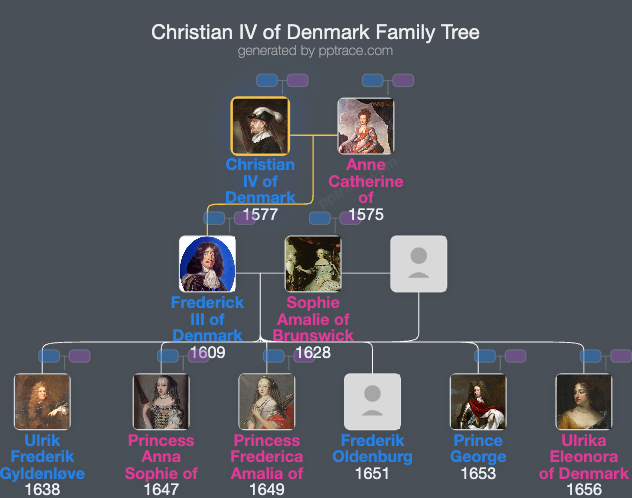
Family Tree
Tap  to expand more relatives
Introduction
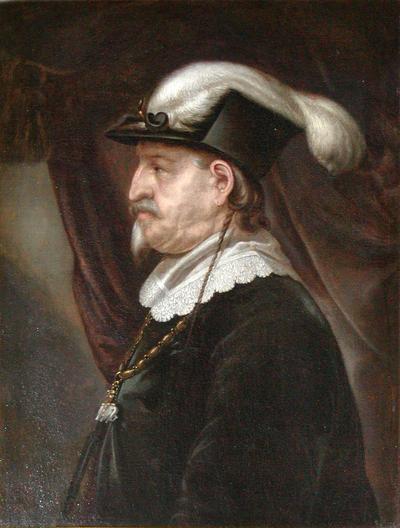
Christian IV (12 April 1577 – 28 February 1648) was the King of Denmark and Norway, reigning from 1588 until his death in 1648. He also held the titles of Duke of Holstein and Schleswig. His period of rule lasted 59 years and 330 days, making it the longest in Scandinavian history.
Born at Frederiksborg Castle in Denmark, Christian was the third child and eldest son of King Frederick II of Denmark–Norway and Sofie of Mecklenburg-Schwerin. On his mother's side, he was descended from King John of Denmark, making him the first descendant of that monarch to ascend the Danish throne following the deposition of King Christian II. Denmark was an elective monarchy at the time; however, Norway was a hereditary monarchy, and the union of the crowns was preserved by electing Christian as prince and successor in 1580, when he was three years old.
Christian succeeded to the throne after the death of his father on 4 April 1588, at the age of ten. Due to his youth, a regency council led by Chancellor Niels Kaas was established to govern until Christian reached majority. After Niels Kaas's death in 1594, Jørgen Rosenkrantz took over leadership of the regency. Christian continued his education at Sorø Academy, where he was known as a talented student.
He assumed personal control of the government in August 1596 at age 19, when he signed his haandfæstning ("Handbinding"), a document limiting royal power similar to the Magna Carta. Christian was crowned later that month at the Church of Our Lady in Copenhagen. In November 1597, he married Anne Catherine of Brandenburg, daughter of Joachim Friedrich, Margrave of Brandenburg and Duke of Prussia. Anne Catherine bore Christian seven children.
During his reign, Christian IV implemented military and economic reforms. He invested in fortifications, expanded the navy from twenty-two ships in 1596 to over sixty by 1610, and attempted to establish a standing army primarily composed of hired mercenaries and peasant levies. His domestic reforms included founding several merchant cities, supporting trade, and constructing many buildings in Dutch Renaissance style.
Christian's foreign policy was marked by military conflicts, including the Kalmar War against Sweden (1611–1613), which resulted in the Treaty of Knäred. He actively participated in the Thirty Years' War, seeking control of German rivers and territorial gains, but his military efforts faced significant setbacks. His forces were defeated at the Battle of Lutter in 1626, and he later allied with Sweden in 1628 to counter the Holy Roman Empire. The war concluded with the Treaty of Lübeck in 1629, which temporarily limited Swedish territorial expansion.
He also engaged in explorations and colonization efforts, with voyages to Greenland in the early 1600s seeking to locate the lost Norse settlements and expeditions to North America. In 1618, he attempted to establish a Danish colony in Ceylon (modern-day Sri Lanka), resulting in the founding of Tranquebar after treaty negotiations with the Nayak of Tanjore.
Christian IV was involved in the First Kalmar War with Sweden, and later in conflicts stemming from the Thirty Years' War, including the Torstenson War (1643–1645). Swedish forces seized Jutland in 1644, leading to battles such as the Battle of Colberger Heide, where Christian was wounded. The subsequent Treaty of Brömsebro in 1645 resulted in territorial losses for Denmark and Norway, including Gothland, Ösel, and Halland.
He spent considerable time in Norway, founding cities such as Christiania (modern Oslo), establishing mines (Kongsberg and Røros), and improving fortifications like Akershus Castle. Christian attempted to secure the northern territories, including parts of present-day northern Norway.
Christian IV's later years were marred by conflicts with his sons-in-law and internal political disputes. He was also responsible for initiating witch hunts, leading to executions including that of Maren Spliid in 1641. He died on 28 February 1648 and was buried in Roskilde Cathedral. His legacy includes numerous city foundations, architectural projects, and contributions to Danish culture. Notably, the Christian IV Glacier in Greenland bears his name.
Christian IV was multilingual, speaking Danish, German, Latin, French, and Italian. He was active in arts and music, employing musicians and artists from across Europe. His reign left a lasting impact on Danish monarchy and urban development, although his military ambitions ultimately resulted in territorial losses and financial strain.