Duchess Anna Amalia Of Brunswick-Wolfenbüttel
| Name | Duchess Anna Amalia Of Brunswick-Wolfenbüttel |
| Title | German princess, composer, editor (1739-1807) |
| Gender | Female |
| Birthday | 1739-10-24 |
| nationality | Q155570 |
| Source | https://www.wikidata.org/wiki/Q241250 |
| pptrace | View Family Tree |
| LastUpdate | 2025-11-12T01:15:54.444Z |
Family Tree
Tap  to expand more relatives
Introduction
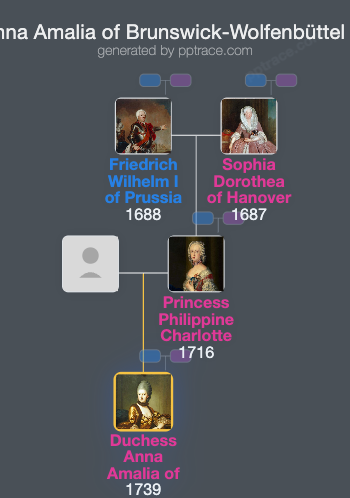
Anna Amalia of Brunswick-Wolfenbüttel was born on 24 October 1739 at Schloss Wolfenbüttel in Wolfenbüttel, Germany. She was the fifth child among thirteen siblings born to Karl I, Duke of Brunswick-Wolfenbüttel, and Princess Philippine Charlotte of Prussia. Her maternal grandparents were Frederick William I of Prussia and Sophia Dorothea of Hanover. Her family connections extended to European royalty; her niece was Queen Caroline, wife of King George IV of the United Kingdom.
She received an education typical of high nobility, emphasizing religious instruction in both German and French, and was taught by theologians Johann Friedrich Wilhelm Jerusalem and Matthias Theodor Christoph Mittelstädt. Her upbringing followed Protestant traditions but also incorporated principles related to knowledge and religious reconciliation. Her curriculum included the history of states, geography, the fine arts, dance, and music. She studied music under Friedrich Gottlob Fleischer and Ernst Wilhelm Wolf. Her mother, Princess Philippine Charlotte, was also a composer.
On 16 March 1756, at the age of sixteen, Anna Amalia married Ernst August II Konstantin, Duke of Saxe-Weimar-Eisenach. They had two sons. Ernst August II died on 28 May 1758 when only twenty years old, leaving Anna Amalia as regent for their nine-month-old son, Karl August. At the time, she was pregnant with their other son, Prince Constantine, who was born three months after his father's death.
During her regency, from 1758 to 1775, Anna Amalia governed the duchy with prudence, focusing on strengthening its resources and improving its political and cultural standing. She continued her personal engagement with music and the arts, taking lessons in composition and keyboard playing. Her court became a notable cultural center, attracting prominent figures such as Johann Gottfried Herder, Johann Wolfgang von Goethe, and Friedrich Schiller. She appointed Christoph Martin Wieland as tutor to her sons, emphasizing the importance of education and intellectual development.
In 1771, she invited Abel Seyler's theatre company to Weimar, initiating a cultural movement that contributed to the emergence of Weimar Classicism. This period saw the first performance of Johann Adam Hiller's "Die Jagd" in 1770 and the première of Wieland's "Alceste" on 28 May 1773, which is recognized as the first German opera. Anna Amalia also established the Duchess Anna Amalia Library, which now holds approximately one million volumes.
She spent the years 1788 to 1790 in Rome and Naples, engaging with the arts and nature, and maintaining a clandestine friendship with the Archbishop of Taranto. Her travels to Italy were unconventional for a Protestant princess of her time. She brought back, among other artifacts, the Spanish guitar, known as the "Italian guitar," to Germany around 1790.
Anna Amalia's personal interests included drawing, learning languages (English, Italian, Greek), and writing literary manuscripts. She was also a composer whose works mostly belong to the Empfindsamkeit style, characterized by expressive and sensitive musical expressions. Her compositions include chamber music, harpsichord sonatas, operas, an oratorio, sacred choruses, symphonies, and songs. Some works, such as her operas "Das Jahrmarktsfest zu Plundersweilern" and "Erwin und Elmire," were based on texts by Goethe.
She died on 10 April 1807 at the Wittum palace in Weimar after a brief illness. Goethe wrote an obituary upon her death. She was buried in the city church of Weimar per her own wish; her remains were not transferred to the Princely Crypt, which was completed in 1828 at the behest of her son, Karl August.
Anna Amalia’s contributions to cultural life and her patronage significantly shaped the intellectual and artistic environment of Weimar during her lifetime.