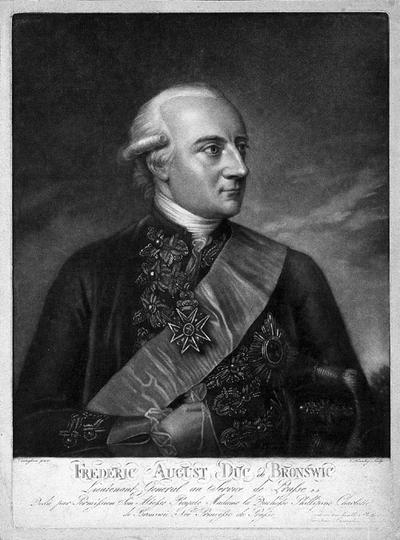
Frederick Augustus, Prince Of Brunswick-Wolfenbüttel-Oels
| Name | Frederick Augustus, Prince Of Brunswick-Wolfenbüttel-Oels |
| Title | Duke of Oels and Bernstadt (1740-1805) |
| Gender | Male |
| Birthday | 1740-10-29 |
| nationality | Germany |
| Source | https://www.wikidata.org/wiki/Q89340 |
| pptrace | View Family Tree |
| LastUpdate | 2025-11-12T01:15:55.384Z |
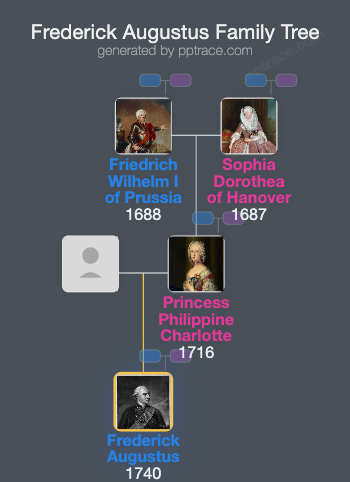
Family Tree
Tap  to expand more relatives
Introduction
Frederick Augustus of Braunschweig-Wolfenbüttel was born on October 29, 1740, in Wolfenbüttel, Germany. He was one of thirteen children of Charles I, Duke of Brunswick-Wolfenbüttel, and Princess Philippine Charlotte of Prussia. He died on October 8, 1805, in Eisenach, Germany.
He held the noble title of Prince of Braunschweig-Wolfenbüttel and was a member of the House of Brunswick-Lüneburg. In 1792, he was granted the Duchy of Oels and the Duchy of Bernstadt, thereby becoming the ruling duke of these duchies.
In 1754, Frederick Augustus became a captain in the Brunswick-Wolfenbüttel Lifeguard regiment. On April 28, 1761, he attained the rank of oberst, and became the commander of the Zastrow Foot Regiment. During the Seven Years' War, he participated in battles at Vellinghausen, Wilhelmsthal, Melsungen, Homburg, and Fritzlar. He was promoted to major general on August 17, 1761. In October of that year, he fought at Ölper, contributing to the liberation of the city of Brunswick from its last siege. The poet Anna Luise Karsch wrote an ode in 1761 titled "Über den Entsatz von Braunschweig," referencing his contributions.
In 1764, she composed an ode on the virtues of Frederick Augustus. He and two of his brothers—Wilhelm Adolf and Leopold—were members of Freemasonry. Starting in 1771, he was a Socius, Amicus et Fautor of the Rite of Strict Observance Masonic order, and in 1773, he served as Prefect of the Temple in Berlin for the order. From 1772 to 1799, he was the National Grand Master of the Grand National Mother Lodge 'Zu den drei Weltkugeln,' which was also associated with Frederick II of Prussia.
Historical records from the Freimaurerlexikon of 1932 describe him as having mystical inclinations and note that he was believed to be an alchemist, Rosicrucian, exorcist, and miracle-working doctor. He maintained contacts with notable occultists, including Gottlieb Franz Xaver Gugomos, Schröpfer, and the Count of Saint Germain. Despite warnings, he kept correspondence with Duke Ferdinand of Brunswick, his uncle, regarding these pursuits.
In 1763, Frederick Augustus achieved the rank of lieutenant general and served as commander of the Tettenborn Foot Regiment, later known as the 19th Regiment, in Prussian service. He became a favorite of King Frederick II of Prussia, often accompanying him on military maneuvers. He was appointed governor of the fortress at Küstrin and was made a knight of the Order of the Black Eagle on October 1, 1763. The following year, he was named an honorary member of the Prussian Academy of Sciences on December 20.
He married Princess Friederike Sophie Charlotte Auguste of Württemberg-Oels on September 6, 1768. She was the daughter of Charles Christian Erdmann, Duke of Württemberg-Oels. The marriage was childless and lasted until her death in 1789. In 1774, Frederick Augustus was appointed provost of Brandenburg. He attained the rank of General of Infantry on May 21, 1787. On December 13, 1792, he was elevated to the title of duke of Oels in Lower Silesia.
In late 1792, he was appointed to lead a Prussian army corps intended for deployment in Westphalia. He delegated command due to health issues in March 1793 and was officially dismissed from the position in March 1794. Subsequently, he retired to Schloss Sibyllenort in Lower Silesia, where he focused on translating French plays and engaging in literary pursuits.
Frederick Augustus passed away in October 1805 while visiting his sister, Anna Amalia, in Eisenach. He was buried in Weimar. The duchy of Oels was inherited by his nephew, Frederick William, Duke of Brunswick-Wolfenbüttel, known as the 'Black Duke.'
His published work includes *Militärische Geschichte des Prinzen Friedrich August von Braunschweig-Lüneburg,* published in 1797.