Charles William Ferdinand, Duke Of Brunswick-Wolfenbüttel
| Name | Charles William Ferdinand, Duke Of Brunswick-Wolfenbüttel |
| Title | Prince of Brunswick-Wolfenbüttel and Duke of Brunswick-Lüneburg |
| Gender | Male |
| Birthday | 1735-10-09 |
| nationality | Q830084 |
| Source | https://www.wikidata.org/wiki/Q58773 |
| pptrace | View Family Tree |
| LastUpdate | 2025-11-12T01:16:17.229Z |
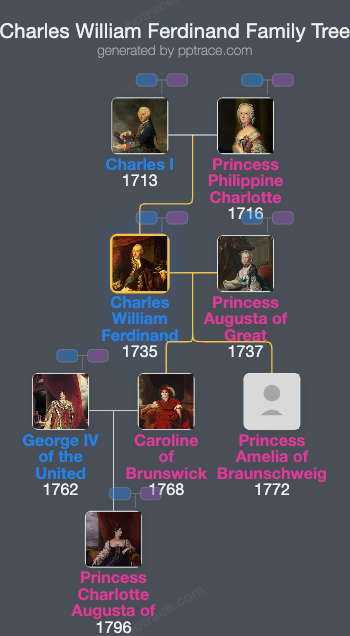
Family Tree
Tap  to expand more relatives
Introduction
Charles William Ferdinand (German: Karl Wilhelm Ferdinand) was born on 9 October 1735 in Wolfenbüttel, likely at Wolfenbüttel Castle. He was the eldest son of Charles I, Duke of Brunswick-Wolfenbüttel, and Philippine Charlotte, who was the daughter of King Frederick William I of Prussia and sister of Frederick II (Frederick the Great). As heir apparent of the principality, he held the title of Hereditary Prince (Erbprinz).
His education was comprehensive and overseen by his mother. In his youth, he traveled extensively throughout the Netherlands, France, and various regions of Germany. In 1753, his family moved the capital from Wolfenbüttel to Brunswick (Braunschweig), establishing residence in the newly constructed Brunswick Palace.
He began his military career during the Seven Years' War (1756–1763), joining the allied North-German forces of the Hanoverian Army of Observation, which aimed to defend Hanover, in personal union with Great Britain, against French invasion. During the Battle of Hastenbeck in 1757, he led a charge with an infantry brigade, attracting attention and recognition. Following the subsequent French invasion and the Convention of Klosterzeven, Ferdinand's uncle Ferdinand of Brunswick led the forces, and Charles William Ferdinand agreed to continue military service as a general officer. He participated in the Battle of Minden (1759) and the Battle of Warburg (1760), both decisive victories. Throughout the war, he gained a reputation as an effective subordinate commander and a master of irregular warfare.
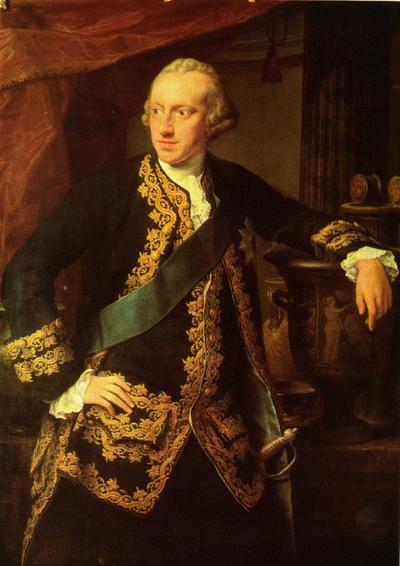
In 1764, he married Princess Augusta of Great Britain, the eldest sister of King George III, in London. The marriage linked the Brunswick and Hanoverian royal houses, which often married within their extended family to prevent further territorial division under Salic law. Shortly after the marriage, he traveled across Europe with his wife, visiting France, Switzerland, Italy, and other states. During their travels, he met notable figures such as Voltaire, and he had his portrait painted by Pompeo Batoni.
As ruler of Brunswick-Wolfenbüttel, he inherited the principality in 1780 following his father's death. His tenure was marked by efforts to restore the state's finances and promote cultural and scientific pursuits. He was a patron to mathematician Carl Friedrich Gauss and supported arts and sciences. Diplomatic activities included hosting meetings that led to the formation of the Fürstenbund in 1785, a league of smaller German states aimed at countering Habsburg ambitions.
He served as a Prussian general from 1773 and participated in various military campaigns, including the War of the Bavarian Succession (1778–1779), receiving praise from Frederick II of Prussia. In 1787, he was appointed Generalfeldmarschall (field marshal) by Frederick William II of Prussia and commanded the Prussian invasion of the Netherlands to suppress the Patriot movement. His campaign, characterized as swift and nearly bloodless, resulted in the restoration of William V’s authority.
During the early years of the French Revolution, he commanded Allied forces and issued the Brunswick Manifesto (also known as the Brunswick Proclamation) on 25 July 1792 from Coblenz. The proclamation threatened dire consequences if Louis XVI and his family were harmed, aiming to restore the monarchy but instead fueling revolutionary fervor in France.
In 1792, he led an invasion into France but was ultimately forced to retreat after the Battle of Valmy. He participated in the War of the First Coalition and recaptured Mainz in 1793. He resigned his command in 1794 due to disagreements over Prussia’s interference in military matters.
He returned to command during the War of the Fourth Coalition in 1806, at age over 70. As commander of the Prussian army during the Battle of Jena–Auerstedt on 14 October 1806, his forces were defeated by Napoleon’s forces. He was wounded by a musket ball during the battle, losing both eyes, and died of his wounds on 10 November 1806 in Ottensen.
His remains were initially interred in the Christianskirche in Ottensen and later reburied in Brunswick Cathedral in 1819.
Charles William Ferdinand married Princess Augusta of Great Britain in 1764. They had four sons and three daughters. Three of his sons suffered from significant disabilities, including learning impairments and blindness. His eldest son, Karl Georg August, died in 1806 before inheriting the dukedom. His second son, Georg Wilhelm Christian, and third son, August, were incapacitated and excluded from succession. The fourth son, Friedrich Wilhelm, succeeded him, marrying and fathering two sons.
His daughters included Auguste Caroline Friederike, who married the future king Frederick I of Württemberg, and Caroline of Brunswick, who married the future King George IV of the United Kingdom and was the mother of Princess Charlotte of Wales. Both daughters' marriages ended poorly, and Caroline's attempted divorce was never finalized.
The duke’s family historically engaged in inbreeding, leading to several offspring with disabilities. His illegitimate son, Forstenburg, was killed in action in 1793 during military service.
His ancestry traces back to the House of Welf, with connections to various European royal families.