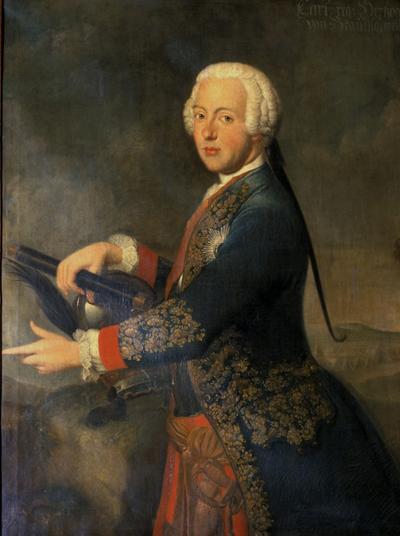
Charles I, Duke Of Brunswick-Wolfenbüttel
| Name | Charles I, Duke Of Brunswick-Wolfenbüttel |
| Title | Duke of Brunswick-Wolfenbüttel (1713-1780) |
| Gender | Male |
| Birthday | 1713-08-01 |
| nationality | Germany |
| Source | https://www.wikidata.org/wiki/Q543311 |
| pptrace | View Family Tree |
| LastUpdate | 2025-11-12T01:17:22.201Z |
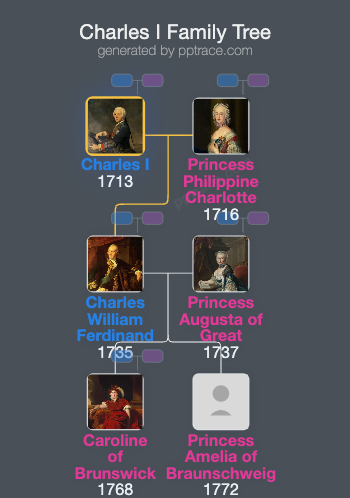
Family Tree
Tap  to expand more relatives
Introduction
Charles (German: Karl) was born on 1 August 1713 in Braunschweig and died on 26 March 1780 in Braunschweig. He held the title of Duke of Brunswick-Lüneburg (Bevern line) and reigned as Prince of Brunswick-Wolfenbüttel from 1735 until his death.
He was the eldest son of Ferdinand Albert II, Duke of Brunswick-Wolfenbüttel. During his early years, Charles participated in military campaigns against the Ottoman Empire, fighting under Prince Eugene of Savoy. In 1735, he inherited the Principality of Brunswick-Wolfenbüttel from his father.
Through his mother, Charles was related to European royal families; he was a first cousin of Empress Maria Theresa. In 1745, he founded the Collegium Carolinum, an institution of higher education now known as TU Braunschweig, upon the suggestion of his court preacher, Johann Friedrich Wilhelm Jerusalem. He employed Gotthold Ephraim Lessing as the librarian for the ducal library, Bibliotheca Augusta. Additionally, Lorenz Heister of the University of Helmstedt named the botanical genus Brunsvigia in his honor, recognizing his support for botany and botanical studies, particularly of B. orientalis.
Charles undertook efforts to promote economic development within his principality. These included founding the Fürstenberg Porcelain Company and implementing mandatory fire insurance policies. Despite these initiatives, he faced financial difficulties; his inability to maintain the state’s finances led to his eldest son, Charles William Ferdinand, assuming governance in 1773.
During the American Revolution, starting in 1775, Charles sought to augment the ducal treasury by renting out his army to Great Britain. In 1776, he signed a treaty with his cousin, King George III of Great Britain, to supply troops for service in North America. Under General Friedrich Adolf Riedesel, approximately 4,000 soldiers were dispatched to assist the British. These troops participated in the Battles of Saratoga in 1777, under General John Burgoyne’s army, and were taken prisoner as part of the Convention Army. Although the terms allowed their return to Europe, the American Continental Congress cancelled the convention, and the prisoners remained in America until the end of the war in 1783.
Charles married Philippine Charlotte in 1733. She was the daughter of King Frederick William I of Prussia and sister of Frederick the Great. They had several children who reached adulthood, including:
- Charles William Ferdinand (1735–1806), father of Queen Caroline of Brunswick, the wife of King George IV of the United Kingdom.
- Sophie Caroline Mary (1737–1817), who married Frederick, Margrave of Brandenburg-Bayreuth.
- Anna Amalia (1739–1807), married Ernest Augustus II, Duke of Saxe-Weimar-Eisenach.
- Frederick Augustus (1740–1805).
- Elizabeth Christine Ulrike (1746–1840), who married King Frederick William II of Prussia and was the mother of Frederica, Duchess of York.
- Augusta Dorothea (1749–1803), who served as Abbess of Gandersheim.
- Maximilian Jules Leopold (1752–1785).
He also had an illegitimate child, Christian Theodor (1750–1824), who later adopted the surname de Pencier after his stepfather.
No further personal or biographical details beyond these are available.