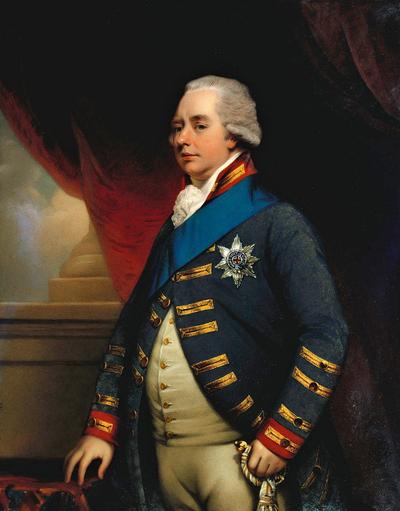
William V, Prince Of Orange
| Name | William V, Prince Of Orange |
| Title | Prince of Orange, General Stadtholder of the United Provinces (1748-1806) |
| Gender | Male |
| Birthday | 1748-03-08 |
| nationality | Dutch Republic |
| Source | https://www.wikidata.org/wiki/Q312215 |
| pptrace | View Family Tree |
| LastUpdate | 2025-11-12T01:16:10.484Z |
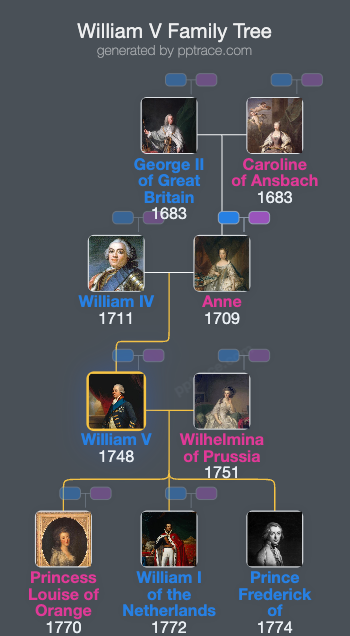
Family Tree
Tap  to expand more relatives
Introduction
William V, also known as Willem Batavus, was born on 8 March 1748 in The Hague. He was the only son of William IV, who had been restored as stadtholder of the United Provinces in the year prior to William V's birth. William V’s father died in 1751 when William was only three years old, leading to a regency period overseen by multiple regents. His mother, Princess Anne, served as regent from 1751 until her death in 1759, after which his grandmother, Princess Marie Louise, held the regency until her death in 1765. Concurrently, Duke Louis Ernest of Brunswick-Lüneburg was regent from 1759 to 1766 and remained a privy counsellor until October 1784. Additionally, Princess Carolina, William’s sister, acted as regent from 1765 until his majority in 1766. In 1752, William V was made the 568th Knight of the Order of the Garter.
William V assumed the role of stadtholder and Captain-General of the Dutch States Army upon reaching his majority in 1766. His early regency period was characterized by significant influence from the Duke of Brunswick under the Acte van Consulentschap. On 4 October 1767, he married Princess Wilhelmina of Prussia in Berlin. She was the daughter of Augustus William of Prussia, niece of Frederick the Great, and a cousin of King George III of Great Britain, with whom William was also related as a first cousin.
In the realm of arts, William V was an active collector, and his gallery, known as Galerij Prins Willem V, was opened to the public in 1774. His tenure coincided with the period of the American War of Independence, during which the Dutch maintained a position of neutrality. William V supported pro-British factions within the Dutch government, opposing pro-American and pro-French groups. Tensions escalated with Dutch attempts to join the Russian-led League of Armed Neutrality, resulting in the Fourth Anglo-Dutch War in 1780. The conflict was unfavorable for the Dutch, leading to losses such as Sint Eustatius and Nagapattinam, and scandals like the Brest Affair. These events undermined confidence in William’s regime, fueling calls for political reform, exemplified by the publication of the pamphlet "Aan het Volk van Nederland" in 1781 by Joan van der Capellen.
By 1783, following the Treaty of Paris, dissent against William V grew, culminating in military confrontations. In September 1785, William evacuated The Hague for Het Loo Palace in Gelderland. The following year, in 1786, he ordered troops to defeat Patriot supporters, which resulted in the Patriot-dominated States of Holland stripping him of his role as Captain-General of the Army. His wife, Wilhelmina, attempted to ignite Orangist support in The Hague in 1787 but was intercepted and detained near Goejanverwellesluis. Her brother, Frederick William II of Prussia, responded with a military invasion of Holland in September 1787, supporting the Orangists against the Patriots, who had retreated to France.
During the French Revolution, William V aligned with the First Coalition against France beginning in 1793. His troops participated in the Flanders Campaign. By 1794, the Dutch military situation worsened, and in 1795, supported by French revolutionary forces, the Dutch Republic was replaced by the Batavian Republic. William V fled to England shortly thereafter. Upon his arrival, he issued the so-called Kew Letters, instructing Dutch colonies to surrender to the British while the Netherlands was under French occupation. Many colonies were subsequently captured and later returned following treaties in 1814.
William V continued to hold the principality of Orange-Nassau until his death in exile at his daughter’s palace in Brunswick on 9 April 1806. His remains were moved to the Dutch Royal Family crypt in Delft in 1958. His son, William VI, returned to the Netherlands in 1813 and proclaimed himself king, establishing the House of Orange-Nassau as reigning monarchs.
William V and Wilhelmina of Prussia had five children, including Willem Frederik, who became the first King of the Netherlands as William I.
William V's legacy includes geographical names such as Orange County in North Carolina and Indiana, and the Orange River in South Africa, named in his honor.